Types of Wood Joining: A Grade & Quality Guide for Builders
Master the types of wood joining with our grade and quality guide. Learn structural strengths, lumber grades, and best joinery methods for building.

The integrity of any wood-framed structure, heavy timber pavilion, or architectural millwork installation relies entirely on the intersection of lumber grading and joint mechanics. Selecting the appropriate types of wood joining is not merely a matter of aesthetic preference; it is a structural imperative governed by material science, moisture dynamics, and load-path continuity. When builders mismatch lumber grades with incompatible joinery methods, the result is premature joint failure, differential checking, and compromised load capacities.
This guide evaluates the primary types of wood joining through the lens of grade and quality assurance, providing exact specifications, adhesive requirements, and structural tolerances for modern construction.
Structural vs. Architectural Joinery: Defining the Grade Requirements
Lumber grading rules, established by agencies such as the National Lumber Grades Authority (NLGA) and the American Wood Council (AWC), dictate the allowable slope of grain, knot size, and wane limits for specific structural applications. These natural characteristics directly influence how a piece of wood will accept and hold a joint.
Conversely, architectural millwork and interior cabinetry utilizing biscuit or pocket-hole joinery can safely utilize No. 2 Common or Finish grades, where visual characteristics and minor slope-of-grain deviations do not compromise the relatively low shear loads experienced by interior fixtures.
Evaluating the 5 Primary Types of Wood Joining in Modern Construction
1. Mortise and Tenon (Heavy Timber & Post-and-Beam)
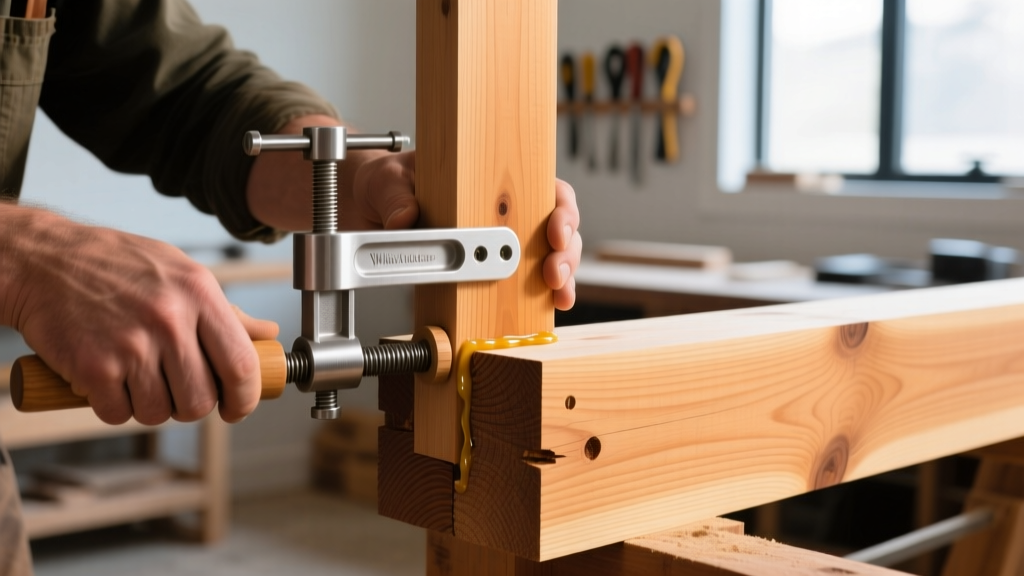
The mortise and tenon remains the gold standard for heavy timber framing. In modern structural applications, this joint relies on mechanical interlock and wood-to-wood bearing rather than adhesive. For a standard 6x6 Douglas Fir-Larch timber, the tenon should be cut to a minimum length of 1.5 inches (typically one-third the thickness of the timber). To secure the joint, builders use 3/4-inch dry oak draw-pegs. The peg hole in the tenon must be offset by exactly 1/16-inch to 1/8-inch from the mortise hole; this "draw" pulls the shoulder tight against the mortise cheek as the peg is driven home, creating immense friction and structural rigidity.
2. Dowel and Biscuit Joinery (Millwork & Panel Assembly)
Dowel joinery provides exceptional tensile strength in panel glue-ups and cabinet face-frame assembly. Quality control here hinges on precision drilling and flute design. Fluted dowels allow excess polyvinyl acetate (PVA) adhesive to escape; using smooth dowels in tight tolerance holes (±0.005 inches) creates hydraulic pressure that can split the receiving stile. Biscuit joinery (#0, #10, #20 sizes) is strictly for alignment in edge-gluing and miter joints, offering negligible structural shear strength. Biscuit slots must be cut 1/32-inch deeper than half the biscuit width to allow for swelling when the water-based adhesive is applied.
3. Pocket Hole and Structural Screw Joinery (Framing & Light Assembly)
While pocket screws are ubiquitous in light cabinetry, structural screw joinery has revolutionized timber framing and deck construction. High-strength structural screws (e.g., GRK RSS or Simpson Strong-Tie SDS) eliminate the need for pre-drilling in dense species like Southern Yellow Pine. A 3/8-inch x 4-inch structural screw driven into SPF (Spruce-Pine-Fir) lumber yields an allowable shear capacity of approximately 400 to 500 lbs per fastener. For graded structural connections, always verify the fastener's ICC-ES Evaluation Report for specific withdrawal and shear values based on the lumber's specific gravity.
4. Fingerjointing (Lumber Manufacturing & Structural Studs)
Fingerjointing is a critical manufacturing process that creates continuous structural lumber from shorter offcuts. Governed by ASTM D3737 standards as outlined in the Forest Products Laboratory guidelines, finger-jointed studs feature micro-joints with a slope typically between 1:10 and 1:12. In quality assurance, these joints are cured using Radio Frequency (RF) heating and waterproof resorcinol or melamine-urea-formaldehyde (MUF) adhesives. When inspecting finger-jointed lumber on-site, look for the "VERTICAL USE ONLY" or "STUD USE ONLY" stamp; using horizontal-rated finger-jointed lumber in load-bearing bending applications (like rafters) is a severe code violation.
5. Steel Connector Joinery (Modern Truss & Joist Systems)
In light-frame construction, wood-to-wood joints are rarely sufficient to meet modern uplift and lateral load requirements. Steel connector joinery bridges this gap. When specifying joist hangers, post bases, and hold-downs, the galvanization grade must match the preservative treatment of the lumber. For ACQ or CA-C treated lumber, standard G90 galvanized connectors will corrode rapidly. You must specify ZMAX (G185) or hot-dip galvanized (ASTM A153) connectors to prevent galvanic degradation at the joint interface.
Joinery Quality Matrix: Shear Strength and Grade Compatibility
The following matrix provides a comparative baseline for selecting the correct joint type based on structural requirements and lumber grading.
| Joint Type | Primary Application | Minimum Lumber Grade | Estimated Shear Capacity | Required Fastener / Adhesive Spec |
|---|---|---|---|---|
| Mortise & Tenon (Pegged) | Heavy Timber, Post-and-Beam | Select Structural / No. 1 | 1,500+ lbs (depending on bearing area) | 3/4" Dry Oak Pegs, No adhesive required |
| Dowel (Fluted) | Cabinetry, Millwork, Furniture | No. 2 Common / Finish | 400 - 600 lbs per dowel | ANSI/HPVA Type I PVA (e.g., Titebond III) |
| Structural Screw | Decking, Ledger Boards, Trusses | No. 2 or Better | 400 - 800 lbs (based on screw dia/length) | GRK RSS / Simpson SDS (ICC-ES rated) |
| Fingerjoint (Factory) | Vertical Studs, Non-bending members | Stud Grade (Machine Rated) | Equal to solid wood tensile strength | MUF or Resorcinol (RF Cured) |
| Steel Connector (Hangers) | Floor Joists, Rafters, Shear Walls | No. 2 or Better | 600 - 3,000+ lbs (per manufacturer table) | ZMAX (G185) or HDG, 1.5" x 0.148" nails |
Adhesive Selection and Moisture Content Tolerances
A wood joint is only as strong as the adhesive bridging its long-grain surfaces. Quality control in joinery demands strict adherence to Moisture Content (MC) parameters during the gluing process. According to the American Wood Council's National Design Specification (NDS), dimensional changes in wood below the fiber saturation point (typically 28-30% MC) are directly proportional to moisture loss or gain.
- Interior Millwork (6% - 8% MC): Use standard ANSI/HPVA Type II PVA. It offers high initial tack and sands easily without clogging abrasives.
- Exterior/High-Moisture (10% - 15% MC): Use ANSI/HPVA Type I Waterproof PVA (e.g., Titebond III) or PUR. Type I adhesives survive cyclic boiling tests, making them mandatory for exterior doors and windows.
- End-Grain Joinery: End-grain absorbs adhesive like a sponge, starving the joint. Always apply a 10% diluted "sizing" coat of PVA, let it tack up for 10 minutes, and then apply full-strength adhesive to the mating long-grain surface.
Common Joinery Failure Modes in Graded Lumber
Even when utilizing the highest grade of lumber, improper execution of wood joining techniques leads to predictable failure modes. Understanding these edge cases is vital for site superintendents and quality assurance inspectors.
1. Moisture-Induced Dowel Shearing
When hardwood dowels are glued into softwood stiles at 10% MC, and the interior environment drops to 4% MC during winter, the softwood shrinks radially while the dense hardwood dowel resists. This differential shrinkage generates immense internal radial tension, frequently splitting the stile or shearing the dowel internally. Solution: Always kiln-dry hardwood dowels to an MC 2% lower than the receiving softwood to allow for seasonal expansion without splitting.
2. Cross-Grain Gluing Restrictions
Gluing long-grain to end-grain or long-grain to cross-grain creates a mechanical conflict. As the long-grain member expands and contracts tangentially with seasonal humidity shifts, the cross-grain member remains dimensionally static. This inevitably results in the joint tearing itself apart. Solution: Utilize floating tenons, elongated mechanical slots, or specialized slotted fasteners that allow for lateral translation while maintaining structural alignment.
3. Galvanic Corrosion in Treated Lumber Joints
The copper-based preservatives used in modern ground-contact lumber (UC4A and UC4B categories) are highly corrosive to standard zinc and aluminum. Using uncoated aluminum joist hangers or standard G90 nails in ACQ-treated lumber will result in severe pitting and joint failure within 3 to 5 years. Solution: Mandate the use of 304 or 316 stainless steel connectors and fasteners for all ground-contact and saltwater-adjacent wood joints.
Mastering the types of wood joining requires moving beyond basic carpentry and embracing the material science of graded lumber. By aligning joint geometry with lumber grade, respecting moisture content tolerances, and specifying the correct mechanical and chemical fasteners, builders ensure that their structural assemblies perform flawlessly over decades of environmental cycling.
Written by
David NakamuraDavid Nakamura is a licensed architect (AIA) and construction technology writer focused on sustainable building methods, mass timber engineering, and high-performance building envelopes. He holds a Master of Architecture from the University of Washington and is a certified Passive House Consultant (CPHC). David spent eight years at the Seattle firm Mithun, where he led the design of three LEED Platinum projects, before founding his own practice specializing in net-zero residential design. He serves on the editorial advisory board of GreenBuilder Magazine and has authored peer-reviewed papers on cross-laminated timber (CLT) connections for the Journal of Structural Engineering. In his spare time, David teaches woodworking at Pratt Fine Arts Center and kayaks the Puget Sound.
More from David Nakamura
View all
Construction Cost
Labor Cost to Build a Deck Per Sq Ft: 2026 Installation Guide
Discover the exact labor cost to build a deck per sq ft in 2026. This installation guide breaks down contractor rates, complexity factors, and hidden fees.
Aug 4, 2026

Construction Cost
How Much Does It Cost to Build a 3 Bedroom House? Financing Guide
Learn exactly how much it costs to build a 3 bedroom house and explore 2026 financing options, construction loan types, and budget frameworks for your build.
Aug 4, 2026

Construction Cost
Cost to Build a Tennis Court: 2026 Guide
How much does it cost to build a tennis court in 2026? Breakdowns for asphalt, concrete, and synthetic surfaces plus fencing and lighting.
Jul 30, 2026