Cedar Shake Siding Taxonomy: Species, Grades, and Selection
Master cedar shake siding selection with our taxonomy of wood species, edge vs. flat grain cuts, and CSSB grading standards for lasting durability.
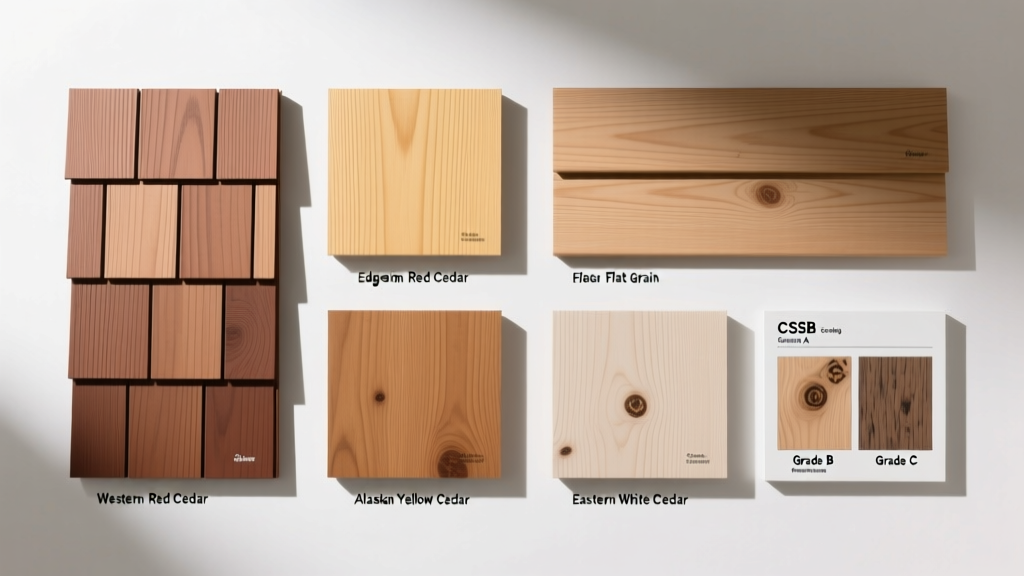
Defining the Material: Shakes vs. Shingles
Before selecting cedar shake siding, it is critical to distinguish shakes from shingles, as their manufacturing processes dictate their performance profiles. Shingles are uniformly sawn on both sides, resulting in a smooth, tapered profile. Shakes, conversely, are either split-sawn (one split face, one sawn face) or 100% edge-grain sawn, yielding a much thicker butt line and a rugged, highly textured shadow profile. Because shakes are thicker and often wider, they require different fastening schedules, exposure limits, and underlayment strategies than standard 16-inch Fivex shingles.
Species Taxonomy: The Three Commercial Cedars
Not all cedar performs identically in exterior cladding applications. The North American market relies on three primary species, each with distinct cellular structures, extractive chemical profiles, and dimensional stability metrics.
Western Red Cedar (Thuja plicata)
Western Red Cedar (WRC) is the industry benchmark for exterior wood cladding. It boasts a Class 1 natural decay resistance rating due to its high concentration of water-soluble tannins and extractives. WRC has a low shrinkage factor (tangential shrinkage of 3.9%), making it highly dimensionally stable. However, these same tannins cause severe extractive bleeding when exposed to moisture, requiring specialized primers or oil-based finishes to prevent dark streaking on underlying trim.
Alaskan Yellow Cedar (Cupressus nootkatensis)
Technically a cypress rather than a true cedar, Alaskan Yellow Cedar (AYC) is significantly denser (33 lbs/ft³ vs. 23 lbs/ft³ for WRC) and harder. It contains far fewer water-soluble tannins, virtually eliminating the extractive bleeding issue. AYC weathers to a uniform, light silver-gray rather than the dark, mottled gray of WRC. Its high density makes it more resistant to mechanical impact and wind-driven abrasion, though it is generally 15% to 20% more expensive per square.
Eastern White Cedar (Thuja occidentalis)
Eastern White Cedar (EWC) is lighter, more brittle, and contains more knots than its western counterparts. While it accepts solid-color stains and paints exceptionally well due to its low tannin content, its natural decay resistance is slightly lower. EWC is primarily utilized when the architectural intent is a painted finish rather than a natural, weathered look. According to the USDA Forest Products Laboratory Wood Handbook, EWC requires more rigorous moisture management detailing to achieve the same lifespan as WRC in high-rainfall zones.
Grain Orientation: The Edge Grain Mandate
The single most common cause of premature cedar shake failure is the inclusion of flat-grain (plain-sawn) material in exposed courses. Grain orientation dictates how the wood reacts to moisture cycling.
Flat grain shakes have growth rings running parallel to the face. When exposed to rain and sun, the outer face absorbs moisture and expands faster than the inner face, causing the shake to cup, curl, and eventually snap off the fastener. For any exposed siding application, 100% edge grain (quartersawn) material is mandatory. Edge grain shakes have growth rings perpendicular to the face, ensuring they expand and contract uniformly in thickness rather than width.
CSSB Grading Standards Decoded
The Cedar Shake & Shingle Bureau (CSSB) establishes the grading rules that govern commercial shake production. Understanding these grades prevents costly procurement errors.
| CSSB Grade | Edge Grain Requirement | Flat Grain Allowance | Intended Application |
|---|---|---|---|
| Premium (No. 1) | 100% | 0% | Exposed siding, high-end architectural cladding, coastal environments. |
| Grade 1 (Select) | 80% minimum | Up to 20% (restricted to wider pieces) | Standard residential siding, secondary structures. Flat grain must be face-down. |
| No. 2 Undercoursing | N/A | Unrestricted | Strictly for double-coursing under the weather line. Never exposed to weather. |
Climate-Specific Selection Framework
Selecting the correct shake length, thickness, and finish requires adapting to the local macroclimate. Use this decision matrix to specify materials based on regional environmental stressors.
- Coastal / Salt-Spray Zones (Within 15 miles of ocean): Specify 24-inch Alaskan Yellow Cedar, Premium Grade. The density of AYC resists salt abrasion, and the lack of tannins prevents salt-induced chemical streaking. Fasten exclusively with 316 marine-grade stainless steel.
- Pacific Northwest / High Rainfall (60+ inches annually): Specify 18-inch Western Red Cedar, Premium Grade. Install over a minimum 3/8-inch ventilated rainscreen gap to allow the back-face to dry. Use a 5.5-inch maximum exposure to maintain a 3-ply overlap.
- Arid / High-UV Desert Climates: Specify 24-inch WRC, pre-dipped in a penetrating, UV-inhibiting oil (e.g., Amteco TWP). Reduce exposure to 8 inches to increase the overlap mass, which mitigates the severe moisture gradients caused by intense solar radiation.
Fastener Chemistry and Tannin Management
Cedar extractives are highly reactive to certain metals. Using the wrong fastener will result in corrosive failure and permanent black staining.
The Fastener Hierarchy
- Type 316 Stainless Steel: Mandatory for coastal applications and areas with high acid rain. Contains molybdenum for superior pitting resistance.
- Type 304 Stainless Steel: The standard for inland applications. Provides excellent resistance to tannic acid corrosion.
- Hot-Dipped Galvanized (HDG): Not recommended. The zinc coating will react with cedar tannins, degrading the coating and causing severe black streaks down the siding profile. Electro-galvanized fasteners will fail within three to five years.
For 18-inch and 24-inch shakes, use 1-3/4" to 2" ring-shank or screw-shank nails. Each shake requires two fasteners, placed exactly 3/4" to 1" from each edge and 1" to 2" above the butt line of the overlapping course. The National Research Council of Canada emphasizes that overdriving fasteners crushes the wood cells, creating a moisture pocket that accelerates localized rot.
2026 Pricing and Exposure Mathematics
Cedar shake siding is sold by the "square," which covers 100 square feet of roof or wall area at the manufacturer's recommended maximum exposure. As of 2026, material costs reflect both timber harvesting constraints and milling precision.
Material Cost Ranges (Per Square)
- 18" Western Red Cedar (Premium, 100% Edge Grain): $380 – $460
- 24" Western Red Cedar (Premium, Heavy Handsplit): $520 – $650
- 18" Alaskan Yellow Cedar (Premium): $450 – $580
- Eastern White Cedar (Grade A, Sawn): $290 – $350
Calculating Exposure and Ply
Wall applications require a minimum 2-ply coverage, though 3-ply is the architectural standard for premium aesthetics and weather resistance. To calculate the exposed area of a single bundle, use the CSSB exposure formula:
Example (18" Shake, 3-Ply, Standard 4" Headlap):
18" - 4" = 14"
14" / 3 = 4.66" (Rounds down to 4.5" maximum exposure for safety margins)
Never exceed the CSSB maximum exposure for your specific shake length and ply configuration. Stretching the exposure to save on material costs reduces the overlap below the critical threshold, allowing wind-driven rain to bypass the capillary breaks and infiltrate the weather-resistive barrier.
Wall Assembly and Rainscreen Integration
Modern building science dictates that cedar shake siding must never be applied directly to flat sheathing or housewrap. The irregular thickness of shakes creates natural capillary paths for moisture. To ensure longevity, install the shakes over a code-compliant ventilated rainscreen system.
Use vertical 1x3 or 1x4 pressure-treated or cedar furring strips, or a synthetic drainage mat (such as Keene Driwall or Benjamin Obdyke Home Slicker), to create a minimum 3/8-inch air gap between the back of the shakes and the weather-resistive barrier (WRB). This gap allows hydrostatic pressure to equalize and provides a chimney effect for convective drying, effectively doubling the service life of the wood in humid or high-precipitation climates.