How to Identify Type of Wood in Structural Framing
Learn how to identify type of wood in structural framing using grade stamps, end-grain analysis, and NDS values for safe load calculations.
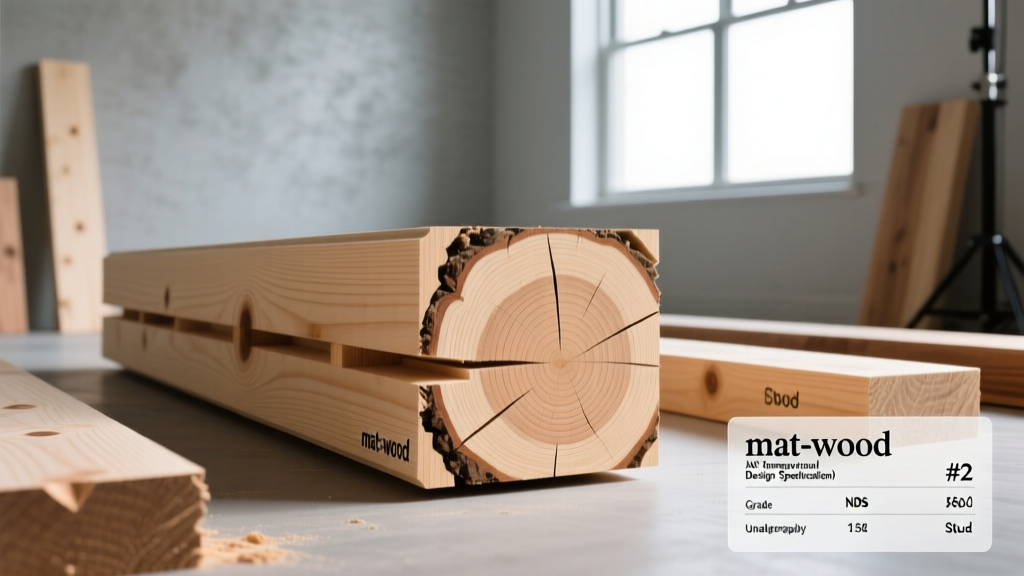
The Engineering Stakes: Allowable Design Values
When planning structural renovations, adding load-bearing walls, or sistering joists, the existing lumber's species and grade dictate the entire engineering framework. Misidentifying a Southern Pine joist as Spruce-Pine-Fir (SPF) can lead to a massive overestimation of bending capacity, resulting in catastrophic deflection or structural failure. To calculate safe spans and loads, structural engineers rely on the American Wood Council’s National Design Specification (NDS), which assigns specific allowable design values based on exact species and grade combinations.
Before you can run span tables or sizing software, you must definitively identify type of wood currently supporting the structure. The three critical engineering properties affected by species identification are:
- Fb (Bending Stress): The fiber stress in bending, measured in psi. This determines how much weight a joist or beam can hold before snapping.
- E (Modulus of Elasticity): The stiffness of the wood. This dictates how much the floor will bounce or deflect under live loads.
- Fv (Shear Stress): The horizontal shear capacity, critical for short, heavily loaded beams near support columns.
Assume you are spanning 14 feet with a 2x10 No. 2 grade joist at 16" on-center. If you mistakenly identify Southern Pine as SPF, you are assuming an Fb of 1,500 psi instead of the actual 900 psi. This 66% overestimation of bending strength could result in a floor system that fails to meet the International Residential Code (IRC) L/360 deflection limits, leading to cracked drywall and bouncy floors.

Decoding the Lumber Grade Stamp
The most reliable way to identify type of wood in modern construction (post-1960s) is by reading the ink grade stamp located on the face or edge of the lumber. According to the Forest Products Laboratory Wood Handbook, these stamps are regulated by accredited grading agencies and provide a definitive structural pedigree.
Anatomy of a Structural Grade Stamp
Use a high-lumen work light and a wire brush to clear away dust or paint from the stamp. You are looking for four distinct data points:
- Species Mark: Often abbreviated. DF-L (Douglas Fir-Larch), SP (Southern Pine), HF (Hem-Fir), or SPF (Spruce-Pine-Fir).
- Grade Mark: Indicates the visual grading classification. Common structural grades include No. 1, No. 2, No. 3, Stud, or SS (Select Structural).
- Condition Mark: Denotes moisture content at the time of surfacing. S-DRY (Surfaced Dry, max 19% moisture), S-GRN (Surfaced Green, >19% moisture), or MC-15 (Max 15% moisture).
- Certifying Agency: The mill number and the logo of the grading agency, such as WWPA (Western Wood Products Association), SPIB (Southern Pine Inspection Bureau), or NLGA (National Lumber Grades Authority).
Visual and Tactile Identification of Unstamped Timber
In older homes, rough-sawn beams, or timber where the stamp has been planed off or obscured by decades of paint, you must rely on visual and tactile wood anatomy. This requires examining the end-grain using a 10x or 20x jeweler's loupe to assess growth ring structure, resin canals, and earlywood-to-latewood transition.
| Species Group | End-Grain & Transition | Color & Texture | Resin Canals |
|---|---|---|---|
| Southern Pine (SP) | Abrupt earlywood to latewood transition; high density latewood bands. | Yellowish-brown heartwood; very heavy, resinous feel. | Large, numerous, easily visible without magnification. |
| Douglas Fir-Larch (DF-L) | Moderate to abrupt transition; distinct, wavy grain patterns on flat-sawn faces. | Reddish-brown heartwood; prominent, sharp ridges between growth rings. | Present, but smaller and less frequent than Southern Pine. |
| Hem-Fir (HF) | Gradual transition; very uniform, fine texture on end-grain. | Pale, almost white to light brown; lacks strong color contrast between rings. | Absent (Hemlock) or very small/rare (True Firs). |
| Spruce-Pine-Fir (SPF) | Gradual transition; very fine, even growth rings. | White to pale yellow; low natural luster, lightweight feel. | Present in Pine/Spruce, but extremely small (requires 20x loupe). |
The Scratch and Smell Test
When visual cues are ambiguous due to aging or oxidation (which turns most exposed wood a uniform gray-brown), expose fresh wood by making a deep cut with a chisel. Southern Pine will emit a sharp, turpentine-like resin scent and feel sticky. Douglas Fir has a distinct, sweet, resinous aroma. Hemlock has virtually no odor and a dull, chalky texture when cut.
Advanced Field Testing for Concealed or Degraded Wood
When assessing historic timber frames or heavily degraded structural members where visual identification is impossible, structural engineers employ non-destructive testing (NDT) methods. According to guidelines supported by the American Wood Council's NDS, you cannot guess the species of a compromised beam; you must test it.
A Resistograph drills a micro-needle (typically 1.2mm to 3mm) into the timber, measuring the drilling resistance to map internal density and decay. While excellent for finding internal rot, density mapping alone cannot definitively separate species with overlapping density ranges (e.g., dense SPF vs. low-grade Hem-Fir). Always combine Resistograph data with core sampling for microscopic end-grain analysis.
For definitive species identification on site without destroying the beam, professionals extract a 5mm increment core using a Swedish increment borer. This core is then sanded to 400-grit, stained with a phloroglucinol-HCl solution (which turns lignin-rich latewood red), and examined under a digital microscope to count ray cells and pit structures, matching them against the FPL wood anatomy database.
Decision Matrix: What to Do When You Cannot Identify the Wood
In renovation scenarios where opening walls is cost-prohibitive and stamps are entirely absent, structural engineers must apply a conservative assumption framework. The NDS provides baseline design values for "unknown" or ungraded lumber to ensure life-safety margins are maintained.
The "Worst-Case Scenario" Calculation Framework
If you cannot identify type of wood after exhaustive visual and stamp inspections, follow this decision tree for your load calculations:
- Assume the Lowest Regional Species: If you are in the Eastern US, assume SPF or Eastern Spruce. If in the West, assume Hem-Fir.
- Assume the Lowest Structural Grade: Assume the lumber is No. 3 or Stud grade, rather than the standard No. 2. This automatically reduces the Fb (bending) value by roughly 30% to 40%.
- Apply the Condition Factor: If the wood is unseasoned or shows checking (cracking along the grain), apply the wet service factor (Cm) and incising factor (Ci) reductions outlined in NDS Chapter 4.
- Reduce Allowable Spans: By assuming Hem-Fir Stud Grade, a 2x10 joist's maximum span drops from roughly 16 feet (under DF-L No. 2) to under 11 feet. If your actual span exceeds this conservative calculation, you must sister the joists or add a mid-span beam, regardless of what the hidden wood actually is.
For comprehensive design values and adjustment factors based on specific species and grades, always consult the latest WoodWorks design library or the published NDS supplement tables before finalizing structural plans.
Frequently Asked Questions
Can I use a moisture meter to identify wood species?
No. Moisture meters measure electrical resistance or dielectric capacitance to determine water content, not cellular structure. While different species have varying specific gravities that can slightly alter baseline meter readings, the variance caused by ambient humidity and internal moisture gradients makes this method entirely useless for species identification.
Does reclaimed timber retain its original structural grade?
Reclaimed timber loses its original visual grade stamp validity once it is re-sawn, notched, or drilled. To use reclaimed heavy timber structurally, it must be re-graded by a certified lumber grader or stress-graded using ultrasonic or transverse vibration NDT equipment to establish a new, verified Modulus of Elasticity (E).
What is the difference between Hem-Fir and Douglas Fir-Larch?
Douglas Fir-Larch (DF-L) is significantly stronger and stiffer than Hem-Fir (HF). In No. 2 grade, DF-L boasts an Fb of 900 psi and an E of 1,600,000 psi, while Hem-Fir drops to an Fb of 850 psi and an E of 1,300,000 psi. Confusing the two in a long-span beam application will result in excessive deflection.
Written by
Marcus ChenMarcus Chen is a licensed structural engineer (PE) and building materials analyst with over 12 years of experience across residential, commercial, and industrial construction. He holds a Master of Science in Civil Engineering from UC Berkeley and spent six years at Thornton Tomasetti before transitioning to independent consulting and technical writing. Marcus specializes in material selection for seismic-prone regions, concrete reinforcement strategies, and lifecycle cost analysis. His work has been cited by the American Concrete Institute (ACI) and the Structural Engineers Association of California (SEAOC). When he is not on a job site or at his desk, you will find him hiking the Sierra Nevada or restoring a 1920s craftsman bungalow in Oakland, CA.
More from Marcus Chen
View all
Construction Cost
How Much Did the Eiffel Tower Cost to Build?
How much did the Eiffel Tower cost to build in 1889? We adjust for inflation and compare its budget to modern skyscraper construction.
Aug 4, 2026

Fire Resistance
What Is a Fire Resistant Material? Testing & Certification Guide
Discover what is a fire resistant material through ASTM and UL testing. Learn how fire ratings, certifications, and assemblies work in construction.
Aug 4, 2026

Construction Cost
How Much Did the Burj Khalifa Cost to Build?
How much did the Burj Khalifa cost to build? We break down the $1.5B project and extract 5 money-saving strategies for your next build.
Jul 30, 2026