What Type of Wood Burns the Longest? A Firewood BTU & Density Comparison
Discover what type of wood burns the longest with our BTU and density comparison. Find the best firewood species for maximum heat and overnight burns.

The Short Answer: Density Dictates Burn Time
If you are asking what type of wood burns the longest, the technical answer is Osage Orange, which produces a massive 32.9 million BTUs per full cord. However, because Osage Orange sparks violently and is difficult to source in many regions, the practical champion for indoor wood stoves is Black Locust (27.9 million BTUs/cord), closely followed by Hickory and White Oak.
Burn time is not determined by the species name alone; it is a function of cellular density (lignin and cellulose concentration) and moisture content. A dense hardwood with a moisture content below 20% will always outlast a low-density softwood or a poorly seasoned log, regardless of the species. Below, we break down the exact BTU outputs, coal-bed longevity, and 2026 market pricing for the longest-burning firewood species available.
Firewood Species Comparison Matrix
The following data assumes a standard full cord (128 cubic feet) of wood seasoned to an optimal 20% moisture content. BTU ratings represent the potential heat output, which directly correlates to burn duration in a controlled, EPA-certified wood stove.
| Wood Species | BTUs (Millions/Cord) | Density (lbs/cu ft) | Coal Quality | Sparking | Splitting Difficulty |
|---|---|---|---|---|---|
| Osage Orange | 32.9 | 51 | Excellent | Severe | Very Hard |
| Black Locust | 27.9 | 46 | Excellent | Low | Hard |
| Hickory (Shagbark) | 27.7 | 45 | Excellent | Low | Moderate |
| White Oak | 26.2 | 43 | Very Good | Low | Moderate |
| Beech (American) | 26.1 | 43 | Very Good | Moderate | Hard |
| Red Oak | 24.6 | 41 | Good | Low | Easy |
| Yellow Birch | 23.6 | 39 | Good | Low | Moderate |
| White Pine (Softwood) | 15.9 | 25 | Poor | Moderate | Easy |
Deep Dive: The Longest Burning Hardwoods
Osage Orange: The BTU King (With Caveats)
Osage Orange (Maclura pomifera) is legendary among wood burners. At nearly 33 million BTUs per cord, it burns so hot that it can literally melt the internal baffles of older, non-certified wood stoves. It forms a dense, long-lasting coal bed that can sustain a burn for 10 to 12 hours in a modern catalytic stove.
Black Locust: The Practical Champion
For indoor heating, Black Locust is widely considered the best firewood in North America. It yields 27.9 million BTUs per cord and produces a coal bed rivaling anthracite coal. A unique advantage of Black Locust is its rot resistance; unlike oak, which must be split and stacked immediately to prevent fungal degradation, locust logs can sit in the woods for a year before splitting without losing structural integrity to rot. Furthermore, it seasons faster than oak, often reaching 20% moisture content in 6 to 9 months.
Hickory: The Aroma and Heat Standard
Hickory (particularly Shagbark and Pignut) offers 27.7 million BTUs per cord. It is exceptionally dense, holds a fire overnight with ease, and produces the classic, savory smoke associated with Southern barbecue. The primary drawback is mechanical: hickory fibers are interlocking and notoriously difficult to split by hand. If you are buying hickory in 2026, expect to pay a premium due to the labor costs associated with hydraulic splitting.
White Oak: The Reliable Baseline
White Oak (26.2 million BTUs) is the most widely available high-density firewood. While it doesn't quite match the sheer heat output of locust or Osage orange, its predictable burn rate, low smoke profile, and excellent coaling properties make it the default choice for primary winter heating. The critical failure mode with White Oak is moisture retention; its cellular structure traps water, requiring a minimum of 18 to 24 months of air-drying after splitting to reach optimal combustion efficiency.
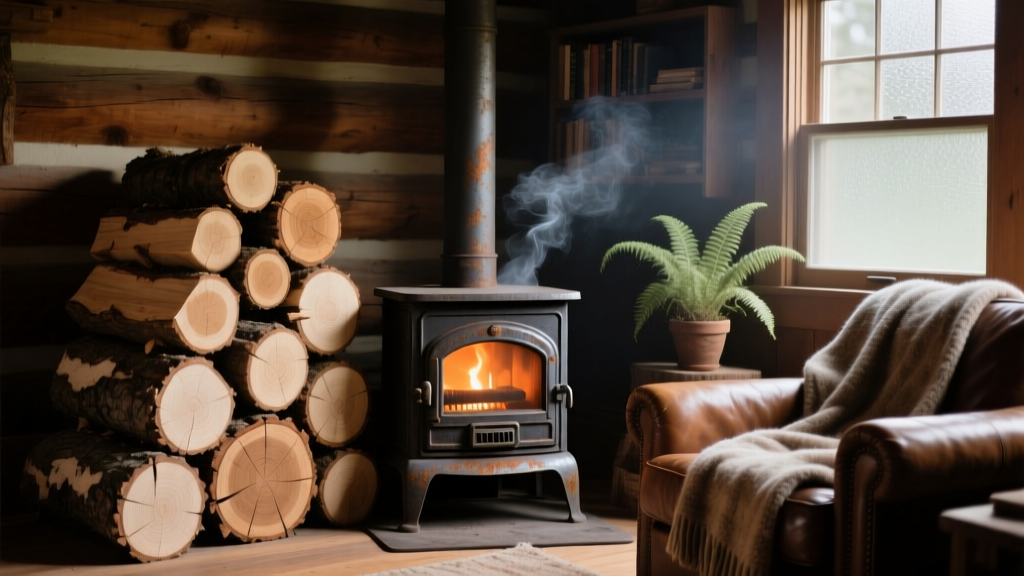
The Physics of Burn Time: Why Moisture Content is the Real Bottleneck
Many consumers buy premium oak or hickory but experience short, smoldering burns. The culprit is almost always latent heat of vaporization. According to the EPA's Burn Wise program, burning wood with a moisture content above 20% drastically reduces usable heat.
When you burn unseasoned wood, the fire's thermal energy is diverted away from heating your home and is instead used to boil the water trapped inside the wood cells. It takes approximately 1,000 BTUs to boil off a single pound of water. A 40-lb log of green oak (at 50% moisture) contains 20 lbs of water. That means 20,000 BTUs are wasted purely on steam generation before the wood can even begin to combust efficiently. This not only shortens your burn time by up to 35% but also accelerates creosote buildup in your flue, creating a severe chimney fire hazard.
2026 Firewood Pricing and Value Analysis
Firewood pricing fluctuates based on regional availability, delivery distances, and local labor costs. Below is the average market rate for a full cord (128 cubic feet, split and delivered within 15 miles) in the Northeastern and Midwestern United States as of early 2026.
- White/Red Oak Mix: $350 - $450 per cord. (Best overall value for daily heating).
- Hickory: $450 - $600 per cord. (Premium pricing due to splitting labor and high demand from culinary smokers).
- Black Locust: $500 - $700 per cord. (Often sold in mixed 'hardwood' loads; pure locust commands a premium).
- Osage Orange: $400 - $550 per cord. (Highly regional; abundant in the Plains states, virtually unavailable in the Northeast).
- Kiln-Dried Mixed Hardwood: $650 - $850 per cord. (Guaranteed sub-15% moisture, ideal for immediate use or wood-fired pizza ovens).
When calculating value, look at the cost per million BTUs rather than the cost per cord. A $500 cord of Black Locust (27.9M BTUs) yields a cost of $17.92 per million BTUs. A $350 cord of Red Oak (24.6M BTUs) yields $14.22 per million BTUs. If Red Oak is properly seasoned, it often represents a better financial investment despite the slightly shorter burn time.
Decision Framework: Which Wood Should You Buy?
Use this diagnostic framework to select the right wood for your specific heating apparatus and lifestyle:
Scenario A: You need overnight burns in a modern catalytic stove.
Buy: Black Locust or White Oak.
Why: You need high-density wood that forms a robust, long-lasting coal bed to maintain the stove's core temperature through an 8-to-10-hour sleep cycle. Avoid ash or birch, which burn too quickly and leave fine, powdery ashes that fail to retain heat.
Scenario B: You are heating a drafty cabin or outdoor boiler.
Buy: Osage Orange or a Locust/Oak mix.
Why: Outdoor boilers and poorly insulated spaces require maximum raw BTU output to overcome heat loss. The sparking issues of Osage Orange are negated by the closed, outdoor environment of a boiler system.
Scenario C: You burn in an open masonry fireplace for ambiance.
Buy: Hickory or Cherry.
Why: Open fireplaces are highly inefficient (often operating at negative efficiency by pulling heated air up the chimney). Therefore, maximizing BTUs is less important than maximizing aroma and minimizing dangerous sparking. Hickory provides excellent scent and a steady, predictable flame without the violent popping associated with locust or Osage orange.
For comprehensive data on regional wood species and their specific thermal properties, the University of Missouri Extension's Firewood Guide remains one of the most thorough botanical and thermal resources available for North American wood burners. Always prioritize local, sustainably harvested hardwoods to minimize the spread of invasive pests like the Emerald Ash Borer, and never transport firewood more than 50 miles from its harvest site.
Written by
Marcus ChenMarcus Chen is a licensed structural engineer (PE) and building materials analyst with over 12 years of experience across residential, commercial, and industrial construction. He holds a Master of Science in Civil Engineering from UC Berkeley and spent six years at Thornton Tomasetti before transitioning to independent consulting and technical writing. Marcus specializes in material selection for seismic-prone regions, concrete reinforcement strategies, and lifecycle cost analysis. His work has been cited by the American Concrete Institute (ACI) and the Structural Engineers Association of California (SEAOC). When he is not on a job site or at his desk, you will find him hiking the Sierra Nevada or restoring a 1920s craftsman bungalow in Oakland, CA.
More from Marcus Chen
View all
Construction Cost
How Much Did the Eiffel Tower Cost to Build?
How much did the Eiffel Tower cost to build in 1889? We adjust for inflation and compare its budget to modern skyscraper construction.
Aug 4, 2026

Fire Resistance
What Is a Fire Resistant Material? Testing & Certification Guide
Discover what is a fire resistant material through ASTM and UL testing. Learn how fire ratings, certifications, and assemblies work in construction.
Aug 4, 2026

Construction Cost
How Much Did the Burj Khalifa Cost to Build?
How much did the Burj Khalifa cost to build? We break down the $1.5B project and extract 5 money-saving strategies for your next build.
Jul 30, 2026