The Cheapest Type of Wood for Building: A Grade & Quality Guide
Discover the cheapest type of wood for construction. Learn how to navigate lumber grades, avoid structural defects, and buy budget framing safely.

When managing tight construction budgets, sourcing the cheapest type of wood is a primary objective for framers, DIY builders, and general contractors. However, 'cheap' in the lumber yard does not simply mean picking the lowest-priced species; it requires a strategic understanding of lumber grading, moisture content, and allowable defects. The absolute cheapest type of wood for structural building in North America is typically Utility or #3 grade Spruce-Pine-Fir (SPF) and Southern Yellow Pine (SYP). But purchasing the lowest tier of dimensional lumber without understanding its structural limitations can lead to catastrophic framing failures, drywall pops, and failed municipal inspections.
This guide dissects the economics of budget lumber, decoding the grade stamps established by the American Lumber Standard Committee (ALSC) so you can confidently purchase inexpensive wood without compromising your building's structural integrity.
The Reality of 'Cheap' Lumber: Price vs. Structural Integrity
Beginners often confuse wood species with lumber grades. A high-grade (Select Structural) piece of Hem-Fir will cost significantly more than a low-grade (#3 or Utility) piece of Douglas Fir. Therefore, finding the cheapest type of wood is primarily an exercise in grade selection rather than just species selection.
Budget lumber is characterized by higher tolerances for visual and structural defects. This includes larger knots, increased wane (bark left on the edge), and greater allowances for warping. While these defects make the wood unsuitable for high-load applications like roof rafters or floor joists, they are perfectly acceptable for non-load-bearing partitions, temporary bracing, and short-span blocking.
Decoding the Cheapest Wood Species in North America
If you are buying standard dimensional lumber (2x4s, 2x6s), the market is dominated by three main species groups. Below is a comparison of their baseline characteristics and average market pricing for a standard 2x4x8 board.
| Species Group | Janka Hardness (lbf) | Typical Price (2x4x8) | Best Budget Application | Primary Drawback |
|---|---|---|---|---|
| SPF (Spruce-Pine-Fir) | 480 - 660 | $3.20 - $4.10 | Interior wall framing, blocking | Low decay resistance; prone to splitting |
| SYP (Southern Yellow Pine) | 690 - 870 | $3.80 - $4.90 | Floor joists, high-load headers | Heavy; high shrinkage if not kiln-dried |
| Hem-Fir (Hemlock-Fir) | 400 - 500 | $3.50 - $4.40 | General framing, sheathing backing | Brittle; lower shear strength |
For the absolute lowest cost per board foot, SPF is generally the cheapest type of wood available at big-box home centers, particularly in northern US and Canadian markets. However, according to the USDA Forest Products Laboratory, SPF has lower specific gravity and shear strength compared to SYP, meaning you cannot span it as far when used as joists or rafters.
Navigating Lumber Grades: Where You Can (and Cannot) Cut Costs
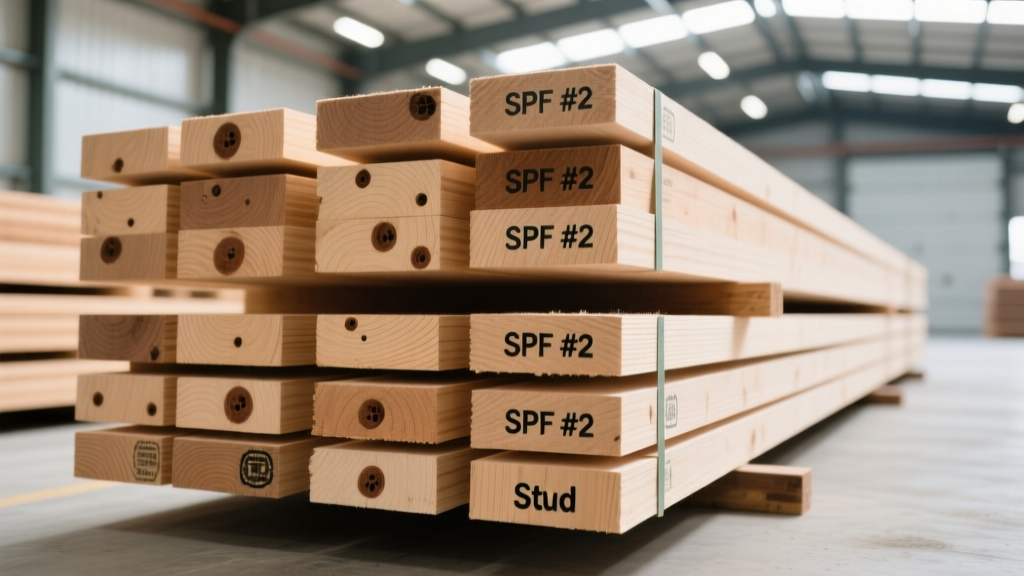
The grade stamp on your lumber dictates its structural capacity. The Southern Pine Inspection Bureau (SPIB) and other regional agencies enforce strict rules on what defects are permissible at each grade level. Here is how the cheapest grades break down:
1. Stud Grade (The Budget Framer's Workhorse)
'Stud' grade is a specific classification designed exclusively for vertical, load-bearing wall studs up to 10 feet in length. It is cheaper than #2 grade because it allows for wider wane and slightly larger knots, but it restricts severe twisting. This is the cheapest type of wood you should use for exterior and interior load-bearing walls.
2. #3 Grade (The Utility Crossover)
#3 grade lumber permits larger knots and more slope of grain than #2. It is significantly cheaper and is safe for top and bottom plates, blocking, and non-load-bearing partition walls. It should not be used for rafters or floor joists.
3. Utility and Economy Grades (The Danger Zone)
Utility grade is meant for temporary structures, crating, and agricultural buildings. Economy grade is essentially salvage wood. Neither should ever be used in residential or commercial stick framing.
Many DIYers buy Utility grade 2x4s because they are 30% cheaper than #2 grade. However, Utility grade lumber has virtually no engineered span ratings. Using it for roof rafters or floor joists will result in excessive deflection (bouncing floors, sagging roofs) and will automatically fail your municipal framing inspection. Restrict Utility grade strictly to non-structural blocking, temporary scaffolding, and concrete formwork.
Defect Tolerances: What the Grade Stamp Actually Means
When you buy cheap lumber, you are accepting higher defect tolerances. Understanding these defects is crucial for sorting your lumber pile on the job site.
- Wane: Missing wood or bark along the edge. Stud grade allows up to 1/3 the width of the board to have wane. This reduces the nailing surface for drywall and sheathing.
- Skip: Areas where the planer missed the wood, leaving rough sawn patches. This makes the board slightly thicker, which can cause alignment issues when framing flush walls.
- Spike Knots: Knots cut longitudinally. In cheap wood, these act as stress concentrators and can cause the board to snap under heavy vertical loads.
| Defect Type | #2 Grade Allowance (8ft board) | Stud Grade Allowance | #3 / Utility Allowance |
|---|---|---|---|
| Crook (edge bend) | 1/2 inch max | 5/8 inch max | 1 inch+ |
| Bow (flat bend) | 1/2 inch max | 5/8 inch max | 1 inch+ |
| Twist | 1/2 inch max | 3/4 inch max | Severe twist allowed |
Moisture Content: The Hidden Cost of Budget Wood
The cheapest type of wood on the rack is often 'S-GRN' (Surfaced Green), meaning it was planed while its moisture content was above 19%. Kiln-dried lumber ('S-DRY' or 'KD', max 19% moisture) costs 10% to 15% more upfront.
Buying S-GRN lumber to save money is a false economy for interior finishing. As green wood acclimates to the interior environment of a heated home, it shrinks. A standard 2x4 can shrink by up to 1/8 inch in width and 1/32 inch in thickness. This shrinkage pulls away from drywall screws, causing massive 'nail pops' and cracking drywall seams. If you are framing a garage, shed, or exterior envelope that will remain unheated, S-GRN is a viable budget choice. For interior, climate-controlled living spaces, always pay the premium for S-DRY or KD lumber.
Field-Testing Cheap Lumber: A 4-Step Quality Check
Because budget lumber has wider defect tolerances, you must manually cull the worst boards at the lumber yard. Do not let the delivery truck drop a bundle of #3 or Stud grade wood without performing this 4-step field test:
- The Sight-Line Test (Crowning): Hold the board at eye level and look down the narrow edge. Every board has a natural curve, or 'crown.' If the crook exceeds 3/4 of an inch on an 8-foot board, reject it. It will be impossible to straighten with standard framing techniques.
- The Twist Check: Rest one end of the board on the ground and look at the opposite end. If the top face is rotated more than 5 degrees off the horizontal axis, the board is severely twisted. Twisted studs will push drywall out of plane, requiring expensive shimming and shaving by the drywall crew.
- The Knot Integrity Check: Inspect the edges for loose, dead, or decaying knots. If you can push a knot out with your thumb, or if a knot is surrounded by dark, crumbly decay, the board's structural continuity is compromised. Reject it for load-bearing use.
- The Weight Test (Moisture Proxy): Pick up two boards of the same species and length. The noticeably heavier board has a higher moisture content. Segregate heavy boards for exterior use or allow them to sticker and dry in a ventilated area before enclosing them behind insulation.
Strategic Sourcing: Maximizing Budget Lumber
To truly capitalize on the cheapest type of wood, separate your material takeoffs by structural requirement. Order premium #2 or Select Structural SYP for floor joists, roof rafters, and main load-bearing headers. Order Stud grade SPF for vertical wall framing. Order #3 or Utility grade for bottom plates, fire blocking, and backing. By stratifying your lumber order by grade and species rather than buying a single grade for the entire structure, you can reduce your total framing lumber budget by 12% to 18% while maintaining full compliance with the International Residential Code (IRC).
Written by
Priya KapoorPriya Kapoor is a real estate market analyst and construction economics researcher with expertise in housing affordability, development feasibility, and infrastructure investment. She holds a Master of Regional Planning from Cornell University and previously worked as a senior analyst at CBRE's Investment Properties group, where she modeled returns for $4B in mixed-use development pipelines. Priya now runs an independent research practice advising developers, municipalities, and REITs on construction cost forecasting and market timing. She publishes the quarterly "BuildMat Market Pulse" report tracking material price indices across 12 commodity categories. Based in Austin, TX, Priya serves on the board of Habitat for Humanity Austin and is a marathon runner.
More from Priya Kapoor
View all
Construction Cost
Cost to Build a 1600 Sq Ft Home in 2026: Full Breakdown
Accurate 2026 cost to build a 1600 sq ft home—material, labor, and regional pricing breakdowns included. Plan your budget with real-time estimates.
Aug 11, 2026

Wood & Lumber
Name the Types of Wood for Pressure Treatment and Preservation
Learn how to name the types of wood best suited for pressure treatment. Compare species treatability, chemical retention levels, and 2026 preservation costs.
Aug 4, 2026

Stone & Masonry
Stone Veneer Suppliers Lindenhurst: 2026 Cost Analysis
Analyze 2026 stone veneer costs in Lindenhurst, NY. Compare local supplier pricing, delivery fees, and Suffolk County installation labor rates.
Aug 4, 2026