What Is the Strongest Type of Wood for Structural Framing?
Discover what is the strongest type of wood for structural framing, comparing solid sawn lumber, Glulam, and LVL beams with 2026 load data and costs.
The Myth of a Single 'Strongest' Wood
When architects and engineers ask, 'what is the strongest type of wood?', the answer requires an immediate pivot away from consumer-grade metrics. If you search for the hardest wood, you will find Australian Buloke or Lignum Vitae, which boast massive Janka hardness ratings (over 4,500 lbf). However, Janka hardness measures resistance to surface denting and wear—it is virtually irrelevant for structural framing. A floor joist or load-bearing column does not fail because it gets scratched; it fails due to bending stress, shear, or compressive buckling.
In structural engineering, strength is defined by specific mechanical properties measured in pounds per square inch (psi). According to the USDA Forest Products Laboratory Wood Handbook, the true measure of a wood's structural viability relies on its Modulus of Rupture (MOR), Modulus of Elasticity (MOE), and Compression Parallel to Grain.
Structural Strength Metrics Defined
- Modulus of Rupture (MOR / Fb): The maximum bending stress a beam can withstand before catastrophic fracture.
- Modulus of Elasticity (MOE / E): A measure of stiffness. High MOE means the beam will resist deflection (sagging) under load, which is often the governing factor in residential floor joist design.
- Compression Parallel to Grain (Fc): The maximum crushing stress a wood column can handle before buckling or crushing.
Top Solid-Sawn Species Ranked by Load-Bearing Capacity
For traditional solid-sawn lumber, softwoods overwhelmingly dominate structural applications due to their rapid growth, straight grain, and high strength-to-weight ratios. The American Wood Council's National Design Specification (NDS) establishes the baseline allowable stress design (ASD) values for these species.
Below is a comparison of the strongest solid-sawn structural lumbers available in North America, specifically looking at their highest commercial grades (Select Structural or Dense Select Structural).
| Wood Species | Grade | Allowable Bending (Fb psi) | Stiffness (E psi) | Best Structural Application |
|---|---|---|---|---|
| Southern Yellow Pine (SYP) | Dense Select Structural | 2,150 | 1,900,000 | Heavy floor joists, truss chords |
| Douglas Fir-Larch | Select Structural | 1,950 | 1,900,000 | Glulam laminations, primary beams |
| Hem-Fir (West Coast) | Select Structural | 1,650 | 1,800,000 | Standard wall framing, rafters |
| Sitka Spruce | Select Structural | 1,600 | 1,700,000 | Aircraft, marine, light trusses |
Note: The Fb values above are base values for normal load duration and dry service conditions. Actual design values must be adjusted for specific spans, bearing lengths, and moisture content.
Engineered Wood Products (EWP): The True Structural Heavyweights
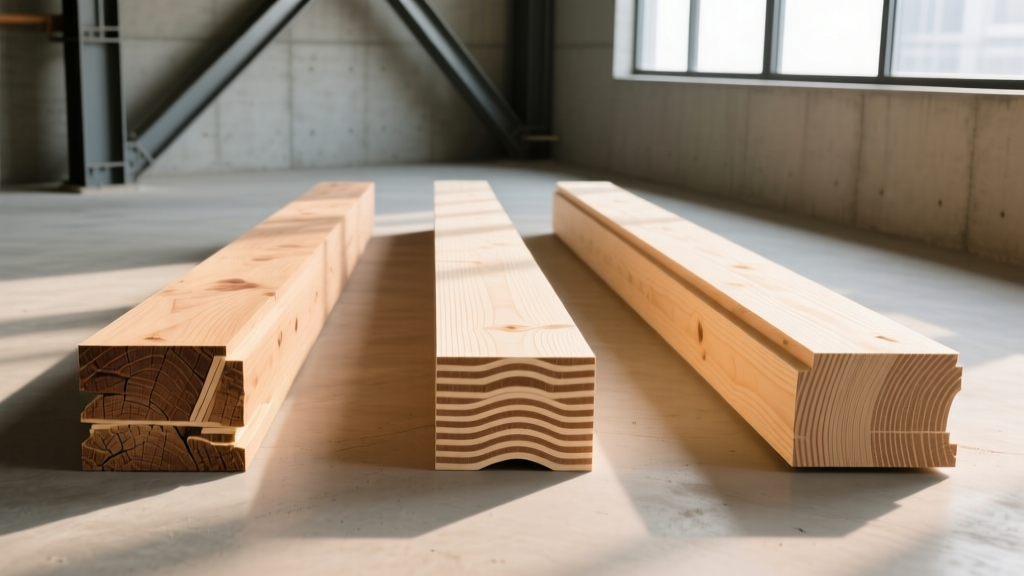
If the question is strictly 'what is the strongest type of wood for long-span beams?', solid sawn lumber is no longer the correct answer. Modern commercial and high-end residential construction relies on Engineered Wood Products (EWPs). By breaking wood down into veneers or strands and bonding them with structural adhesives, manufacturers eliminate natural defects like knots and slope-of-grain, resulting in predictable, massive load-bearing capacities.
1. Laminated Veneer Lumber (LVL)
LVL is manufactured by layering thin wood veneers (usually Douglas Fir or SYP) with parallel grain orientation. A standard 1.75-inch thick LVL beam graded at 2800Fb-2.0E offers a bending stress capacity of 2,800 psi and an MOE of 2,000,000 psi. This makes it roughly 30% stronger in bending than the highest grade of solid Douglas Fir. LVL is the default choice for residential ridge beams, headers, and flush beams spanning up to 20 feet.
2. Parallel Strand Lumber (PSL)
PSL (often recognized by the brand name Parallam) is made from long, thin strands of wood veneer laid parallel and pressed into massive billets. PSL excels in compression and shear strength. It is the strongest wood product for heavy load-bearing columns, posts, and short-span, high-load headers. A 6x6 PSL column can support significantly more axial load than a solid 6x6 timber of the same species due to the dispersion of natural defects.
3. Glued Laminated Timber (Glulam)
Glulam consists of dimensional lumber laminations bonded together. It is the premier choice for exposed architectural beams, long spans (20 to 60+ feet), and curved structural elements. Glulam combinations (like 24F-V8 Douglas Fir) provide immense bending strength while allowing for large cross-sectional dimensions that solid trees simply cannot yield.
Decision Matrix: Specifying the Right Beam for the Load
Choosing the strongest wood is useless if it is the wrong product for the specific structural demand. Use this framework to specify materials for your 2026 projects:
- Span under 12 feet (Standard Headers): Use solid SYP or Douglas Fir 2x10/2x12 doubled or tripled. It is cost-effective and readily available from local yards.
- Span 12 to 22 feet (Open Concept Living Rooms): Specify LVL (2.0E grade). Solid lumber in these spans will suffer from excessive deflection (bounce) and checking. LVL provides the necessary MOE to keep floors rigid.
- Heavy Point Loads / Columns: Specify PSL or solid SYP 6x6. Avoid LVL for unprotected exterior columns, as the edge-glued veneers can wick moisture and delaminate if exposed to weather.
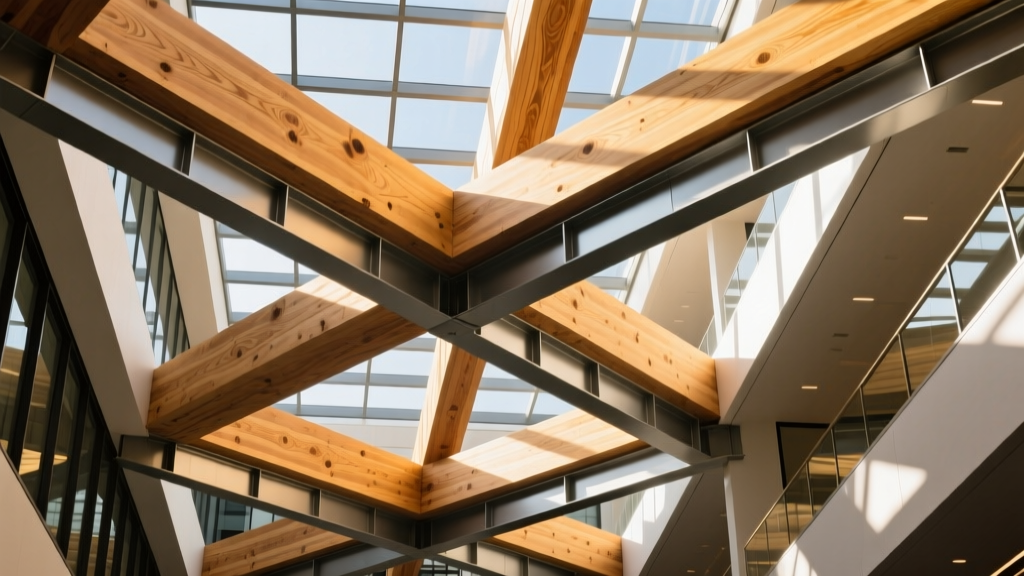
- Spans over 24 feet or Exposed Architectural Beams: Specify Glulam. It offers superior dimensional stability, fire resistance (via predictable char rates), and aesthetic appeal.
The Hidden Variable: How Lumber Grading Dictates Actual Strength
A common mistake in structural framing is assuming all 2x10s of the same species share the same strength. The visual grade stamp dictates the actual allowable stress. According to structural design guidelines from WoodWorks, a knot or slope-of-grain deviation drastically reduces a board's capacity.
For example, a Douglas Fir-Larch 2x10 graded as Select Structural has an allowable bending stress (Fb) of 1,950 psi. That exact same species and size, graded as #2, drops to an Fb of just 1,150 psi—a 41% reduction in strength due to the allowance of larger knots and steeper grain slopes. For critical load paths, always verify the grade stamp; paying a 15% premium for Select Structural or Machine Stress Rated (MSR) lumber prevents costly structural sagging later.
2026 Material Cost and Availability Breakdown
Strength must be balanced against project budgets. Below is a snapshot of early 2026 material costs for structural framing members. Prices fluctuate based on regional supply chains and milling capacities.
| Product Type | Typical Dimensions | Est. Cost per Linear Foot (2026) | Lead Time |
|---|---|---|---|
| Solid SYP #2 2x12 | 1.5' x 11.25' | $1.65 - $2.20 | In Stock |
| LVL (1.75' x 11.87') | 2800Fb-2.0E | $5.80 - $7.50 | In Stock / 1 Week |
| PSL Column | 5.25' x 5.25' | $14.00 - $18.50 | 1 - 2 Weeks |
| Glulam Beam | 6.75' x 12' | $11.00 - $15.00 | 2 - 4 Weeks |
Expert Verdict: Matching the Wood to the Structural Demand
There is no single 'strongest' wood; there is only the most appropriate wood for a specific mechanical demand. If you need maximum surface hardness, look to tropical hardwoods. But for structural framing, Southern Yellow Pine (Dense Select Structural) remains the undisputed king of solid-sawn softwoods, offering unmatched bending and compression values for standard dimensional lumber.
However, for modern long-span beams and heavy point loads, LVL and PSL engineered wood products surpass solid timber entirely. They offer higher, predictable psi ratings, eliminate the risk of natural defect failure, and resist the warping that plagues solid sawn beams. Always consult the NDS supplement and work with a licensed structural engineer to calculate exact deflection limits and shear capacities before finalizing your framing schedule.
Written by
Marcus ChenMarcus Chen is a licensed structural engineer (PE) and building materials analyst with over 12 years of experience across residential, commercial, and industrial construction. He holds a Master of Science in Civil Engineering from UC Berkeley and spent six years at Thornton Tomasetti before transitioning to independent consulting and technical writing. Marcus specializes in material selection for seismic-prone regions, concrete reinforcement strategies, and lifecycle cost analysis. His work has been cited by the American Concrete Institute (ACI) and the Structural Engineers Association of California (SEAOC). When he is not on a job site or at his desk, you will find him hiking the Sierra Nevada or restoring a 1920s craftsman bungalow in Oakland, CA.
More from Marcus Chen
View all
Construction Cost
How Much Did the Eiffel Tower Cost to Build?
How much did the Eiffel Tower cost to build in 1889? We adjust for inflation and compare its budget to modern skyscraper construction.
Aug 4, 2026

Fire Resistance
What Is a Fire Resistant Material? Testing & Certification Guide
Discover what is a fire resistant material through ASTM and UL testing. Learn how fire ratings, certifications, and assemblies work in construction.
Aug 4, 2026

Construction Cost
How Much Did the Burj Khalifa Cost to Build?
How much did the Burj Khalifa cost to build? We break down the $1.5B project and extract 5 money-saving strategies for your next build.
Jul 30, 2026