Types of Wood Stove: Firewood Preservation and Wood Framing Treatment
Analyze how different types of wood stove impact firewood moisture preservation and the fire-retardant treatment required for surrounding wood framing.

The Intersection of Stove Thermodynamics and Wood Preservation
Selecting from the various types of wood stove on the market is rarely just an aesthetic choice; it fundamentally dictates how you must treat, preserve, and store your firewood, as well as how you must protect the structural wood framing of your home. A high-efficiency catalytic stove operates on entirely different thermodynamic principles than a traditional non-catalytic radiant heater or a masonry heater. These operational differences change the acceptable moisture content of your fuel and the thermal load placed on nearby combustible wood structures.
From a treatment and preservation perspective, installing a wood heating appliance requires a dual-focus approach: preserving the chemical and physical integrity of the wood fuel to prevent creosote, and treating or shielding the architectural wood framing to prevent pyrolysis and structural ignition.
Firewood Preservation Requirements by Stove Type
Wood preservation in the context of fuel management means maintaining the optimal moisture content (MC) and preventing fungal degradation (spalting or rot) during the seasoning process. Different stove technologies have strict tolerances for fuel moisture.
Catalytic Stoves: The Strict 20% MC Threshold
Catalytic stoves pass exhaust gases through a ceramic or steel honeycomb combustor coated with platinum or palladium. According to the U.S. Environmental Protection Agency (EPA), these units achieve ultra-low emissions (often below 1.0 g/hr) but are highly sensitive to fuel quality. If firewood exceeds 20% moisture content, the excess water vapor cools the catalyst below its light-off temperature (typically 500°F to 600°F), causing incomplete combustion and rapid degradation of the precious metal coating. Furthermore, wet wood introduces acidic condensation that physically breaks down the catalyst substrate.
Non-Catalytic and Secondary Burn Stoves
Non-catalytic stoves rely on secondary air tubes and firebox insulation to achieve high temperatures. While more forgiving than catalytic models, they still require firewood preserved at or below 20% MC. Wood stored above 25% MC in these units leads to severe creosote accumulation in the flue, as the secondary combustion zone fails to reach the 1,100°F required to ignite the smoke gases.
Masonry Heaters and Pellet Stoves
Masonry heaters utilize a massive thermal mass (soapstone, brick, or tile) to absorb heat from a fast, extremely hot fire. Because the fire burns hot and fast, masonry heaters can tolerate slightly higher moisture wood (up to 25%), though 20% remains ideal. Pellet stoves, conversely, require manufactured wood pellets that are kiln-dried and compressed to exactly 5% to 8% MC. The preservation of pellet fuel requires strict climate control; pellets will absorb ambient humidity and disintegrate into sawdust if stored in environments exceeding 60% relative humidity.
Comparative Fuel Preservation Matrix
| Stove Technology | Max Moisture Content | Preservation / Storage Requirement | Risk of Improperly Cured Wood |
|---|---|---|---|
| Catalytic | 20% | Kiln-dried or 18-month covered air-dry; off-ground pallet storage. | Catalyst poisoning, acidic flue corrosion. |
| Non-Catalytic | 20% | Split and stacked in single rows; top-covered to prevent rain ingress. | Stage 3 glazed creosote buildup, chimney fires. |
| Masonry Heater | 25% | Standard outdoor seasoning; high thermal mass forgives slight moisture. | Reduced thermal transfer, soot staining on masonry. |
| Pellet Stove | 8% (Pellets) | Indoor, climate-controlled storage; sealed poly-bags required. | Auger jams, poor combustion, clinker formation. |
Wood Framing Treatment and Pyrolysis Prevention
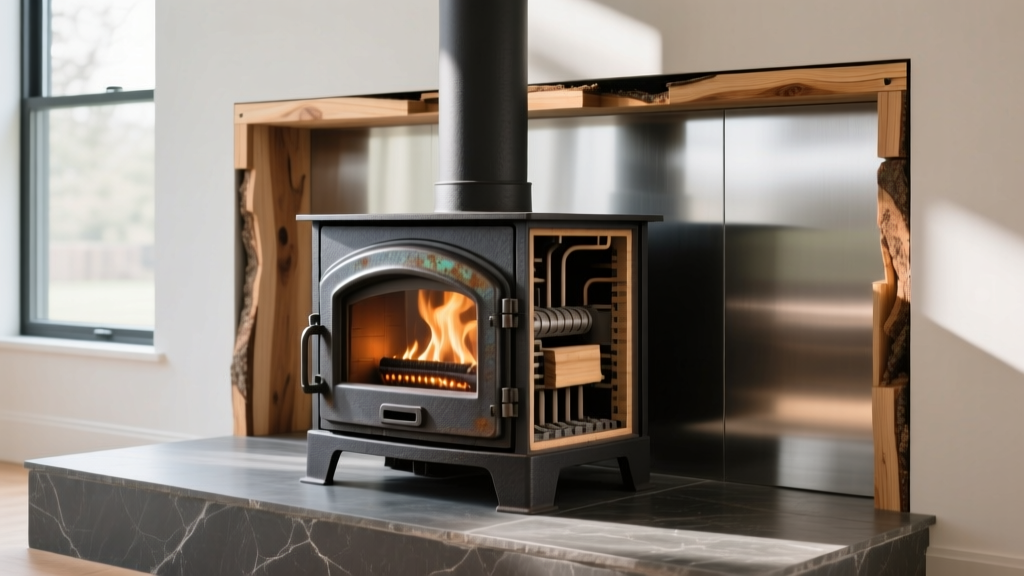
The second critical preservation aspect involves the dimensional lumber (typically Douglas Fir or Spruce-Pine-Fir) used in the wall and floor framing surrounding the stove. Prolonged exposure to the radiant heat emitted by different types of wood stove alters the cellular structure of wood in a process known as pyrolysis.
Pyrolysis is the chemical decomposition of wood through heat. Over years of heating cycles, wood framing exposed to temperatures as low as 150°F to 170°F slowly loses its volatile compounds. This lowers the wood's ignition temperature from its standard 400°F+ down to as low as 200°F. Eventually, a framing stud that has undergone severe pyrolysis can spontaneously ignite from a normal operational heat spike.
Clearance Reductions and Shielding Treatments
To prevent pyrolysis, the NFPA 211 Standard for Chimneys, Fireplaces, Vents, and Solid Fuel-Burning Appliances mandates strict clearance zones. However, architectural constraints often require clearance reductions, which necessitates specific thermal shielding treatments.
- Unshielded Single-Wall Stovepipe: Requires an 18-inch clearance to any combustible wood framing or trim.
- Shielded Wall Protectors: Installing a non-combustible shield (like 24-gauge sheet metal or cement board) with a 1-inch ventilated air gap behind it reduces the required clearance to combustible wood framing by up to 66% (bringing it down to 6 inches). The 1-inch air gap is critical; it allows convective cooling to preserve the structural integrity of the wood studs behind the shield.
- Double-Wall Insulated Pipe: Utilizing double-wall stovepipe (which features an air-insulated or ceramic-insulated inner flue) reduces clearances to wood trim and framing to 6 inches without the need for additional wall shields.
Hearth Extension and Floor Joist Preservation
The floor assembly beneath a wood stove requires both ember protection and thermal insulation to preserve the wooden floor joists below. The required R-value and physical dimensions of the hearth extension depend heavily on the specific type of wood stove installed.
Calculating Thermal Resistance (R-Value) for Joist Protection
Manufacturers test their stoves and specify a minimum R-value for the hearth pad. A standard ceramic tile installation over 3/4-inch plywood provides an R-value of only about 0.2, which is woefully inadequate for preserving the structural integrity of the joists below a high-output cast iron stove.
- Identify the Stove Requirement: Check the UL tag on the back of the stove. A typical medium-sized non-catalytic stove requires an R-value of 1.0 to 1.5.
- Select the Substrate: To achieve an R-value of 1.5 without raising the floor height excessively, use specialized micaceous insulating boards (e.g., Micore 300, which provides an R-value of 1.03 per 1/2-inch sheet) layered beneath cement backer board and your finish material (stone, tile, or brick).
- Protect the Joists: Ensure the insulated hearth pad extends at least 18 inches in front of the loading door and 8 inches on either side. This prevents hot embers from rolling onto unfinished wood floors and ensures the floor joists directly beneath the firebox are shielded from conductive heat transfer.
Maintaining the Stove-to-Chimney Transition
Where the stovepipe penetrates the ceiling or wall to connect to the Class A chimney, the surrounding wood framing is at the highest risk for pyrolysis. The CSA Group and UL standards require a specialized thimble or firestop radiation shield at these penetration points.
When framing the rough opening for a ceiling penetration, carpenters must leave a minimum 2-inch air space between the outer wall of the Class A chimney pipe and any wooden ceiling joists or trusses. This 2-inch gap must remain completely clear of insulation. Stuffing fiberglass batts into this gap to preserve the home's thermal envelope will trap heat against the steel chimney, transferring it to the wood joists and accelerating pyrolysis. Instead, use specialized attic insulation shields (metal cylinders that maintain the 2-inch clearance while deflecting blown-in cellulose or fiberglass) to preserve both the wood framing and the home's energy efficiency.
Summary of Best Practices for Wood and Stove Integration
Successfully integrating a solid fuel appliance into a wood-framed structure requires respecting the thermal limits of both the fuel and the architecture. By matching your firewood seasoning and preservation methods to the specific combustion technology of your stove, you ensure clean burns and protect expensive internal components like catalytic combustors. Simultaneously, by utilizing ventilated thermal shields and strictly maintaining air clearances, you protect your home's dimensional lumber from the silent, long-term threat of pyrolysis. Always defer to the specific clearance reductions outlined in your stove's UL-tested manual and the NFPA 211 guidelines to ensure a safe, code-compliant installation.
Written by
Marcus ChenMarcus Chen is a licensed structural engineer (PE) and building materials analyst with over 12 years of experience across residential, commercial, and industrial construction. He holds a Master of Science in Civil Engineering from UC Berkeley and spent six years at Thornton Tomasetti before transitioning to independent consulting and technical writing. Marcus specializes in material selection for seismic-prone regions, concrete reinforcement strategies, and lifecycle cost analysis. His work has been cited by the American Concrete Institute (ACI) and the Structural Engineers Association of California (SEAOC). When he is not on a job site or at his desk, you will find him hiking the Sierra Nevada or restoring a 1920s craftsman bungalow in Oakland, CA.
More from Marcus Chen
View all
Construction Cost
How Much Did the Eiffel Tower Cost to Build?
How much did the Eiffel Tower cost to build in 1889? We adjust for inflation and compare its budget to modern skyscraper construction.
Aug 4, 2026

Fire Resistance
What Is a Fire Resistant Material? Testing & Certification Guide
Discover what is a fire resistant material through ASTM and UL testing. Learn how fire ratings, certifications, and assemblies work in construction.
Aug 4, 2026

Construction Cost
How Much Did the Burj Khalifa Cost to Build?
How much did the Burj Khalifa cost to build? We break down the $1.5B project and extract 5 money-saving strategies for your next build.
Jul 30, 2026