Composite Wood Decking Material: A Complete Selection Framework
Master our selection framework for composite wood decking material. Compare core densities, capping tech, and top brands for your specific climate.
The Architecture of Modern Composite Decking
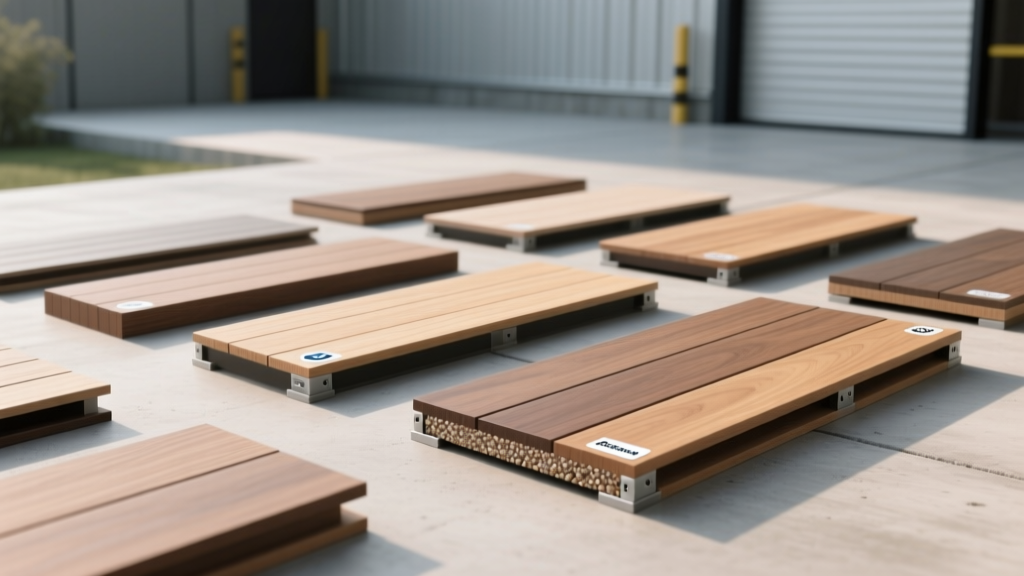
Selecting the right composite wood decking material requires moving beyond surface-level color swatches. Modern composite boards are engineered structural components made from a blend of recycled high-density polyethylene (HDPE) plastics and wood flour. According to the EPA's Sustainable Materials Management guidelines, utilizing recycled HDPE diverts millions of tons of plastic from landfills, but the exact ratio of plastic to wood fiber fundamentally dictates the board's structural integrity, moisture resistance, and thermal expansion rate.
This framework dissects the technical specifications you must evaluate to match a composite profile to your specific structural, climatic, and budgetary requirements.
Phase 1: Core Architecture Selection
The internal geometry of a composite board determines its weight, span capability, and fastener compatibility. Manufacturers engineer three primary core profiles, each with distinct structural trade-offs.
| Core Profile | Weight (per 16ft board) | Max Joist Span | Fastener Compatibility | Best Application |
|---|---|---|---|---|
| Solid Core | 65 - 75 lbs | 16" OC (Straight) | Top-drive, hidden, face-screw | High-traffic commercial, curved decks |
| Scalloped Core | 50 - 60 lbs | 16" OC (Straight) | Hidden clips, top-drive | Standard residential, budget-conscious |
| Hollow Core | 35 - 45 lbs | 12" OC (Straight) | Hidden clips only (no face screws) | Rooftop decks, weight-restricted structures |
Phase 2: Capping Technology & Moisture Defense
The 'cap' is a co-extruded polymer shell that shields the wood-flour core from UV degradation, staining, and moisture intrusion. The evolution of capping technology is the single biggest differentiator in composite wood decking material pricing and longevity.
3-Sided vs. 4-Sided Capping
- 3-Sided Cap (Top and Edges): The bottom of the board remains exposed composite. This allows the board to 'breathe' and release trapped moisture, which is advantageous in humid, ground-level installations. However, it leaves the bottom vulnerable to mold if installed over poorly ventilated joists.
- 4-Sided Cap (Full Wrap): The polymer shell completely encases the board. This provides maximum protection against water absorption and is mandatory for installations near saltwater, in constant ground contact, or in regions with heavy snow accumulation where snow sits on the deck surface and melts against the bottom edge.
Phase 3: Climate-Specific Selection Matrix
Composite materials react to environmental stressors differently than natural timber. Use this matrix to narrow your selection based on your primary climatic challenge.
High UV & Desert Climates
Intense solar radiation breaks down standard polymer caps, leading to chalking and fading. For desert environments (e.g., Arizona, Nevada), prioritize boards with advanced UV-inhibitor packages and lighter color palettes. Darker composite boards can reach surface temperatures exceeding 150°F in direct summer sun, making them barefoot-unfriendly. Look for proprietary cooling technologies, such as TimberTech's CoolDeck or Trex Transcend Lineage, which utilize specialized heat-mitigating pigments to reduce surface heat retention by up to 30%.
High Moisture & Freeze-Thaw Zones
In regions with heavy snow and frequent freeze-thaw cycles, moisture absorption is the enemy. When water enters the wood-flour core and freezes, it expands, causing micro-fractures in the polymer cap. Select a 4-sided capped board with a low water absorption rate (less than 1% by volume after 24 hours of submersion per ASTM D570 testing).
Wildland-Urban Interface (WUI) Zones
If your build is in a designated wildfire zone, standard composite decking may not meet local building codes. The NFPA's Wildfire division emphasizes the use of ignition-resistant materials in WUI zones. While natural heavy timber and specific PVC boards often pass Class A fire ratings, many standard wood-plastic composites only achieve Class C. Always verify the specific product line's ASTM E84 flame spread index before purchasing for a WUI build.
Phase 4: Thermal Expansion & Framing Requirements
Unlike pressure-treated pine, which expands primarily in width when wet, composite wood decking material expands and contracts primarily in length based on temperature fluctuations. Failing to account for thermal dynamics is the leading cause of buckling and fastener failure in composite decks.
The Temperature-Gap Formula
Most premium composites expand at a rate of approximately 1/16 inch per 10 linear feet for every 40°F change in temperature. Installation Rule: Calculate the gap between board ends based on the installation temperature relative to the maximum expected summer temperature.
- Installed at 40°F: Leave a 3/16" gap at end-joins.
- Installed at 70°F: Leave a 1/8" gap at end-joins.
- Installed at 90°F: Leave a 1/16" gap at end-joins.
Substructure Adjustments
Composite boards are denser and possess a lower modulus of elasticity than natural wood. According to structural guidelines detailed by Fine Homebuilding's decking experts, you must upgrade your framing to support the dead load and prevent sagging.
- Joist Spacing: Maximum 16 inches on-center (OC) for straight lays; strictly 12 inches OC for 45-degree diagonal patterns.
- Blocking: Install solid blocking between joists every 4 to 6 feet to prevent lateral twisting and provide structural rigidity to the heavier composite boards.
- Joist Tape: Apply butyl-based joist tape (e.g., Trex Protect) to the top of all framing members. Composite boards trap moisture against the joists, accelerating the rot of untreated wooden substructures.
Phase 5: Cost vs. Lifecycle ROI Analysis
When evaluating composite wood decking material, initial material costs only tell half the story. The true metric is the 25-year lifecycle cost, which factors in maintenance, sealing, and replacement.
| Material Tier | Material Cost (per sq. ft.) | 25-Year Maintenance Cost | Expected Lifespan |
|---|---|---|---|
| Pressure-Treated Pine | $2.50 - $3.50 | $12.00 - $18.00 (staining/sealing every 2 yrs) | 10 - 15 years |
| Uncapped Composite (Legacy) | $4.50 - $6.00 | $8.00 - $12.00 (mold removal, fading) | 15 - 20 years |
| Premium Capped Composite | $8.50 - $13.50 | $1.50 - $3.00 (occasional soap washing) | 25 - 50+ years |
While premium capped composite requires an initial premium of roughly 200% to 300% over pressure-treated lumber, the elimination of bi-annual sanding, staining, and sealing results in a break-even point typically occurring between year 7 and year 10. Furthermore, premium lines from manufacturers like Trex, TimberTech, and Fiberon now offer transferable 50-year fade and stain warranties, which actively increases the resale appraisal value of the property.
Final Selection Checklist
Before finalizing your material order, verify the following specifications against your project parameters:
- Does the core profile support your intended span and fastener system?
- Is the capping configuration (3-sided vs. 4-sided) matched to your ground clearance and local moisture levels?
- Have you adjusted your joist spacing to 12" OC for diagonal layouts or heavy solid-core boards?
- Does the product's fire rating comply with your local WUI mandates?
By systematically filtering composite wood decking materials through this technical framework, you eliminate aesthetic-driven purchasing errors and secure a structurally sound, climate-resilient exterior surface.
Written by
Marcus ChenMarcus Chen is a licensed structural engineer (PE) and building materials analyst with over 12 years of experience across residential, commercial, and industrial construction. He holds a Master of Science in Civil Engineering from UC Berkeley and spent six years at Thornton Tomasetti before transitioning to independent consulting and technical writing. Marcus specializes in material selection for seismic-prone regions, concrete reinforcement strategies, and lifecycle cost analysis. His work has been cited by the American Concrete Institute (ACI) and the Structural Engineers Association of California (SEAOC). When he is not on a job site or at his desk, you will find him hiking the Sierra Nevada or restoring a 1920s craftsman bungalow in Oakland, CA.
More from Marcus Chen
View all
Construction Cost
How Much Did the Eiffel Tower Cost to Build?
How much did the Eiffel Tower cost to build in 1889? We adjust for inflation and compare its budget to modern skyscraper construction.
Aug 4, 2026

Fire Resistance
What Is a Fire Resistant Material? Testing & Certification Guide
Discover what is a fire resistant material through ASTM and UL testing. Learn how fire ratings, certifications, and assemblies work in construction.
Aug 4, 2026

Construction Cost
How Much Did the Burj Khalifa Cost to Build?
How much did the Burj Khalifa cost to build? We break down the $1.5B project and extract 5 money-saving strategies for your next build.
Jul 30, 2026