Types of Expensive Wood: A Grade and Quality Guide for Luxury Builds
Specify premium timber with confidence. Explore types of expensive wood, NHLA grading standards, Janka ratings, and procurement strategies for luxury builds.

The Economics of Premium Timber: What Drives the Cost?
Specifying luxury timber requires moving beyond standard dimensional lumber metrics. When architects and high-end millwork shops evaluate different types of expensive wood, the price per board foot (BF) is dictated by a triad of factors: biological scarcity, geopolitical trade restrictions, and aesthetic figure. Unlike commodity woods like Southern Yellow Pine or Red Oak, premium exotics and rare domestics are often harvested from slow-growth, old-growth forests where a single mature tree can take centuries to reach harvestable girth.
Furthermore, the processing of these timbers adds to the baseline cost. Premium hardwoods require specialized kiln-drying schedules to prevent case-hardening and cellular collapse, often taking 60 to 90 days in the kiln compared to the 14 to 21 days required for standard domestic hardwoods. Understanding these underlying cost structures is essential for accurate budgeting and value engineering in luxury residential and commercial projects.
Top Types of Expensive Wood in High-End Construction
The following matrix outlines the most frequently specified premium species in luxury architectural millwork, high-end flooring, and bespoke furniture. Data reflects average market pricing for FAS (First and Seconds) grade lumber as of current market conditions.
| Species (Botanical) | Janka Hardness (lbf) | Avg. Cost (per BF) | Primary Visual Characteristic | Best Architectural Application |
|---|---|---|---|---|
| African Blackwood (Dalbergia melanoxylon) | 3,670 | $100 - $150+ | Deep, uniform black/brown | Turnery, instrument inlays, small luxury accents |
| Macassar Ebony (Diospyros celebica) | 3,220 | $60 - $90 | Dramatic black/brown striping | Feature wall veneers, luxury cabinetry, executive desks |
| Honduran Mahogany (Swietenia macrophylla) | 900 | $25 - $45 | Ribbon stripe, reddish-brown | Grand entry doors, marine interiors, heritage millwork |
| Bocote (Cordia spp.) | 2,000 | $30 - $50 | Zebrawood-like bold striping | Accent paneling, bespoke flooring borders |
| Pink Ivory (Berchemia zeyheri) | 3,100 | $150+ | Vivid pink to deep watermelon | Decorative inlays, luxury billiard cues, small turnery |
Deep Dive: Macassar Ebony and Honduran Mahogany
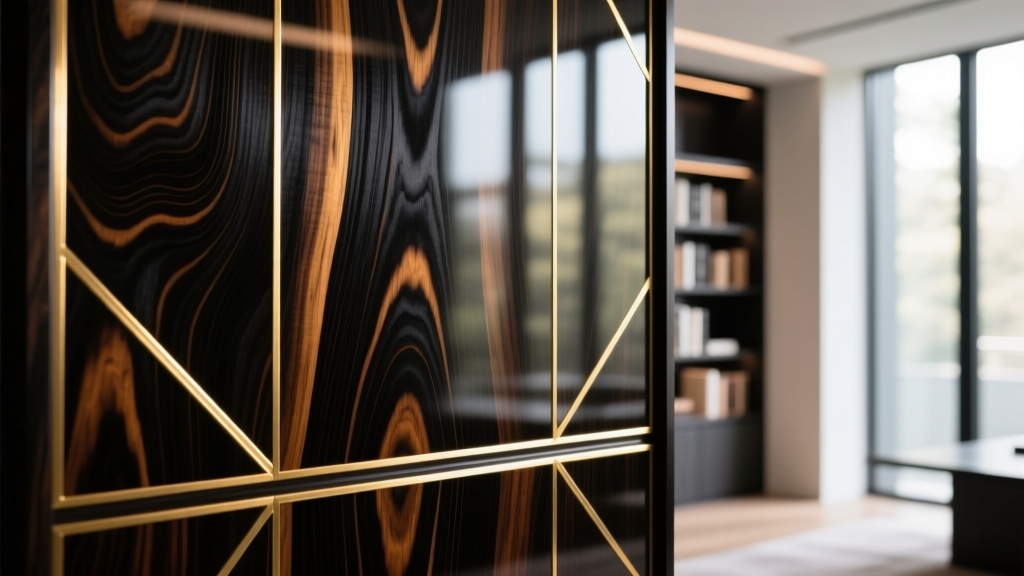
Macassar Ebony is the undisputed king of luxury veneer and paneling. Sourced primarily from Indonesia, its striking alternating dark and light bands create a high-contrast, three-dimensional effect when book-matched. However, its extreme density (Janka 3,220 lbf) requires carbide-tipped tooling and slow feed rates during milling to prevent tear-out and tool burn. According to The Wood Database, Macassar Ebony also contains high levels of natural silica, which accelerates blade dulling significantly.
Genuine Honduran Mahogany remains the benchmark for grand entry doors and traditional luxury millwork. Unlike African Mahogany (Khaya), Honduran Mahogany offers superior dimensional stability and a tighter, more uniform pore structure, making it ideal for deep, hand-rubbed spirit varnish finishes. When specifying this species, always demand FAS grade to ensure long, wide, clear cuttings necessary for seamless door stiles and rails.
Grading Standards for Luxury Hardwoods
Procuring expensive timber requires a rigorous understanding of grading rules. The USDA Forest Products Laboratory and the National Hardwood Lumber Association (NHLA) provide the baseline for domestic and many imported species, but exotic grading often operates outside these strict parameters.
NHLA FAS vs. Select Grade
- FAS (First and Seconds): The highest NHLA grade. Requires a minimum board size of 6 inches wide by 8 feet long. The board must yield at least 83.3% clear, defect-free cuttings. This is the mandatory grade for luxury millwork where long, uninterrupted runs of casing, baseboards, or stiles are required.
- Select Grade: Similar clear-cutting percentages to FAS, but allows for narrower boards (minimum 4 inches wide) and shorter lengths (minimum 6 feet). Suitable for smaller luxury components like drawer fronts or cabinet face frames.
The Exotic Grading Caveat
Many types of expensive wood, particularly those from Africa and South America, do not grow to the massive girths of domestic Oak or Maple. Consequently, finding an 8-foot long, 6-inch wide board of African Blackwood is botanically near-impossible. Exotic suppliers often grade these woods by 'clearness' and 'figure' rather than strict NHLA dimensional rules. When purchasing exotics, specify 'Clear, Kiln-Dried, S2S (Surfaced Two Sides)' and request photographic verification of the exact bundle before shipment.
Specifying Moisture Content and Acclimatization
The most common failure mode in luxury wood installations is improper moisture management. Expensive woods are highly reactive to ambient relative humidity (RH). If a $90/BF Macassar Ebony panel is installed at 12% moisture content (MC) into a climate-controlled penthouse maintained at 35% RH, the wood will rapidly lose moisture, leading to catastrophic checking, joint separation, and finish failure.
- Specify Target MC: For interior, climate-controlled environments (HVAC maintained at 68-72°F and 35-45% RH), specify a kiln-dried MC of 6% to 8%.
- On-Site Acclimatization: Once delivered to the job site, the lumber must be stickered (spaced with 3/4-inch wooden strips) in the exact room of installation for a minimum of 7 to 14 days before milling or installation.
- Moisture Meter Verification: Use a pinless, dual-depth moisture meter to verify the MC of every third board. The differential between the wood's MC and the subfloor's MC must not exceed 2% for solid strip flooring, or 4% for wide-plank flooring.
Legal Compliance and Ethical Sourcing
When specifying rare and expensive timber, legal compliance is just as critical as aesthetic quality. The U.S. Lacey Act and the European Union Timber Regulation (EUTR) strictly prohibit the importation and trade of illegally harvested wood. Violations carry severe federal penalties, including massive fines and confiscation of materials, even if the architect or builder was unaware of the supply chain violation.
To mitigate this risk, always require Forest Stewardship Council (FSC) Chain of Custody (CoC) certification from your supplier. FSC certification ensures that the timber was harvested legally, traceable from the forest to the final mill, and that indigenous land rights were respected. For CITES-listed species like Honduran Mahogany or Bubinga, the supplier must provide valid CITES export permits and corresponding import documentation. Always request these documents during the bidding phase, not after the material has been delivered to the site.
Summary Checklist for the Lead Specifier
Before finalizing the millwork package for a luxury build, ensure your specifications explicitly address the following parameters to protect the client's investment and the integrity of the design:
- Botanical Name: Specify the exact Latin name to avoid bait-and-switch substitutions (e.g., specifying Swietenia macrophylla to prevent receiving Khaya ivorensis).
- NHLA Grade: Mandate FAS grade for all primary visual surfaces.
- Moisture Content: Contractually bind the supplier to deliver lumber at 6-8% MC.
- Chain of Custody: Require FSC CoC documentation and CITES permits for restricted species.
- Milling Tolerances: Specify S4S (Surfaced Four Sides) with a tolerance of +/- 1/64th of an inch for critical joinery applications.
Written by
Elena RodriguezElena Rodriguez is a civil engineer and technical writer specializing in concrete technology, masonry systems, and ASTM/ACI compliance. She earned her B.S. in Civil Engineering from Texas A&M University and spent a decade at a materials testing laboratory, performing over 2,000 concrete compressive strength tests and masonry prism evaluations. Elena is an ACI-certified Field Testing Technician (Grade I) and a member of ASTM Committee C12 on Natural Building Stone. She currently consults on forensic engineering cases involving concrete failures and moisture intrusion. Based in San Antonio, TX, Elena is a proud member of the Society of Women Engineers (SWE) and coaches her daughter's FIRST Robotics team.
More from Elena Rodriguez
View all
Walls & Panels
Cost Analysis: Light Gauge Steel Framing Advantages and Disadvantages
Evaluate light gauge steel framing advantages and disadvantages through a strict cost analysis lens, comparing material, labor, and lifecycle expenses.
Aug 4, 2026

Walls & Panels
Gypsum Board Types: Exact Specifications, Thickness & Dimensions
Compare standard, Type X, and moisture-resistant gypsum board types. Get exact specifications, thicknesses, dimensions, and ASTM standards for your project.
Aug 4, 2026

Fire Resistance
Best Fire-Resistant Outdoor Decking Materials: 2026 Buyer Guide
Discover the best fire-resistant outdoor decking materials for 2026. Compare Class A PVC, aluminum, and hardwood options for WUI compliance and safety.
Aug 4, 2026