2026 Cost Analysis: Complete List of Types of Wood for Building
Analyze the 2026 costs and structural value across our complete list of types of wood for framing, siding, and flooring to maximize your ROI.

The True Cost of Lumber: Beyond the Sticker Price
Procuring lumber for construction requires looking past the initial price per board foot (BF) or linear foot (LF). The true cost of any timber encompasses material waste, fastener withdrawal resistance, moisture-related shrinkage, and long-term maintenance. A cheaper wood species with a high shrinkage coefficient or low nail-holding capacity will inevitably inflate labor and callback costs. This 2026 cost and value analysis breaks down a comprehensive list of types of wood used in modern construction, evaluating each against structural performance, lifecycle durability, and current market pricing to help contractors and developers maximize their return on investment.
Comprehensive List of Types of Wood and 2026 Pricing Matrix
The following matrix outlines current wholesale and distributor pricing averages for early 2026. Costs fluctuate based on regional availability, transportation tariffs, and mill capacity, but these baselines provide a reliable framework for estimating material budgets.
| Wood Species / Type | Grade / Specification | Avg Cost (2026) | Janka Hardness (lbf) | Primary Structural Value |
|---|---|---|---|---|
| SPF (Spruce-Pine-Fir) | #2 & Btr (Dimensional) | $0.75 - $0.90 / BF | 480 - 540 | Standard light-frame wall studs |
| Southern Yellow Pine (SYP) | #2 Dense (Dimensional) | $0.95 - $1.15 / BF | 690 - 870 | High-load floor joists, trusses |
| Douglas Fir-Larch | Select Structural | $1.40 - $1.80 / BF | 660 - 720 | Heavy beams, high-bending rafters |
| Western Red Cedar | Select Tight Knot (STK) | $4.50 - $6.00 / BF | 350 | Exterior siding, decking, trim |
| White Oak | FAS (Firsts and Seconds) | $7.50 - $9.50 / BF | 1360 | Premium flooring, architectural millwork |
| Ipe (Brazilian Walnut) | Select & Better | $13.00 - $16.00 / BF | 3684 | Heavy-duty exterior decking, boardwalks |
| LVL (Laminated Veneer Lumber) | 1.75' x 11.875' (Beam) | $4.20 - $5.10 / LF | N/A (Engineered) | Long-span headers, rim boards, ridge beams |
Structural Framing: SPF, SYP, and Douglas Fir Value Breakdown
When evaluating dimensional lumber for structural framing, the critical metrics are specific gravity (which dictates fastener withdrawal resistance) and the modulus of elasticity (E), which measures stiffness under load.
The Case for Southern Yellow Pine (SYP) in High-Load Applications
While SPF is the default for standard 2x4 and 2x6 wall studs due to its lower cost and lighter weight, SYP offers superior structural value for floor joists and roof trusses. SYP has a specific gravity of 0.55, compared to SPF's 0.42. According to data compiled by the USDA Forest Products Laboratory, this density translates to approximately 55% higher nail and screw withdrawal resistance. In high-wind or seismic zones, this inherent holding power reduces the necessity for additional structural metal connectors, offsetting the $0.20 per board foot premium over SPF.
Douglas Fir: The Bending Strength Champion
For applications requiring high bending strength (Fb), such as long-span rafters or exposed structural beams, Douglas Fir-Larch is the optimal choice. A Select Structural grade Douglas Fir boasts an Fb value of 1,500 psi, significantly outperforming SPF's 1,150 psi. Paying the $1.60/BF premium allows engineers to space joists further apart or reduce the nominal depth of the beam, saving both material volume and ceiling height.
Exterior Applications: Calculating the ROI of Decay Resistance
Exterior wood is subjected to UV degradation, moisture intrusion, and fungal decay. The initial savings of using pressure-treated lumber are often erased by a 10-year maintenance cycle.
Western Red Cedar vs. Pressure-Treated SYP
Western Red Cedar contains natural thujaplicins, which act as potent fungicides and insect repellents. While clear-grade cedar siding costs upwards of $5.00/BF compared to $1.30/BF for MCA (Micronized Copper Azole) pressure-treated SYP, cedar requires minimal chemical maintenance. Over a 25-year lifecycle, the labor and material costs of re-staining and repairing pressure-treated wood typically eclipse the initial capital savings. For high-end residential builds, cedar's dimensional stability (low radial and tangential shrinkage) ensures tight, warp-free siding joints that synthetic alternatives struggle to mimic.
The Rise of Acetylated Wood (Accoya)
For developers seeking the lifespan of tropical hardwoods without the environmental or cost penalties, acetylated wood (sold under brands like Accoya) has gained massive traction. Through a non-toxic acetic anhydride treatment, the wood's cell walls are modified to resist water absorption. The resulting material achieves a Class 1 durability rating (50+ years above ground) and swells up to 75% less than untreated timber. At roughly $8.00 to $10.00/BF, it bridges the gap between standard cedar and premium Ipe.
Hardwood Flooring & Millwork: Lifecycle Cost vs. Initial Investment
When specifying hardwood for interior applications, Janka hardness is the primary indicator of dent resistance and long-term aesthetic retention. The National Wood Flooring Association recommends specific Janka thresholds based on expected foot traffic.
- White Oak (1,360 lbf): The industry standard for residential and light-commercial flooring. At $8.50/BF for FAS grade, it offers an excellent balance of workability, finish adhesion, and dent resistance. Its closed cellular structure (tyloses) also makes it highly resistant to moisture penetration compared to red oak.
- Hickory (1,820 lbf): Ideal for high-traffic residential areas. Priced similarly to White Oak ($7.50 - $9.00/BF), its extreme density makes it difficult to mill and sand, slightly increasing installation labor costs.
- Ipe (3,684 lbf): While technically an exterior decking wood, Ipe is sometimes used for heavy-duty commercial interior flooring. At $14.00+/BF, the material cost is steep, and it requires specialized carbide tooling and pre-drilling for every fastener, increasing installation labor by 40-60%.
Engineered Wood Products (EWP): The Predictability Premium
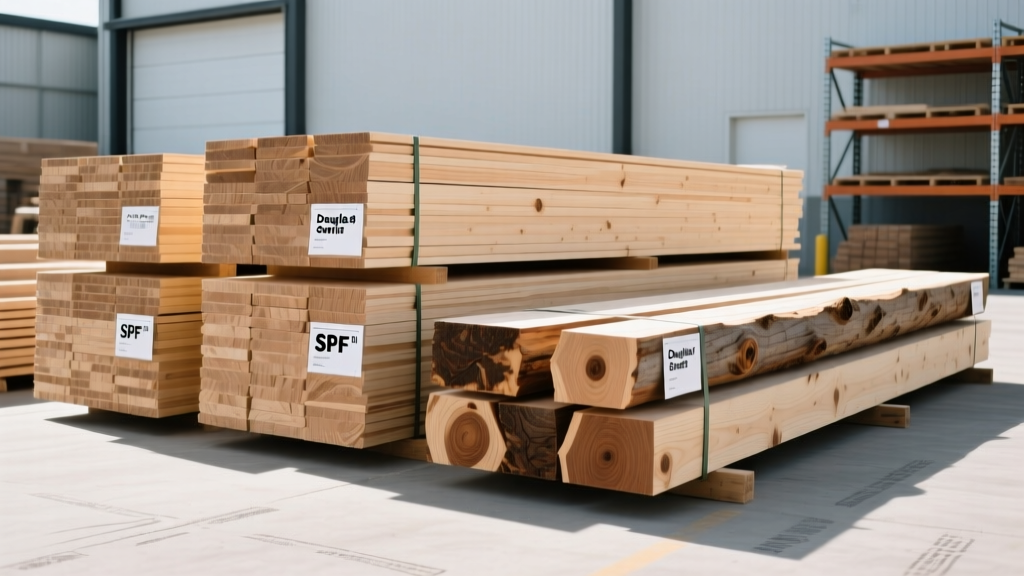
Engineered wood products have fundamentally altered structural framing by eliminating the natural defects (knots, splits, slope of grain) inherent in solid sawn lumber. According to the APA - The Engineered Wood Association, EWPs provide uniform strength and predictable deflection limits.
LVL (Laminated Veneer Lumber) vs. Built-Up Dimensional Beams
Historically, builders created structural headers and beams by nailing together multiple 2x10 or 2x12 dimensional boards. Today, a 1.75' x 11.875' LVL beam costs approximately $4.50 per linear foot. A built-up beam of three #2 Douglas Fir 2x12s costs roughly $6.00 per linear foot. Beyond the 25% material savings, LVL eliminates the labor of drilling bolt holes, applying construction adhesive, and clamping the plies together. Furthermore, LVL will not twist, crown, or split under load, ensuring doors and windows installed beneath the header do not bind over time.
Glulam (Glued Laminated Timber) for Architectural Exposed Structures
For exposed architectural beams where aesthetic appeal must match structural capacity, Glulam is the undisputed value leader. Manufactured by bonding stress-rated lumber laminations, Glulam can be produced in massive cross-sections and long lengths (up to 100 feet) that solid timber cannot match. An architectural-grade Douglas Fir Glulam beam costs between $9.00 and $14.00/LF depending on the cross-section. While more expensive than hidden steel I-beams, Glulam eliminates the need for fireproofing intumescent paint and drywall encapsulation, offering a net savings in commercial and high-end residential projects.
Strategic Procurement: Mitigating Volatility in 2026
Lumber markets remain sensitive to mill closures, environmental regulations, and transportation bottlenecks. To protect project margins when purchasing from this list of types of wood, implement the following procurement strategies:
- Lock in EWP Early: Engineered wood products (LVL, I-Joists, Glulam) have longer manufacturing lead times than dimensional lumber. Secure quotes and place orders for EWPs at least 8 to 12 weeks before the framing phase begins.
- Specify 'Dense' Grades for SYP: When ordering Southern Yellow Pine, specify '#2 Dense'. The 'Dense' designation requires a minimum of six growth rings per inch and a specific gravity of 0.55, guaranteeing the higher withdrawal values needed for critical structural connections.
- Factor in the 'Waste Factor' by Species: When ordering FAS White Oak for custom millwork, factor in a 20-25% waste allowance for cutting around defects and matching grain patterns. Conversely, engineered sheet goods and LVL carry a waste factor of less than 5%.
Understanding the mechanical properties, lifecycle maintenance, and true installed cost of each wood species allows builders to transition from reactive purchasing to strategic material engineering. By selecting the right timber for the specific structural or aesthetic demand, projects achieve superior durability and tighter budget control.
Written by
David NakamuraDavid Nakamura is a licensed architect (AIA) and construction technology writer focused on sustainable building methods, mass timber engineering, and high-performance building envelopes. He holds a Master of Architecture from the University of Washington and is a certified Passive House Consultant (CPHC). David spent eight years at the Seattle firm Mithun, where he led the design of three LEED Platinum projects, before founding his own practice specializing in net-zero residential design. He serves on the editorial advisory board of GreenBuilder Magazine and has authored peer-reviewed papers on cross-laminated timber (CLT) connections for the Journal of Structural Engineering. In his spare time, David teaches woodworking at Pratt Fine Arts Center and kayaks the Puget Sound.
More from David Nakamura
View all
Construction Cost
Labor Cost to Build a Deck Per Sq Ft: 2026 Installation Guide
Discover the exact labor cost to build a deck per sq ft in 2026. This installation guide breaks down contractor rates, complexity factors, and hidden fees.
Aug 4, 2026

Construction Cost
How Much Does It Cost to Build a 3 Bedroom House? Financing Guide
Learn exactly how much it costs to build a 3 bedroom house and explore 2026 financing options, construction loan types, and budget frameworks for your build.
Aug 4, 2026

Construction Cost
Cost to Build a Tennis Court: 2026 Guide
How much does it cost to build a tennis court in 2026? Breakdowns for asphalt, concrete, and synthetic surfaces plus fencing and lighting.
Jul 30, 2026