Identifying Types of Trees in the Woods for Structural Timber
Learn how to identify and evaluate types of trees in the woods for structural timber, focusing on MOE, defect assessment, and milling yields for framing.
The Structural Hierarchy of Forest Species
Sourcing structural timber directly from a forest stand requires translating botanical identification into engineering metrics. When evaluating types of trees in the woods for load-bearing applications, visual species identification is only the first step. Assessing the modulus of elasticity (MOE), fiber stress in bending (Fb), and standing defect patterns dictates whether a tree will yield #1 Structural grade lumber or merely pallet stock. For custom home builders, timber framers, and architects specifying local materials, understanding the mechanical properties of standing timber is critical for structural safety and code compliance.
In structural engineering, forest species are broadly categorized by their cellular structure and growth patterns. Softwoods (gymnosperms) generally possess a higher strength-to-weight ratio and more predictable grain orientation, making them the industry standard for dimensional framing, roof trusses, and floor joists. Hardwoods (angiosperms), while often denser, exhibit complex grain patterns and higher shrinkage rates, restricting their structural use primarily to heavy timber framing, sill plates, and high-shear connectors.
Softwoods vs. Hardwoods in Load-Bearing Roles
The dominance of softwoods in modern structural applications is driven by their tracheid cell structure, which provides excellent longitudinal tensile strength. According to the USDA Forest Products Laboratory, species like Douglas Fir and Southern Yellow Pine offer an optimal balance of high bending strength and workability. Conversely, hardwoods like White Oak and Hickory possess vessel elements and complex ray structures that provide immense compressive and shear strength, but they are prone to severe checking and warping if not quarter-sawn or properly air-dried before installation.
Field Identification: Key Types of Trees in the Woods for Framing
Identifying the right types of trees in the woods requires looking past the foliage and examining the bark, branch attachments, and bole (trunk) geometry. For structural timber, you are specifically hunting for straight-grained, slow-growth trees with minimal taper. Below is a breakdown of the premier structural species and their mechanical benchmarks.
| Species (Common / Botanical) | Modulus of Elasticity (MOE) | Bending Strength (Fb) | Optimal Structural Application |
|---|---|---|---|
| Douglas Fir (Pseudotsuga menziesii) | 1.95 x 10^6 psi | 1,500 psi | Primary beams, ridge boards, long-span joists |
| Longleaf Pine (Pinus palustris) | 1.98 x 10^6 psi | 1,450 psi | Heavy timber posts, foundation sills, marine piling |
| White Oak (Quercus alba) | 1.78 x 10^6 psi | 1,520 psi | Timber frame joinery, pegs, high-load sill plates |
| Sitka Spruce (Picea sitchensis) | 1.64 x 10^6 psi | 1,150 psi | Lightweight trusses, aircraft-grade spars, rafters |
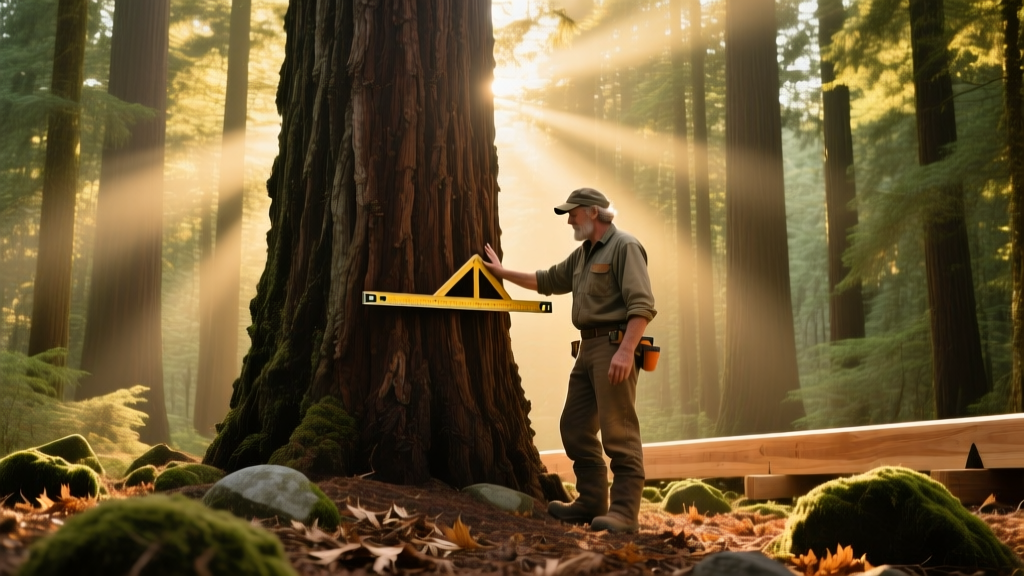
Field Tip: When identifying Douglas Fir in the wild, look for deeply furrowed, dark brown bark with distinctive horizontal resin blisters on younger trees. The branch scars should be small and flush with the trunk, indicating a slow-growth, high-density wood structure ideal for structural beams.
Assessing Standing Timber for Structural Defects
A tree species with high theoretical strength can be rendered structurally useless by internal defects. Before felling, conduct a rigorous visual assessment of the standing timber to predict the internal grain quality.
- Slope of Grain (Spiral Grain): Track the bark fissures from the base to the crown. If the fissures spiral around the trunk rather than running vertically, the internal wood fibers will follow that spiral. A slope of grain steeper than 1:16 drastically reduces the tensile strength of the resulting lumber, making it unsuitable for bottom-chord truss members or tension beams.
- Knot Frequency and Size: Examine the branch whorls. In structural grading, knots are treated as voids that interrupt the continuous grain. Trees with tight, intergrown knots (where the branch base is fused with the trunk wood) are preferable to trees with loose, encased knots, which will fall out during milling and create critical shear planes.
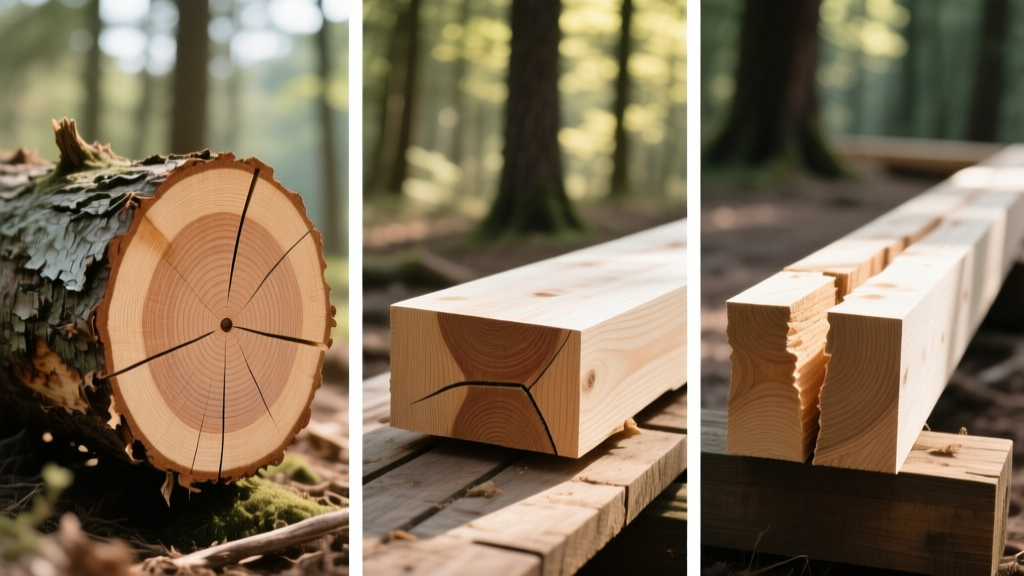
- Heart Shake and Star Shake: Look for radial cracks originating from the pith (center) of the tree, often visible at the stump of nearby fallen trees of the same species. Heart shake indicates internal stress release or frost damage. If you are milling 8x8 or 10x10 box beams, a shaken core will compromise the structural integrity of the entire timber.
Never mill leaning trees for structural framing. Conifers develop 'compression wood' on the lower side of a lean, characterized by high lignin content, abnormal shrinkage, and severe longitudinal warping. Hardwoods develop 'tension wood' on the upper side, which causes severe splintering and machine-tearout during milling. Both forms of reaction wood violate the grading rules set by the WoodWorks structural design standards and will fail under sustained load.
Milling, Moisture, and Grading Realities
Harvesting types of trees in the woods is only half the battle; processing the logs into code-compliant structural lumber requires strict adherence to moisture management and grading protocols. Green timber (moisture content above 30%) will undergo significant dimensional changes as it equilibrates to the ambient environment.
Managing Shrinkage in Heavy Timbers
Wood shrinks anisotropically. Tangential shrinkage (parallel to the growth rings) is typically twice as great as radial shrinkage (perpendicular to the rings). For a 12x12 inch White Oak timber milled at 45% moisture content and dried to 15%, you can expect up to a 3/8-inch reduction in width. Structural engineers must account for this differential shrinkage in timber frame joinery, utilizing slotted holes for steel tie-rods and allowing for vertical settlement in multi-story post-and-beam structures.
Visual Stress Grading (VSG) of green timber requires the grader to anticipate where checks (surface splits) will develop. According to the National Grading Rule for Heavy Timbers, checks that do not cross the neutral axis of the beam do not significantly impair bending strength. However, if a check propagates through the shear plane near the supports, the timber must be downgraded or reinforced with steel flitch plates.
Yield Calculation and Milling Economics
Is it economically viable to harvest and mill your own structural timber? The answer depends heavily on the log scaling rule used to estimate board-foot yield and the specific dimensions required for your structural design.
| Log Scaling Rule | Best Used For | Estimated Structural Yield (8x8 Timbers) |
|---|---|---|
| International 1/4-Inch Rule | Most accurate for modern sawmills; accounts for kerf and shrinkage. | 65% - 75% of gross scale |
| Doyle Rule | Historically used for large hardwood logs; heavily underestimates small logs. | 40% - 50% (for logs under 20" DBH) |
| Scribner Rule | Common in Western US softwoods; based on 1-inch thick boards. | 55% - 65% of gross scale |
To yield a single 16-foot long, 8x8 structural beam (85.3 board feet), you need a log with a minimum Diameter at Breast Height (DBH) of 14 inches, assuming a straight, defect-free bole. Custom portable sawmilling services typically charge between $0.35 to $0.60 per board foot for rough-sawn timber. When factoring in felling, skidding, and air-drying sticker costs, wild-harvested structural timber generally costs 20% to 30% less than purchasing graded, kiln-dried #1 Structural lumber from a commercial yard, provided you have the space and time for a 12-to-18-month air-drying cycle.
Frequently Asked Questions
Can I use standing dead timber for structural framing?
Standing dead timber can be used structurally only if it has been dead for less than two years and shows no signs of fungal decay (such as punky wood or fruiting bodies). Dead trees lose their natural moisture rapidly, leading to severe ring shake (separation of growth rings). Always core-sample a standing dead tree with an increment borer before felling it for structural use.
How do I get wild-harvested lumber certified for building codes?
Building inspectors require structural lumber to bear a grade stamp from an agency certified by the American Lumber Standard Committee (ALSC). If you mill your own types of trees in the woods, you must hire a certified independent grader to inspect and stamp the timbers on-site, or you must provide engineering calculations and stress-test data signed by a licensed structural engineer to prove the material meets the required Fb and MOE values for your specific application.
Written by
David NakamuraDavid Nakamura is a licensed architect (AIA) and construction technology writer focused on sustainable building methods, mass timber engineering, and high-performance building envelopes. He holds a Master of Architecture from the University of Washington and is a certified Passive House Consultant (CPHC). David spent eight years at the Seattle firm Mithun, where he led the design of three LEED Platinum projects, before founding his own practice specializing in net-zero residential design. He serves on the editorial advisory board of GreenBuilder Magazine and has authored peer-reviewed papers on cross-laminated timber (CLT) connections for the Journal of Structural Engineering. In his spare time, David teaches woodworking at Pratt Fine Arts Center and kayaks the Puget Sound.
More from David Nakamura
View all
Construction Cost
Labor Cost to Build a Deck Per Sq Ft: 2026 Installation Guide
Discover the exact labor cost to build a deck per sq ft in 2026. This installation guide breaks down contractor rates, complexity factors, and hidden fees.
Aug 4, 2026

Construction Cost
How Much Does It Cost to Build a 3 Bedroom House? Financing Guide
Learn exactly how much it costs to build a 3 bedroom house and explore 2026 financing options, construction loan types, and budget frameworks for your build.
Aug 4, 2026

Construction Cost
Cost to Build a Tennis Court: 2026 Guide
How much does it cost to build a tennis court in 2026? Breakdowns for asphalt, concrete, and synthetic surfaces plus fencing and lighting.
Jul 30, 2026