Cost to Build Wood Deck: 2026 Material Comparison Guide
Compare the 2026 cost to build a wood deck across pressure-treated pine, cedar, redwood, and tropical hardwoods with exact pricing and lifespan data.

The True Cost to Build a Wood Deck in 2026
Calculating the exact cost to build a wood deck requires looking beyond the initial price tag per board. In 2026, lumber markets have stabilized following the extreme volatility of the early 2020s, but labor rates and specialized substructure requirements continue to drive total project costs upward. The national average to build a 300-square-foot wood deck ranges from $7,500 for basic pressure-treated pine to over $22,500 for premium tropical hardwoods, fully installed.
This comparison review breaks down the material costs, structural requirements, maintenance liabilities, and hidden expenses of the four primary wood decking categories. By analyzing Janka hardness ratings, decay resistance, and fastener compatibility, you can accurately forecast the 20-year lifecycle cost of your deck rather than just the day-one construction invoice.
Quick 2026 Cost Snapshot (Per Square Foot)
- Pressure-Treated Pine: $4.50 – $7.00 (Materials) | $25 – $35 (Installed)
- Western Red Cedar: $7.50 – $11.00 (Materials) | $35 – $48 (Installed)
- California Redwood: $9.00 – $14.50 (Materials) | $40 – $55 (Installed)
- Tropical Hardwoods (Ipe/Cumaru): $14.00 – $23.00 (Materials) | $55 – $80 (Installed)
Wood Decking Material Comparison Matrix
The table below contrasts the physical properties and financial requirements of the most common decking species. Janka hardness measures dent and wear resistance, a critical metric for high-traffic areas and homes with large pets.
| Wood Species | Material Cost / Sq Ft | Expected Lifespan | Janka Hardness (lbf) | Maintenance Cycle |
|---|---|---|---|---|
| Pressure-Treated Southern Yellow Pine | $4.50 - $7.00 | 15 - 20 Years | 870 | Annual Sealing |
| Western Red Cedar | $7.50 - $11.00 | 20 - 25 Years | 350 | Bi-Annual Staining |
| California Redwood | $9.00 - $14.50 | 25 - 30 Years | 420 | Bi-Annual Staining |
| Ipe (Brazilian Walnut) | $16.00 - $23.00 | 40 - 75 Years | 3,680 | Optional UV Oil |
Deep Dive: Species Performance and Installation Nuances
Pressure-Treated Southern Yellow Pine (The Budget Standard)
Pressure-treated (PT) pine accounts for roughly 65% of all wood decks built in North America. The cost to build a wood deck with PT lumber remains the lowest because the wood itself is inexpensive and highly workable with standard carpentry tools. Modern PT lumber is preserved using Micronized Copper Azole (MCA) or Copper Azole Type C (CA-C). When purchasing, you must verify the AWPA Use Category stamped on the end tag: use UC4A for above-ground decking and joists, but strictly require UC4B (Ground Contact) for structural posts embedded in concrete or soil.
- Pros: Lowest upfront cost; readily available at all big-box retailers; accepts stains and paints easily once fully dried (usually 3-6 months post-installation).
- Cons: High shrinkage and warping rates as it dries; prone to splitting and checking; requires hot-dipped galvanized or stainless steel fasteners to prevent chemical corrosion from the copper preservatives.
- Pro Tip: PT lumber is sold wet. If you build a deck with fresh PT boards and butt them tightly together, they will shrink by up to 3/16 of an inch as they dry, leaving massive gaps. Install them tight, or use a 16-penny nail as a spacer if the wood has been drying in a lumberyard for several months.
Western Red Cedar & California Redwood (The Premium Softwoods)
Cedar and redwood offer natural decay resistance due to their high extractive and tannin content, eliminating the need for chemical pressure treatment. The Western Red Cedar Lumber Association (WRCLA) grades cedar from "Clear Heart" (knot-free, premium) down to "Construction Heart" (tight knots allowed). For decking, "Select Tight Knot" (STK) provides the best balance of rustic aesthetics and structural integrity without the exorbitant price of Clear grades.
The primary failure mode for these species is tannin bleeding and water spotting. To prevent extractive bleed-through that ruins surface finishes, all six sides of cedar and redwood boards must be sealed with an alkyd-based primer or specialized tannin-blocking stain before installation. Furthermore, because cedar is exceptionally soft (350 lbf Janka), it will dent from dropped tools or heavy patio furniture. Use wide-head, ring-shank stainless steel nails or coated deck screws to prevent the fastener heads from pulling through the soft face grain.
Tropical Hardwoods: Ipe, Cumaru, and Tigerwood (The Luxury Tier)
If you are calculating the cost to build a wood deck that will outlive the house itself, tropical hardwoods are the only answer. Ipe (Tabebuia spp.) boasts a Janka hardness of 3,680 lbf—making it denser than concrete and virtually impervious to rot, termites, and surface scratching. However, this density introduces severe installation complexities.
- Pre-Drilling is Mandatory: You cannot drive a screw directly into Ipe without snapping the fastener or stripping the head. Every screw hole must be pre-drilled and countersunk using carbide-tipped bits.
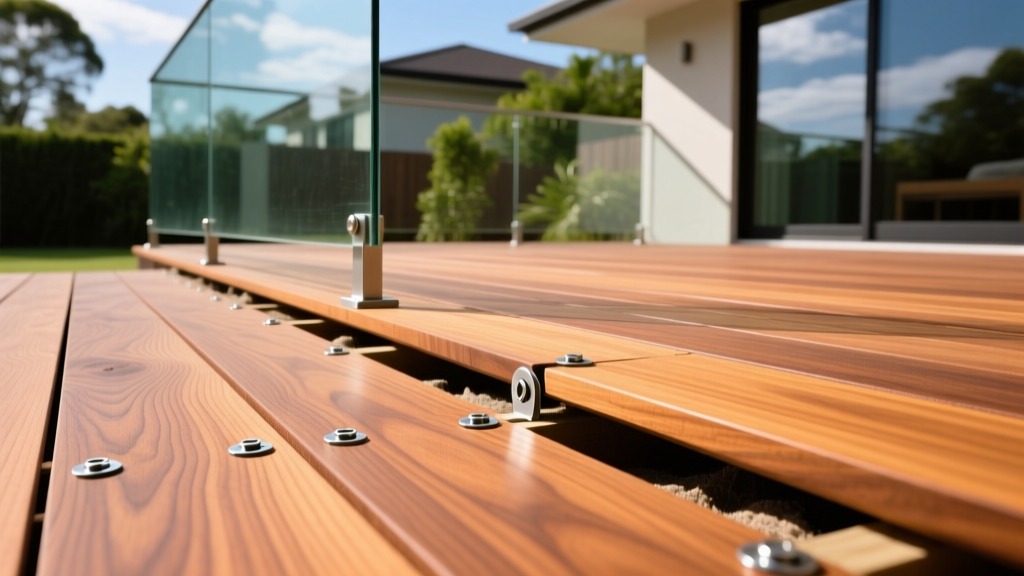
- Hidden Fastener Systems: Because face-screwing requires plugging hundreds of holes with matching wood dowels and glue, most professionals use hidden fasteners. Boards are pre-grooved on a biscuit jointer, and systems like Camo or Eb-Ty lock the boards to the joists from the sides.
- Sustainability Verification: Always demand FSC (Forest Stewardship Council) certification for tropical hardwoods to ensure the timber was not illegally logged from endangered rainforests. Non-FSC Ipe is frequently rejected by municipal building inspectors in strict eco-zones like California and the Pacific Northwest.
If your deck is located within 3,000 feet of a saltwater coastline, standard 304-grade stainless steel fasteners will pit and corrode. You must specify 316-grade marine stainless steel for all structural connectors, joist hangers, and face screws, adding roughly $1.50 to $2.50 per square foot to your hardware budget.
Hidden Costs That Inflate Your Deck Budget
Homeowners often calculate the cost to build a wood deck by multiplying the square footage by the board price. This ignores the substructure and site-prep variables that routinely cause 20% to 30% budget overruns.
| Hidden Cost Factor | Estimated Impact | Mitigation Strategy |
|---|---|---|
| Joist Protection Tape | $0.75 - $1.25 / linear ft | Apply butyl-rubber tape (e.g., Trex Protect or G-Tape) to the top of all joists before laying decking. This prevents water intrusion and doubles the substructure lifespan. |
| Helical Piles vs. Concrete | $250 - $400 per footing | In frost-heave regions or difficult soil, steel helical piles eliminate the need to dig 48-inch sonotubes and pour concrete, saving massive labor hours. |
| Stair Stringer Engineering | $400 - $800 total | Custom closed-stringer stairs with solid risers cost 3x more than standard notched open stringers but are required by many modern codes for safety and longevity. |
Decision Framework: Which Wood Should You Choose?
Use this logic flow to determine the most cost-effective material for your specific scenario:
- If your budget is under $30 per square foot (installed) AND you do not mind annual weekend maintenance: Choose Pressure-Treated Southern Yellow Pine. Plan to apply a penetrating oil-based sealer every 12-18 months to prevent cupping and UV graying.
- If you want a natural, chemical-free aesthetic AND live in a dry, low-humidity climate: Choose Western Red Cedar (Select Tight Knot). The dry climate minimizes the softwood's natural tendency to absorb moisture and warp.
- If you are building near saltwater, over a water feature, OR refuse to perform annual maintenance: Choose Ipe or Cumaru. The high upfront material and labor costs are entirely offset by the elimination of sealing, staining, and board replacement over a 50-year horizon.
Frequently Asked Questions
Does removing an old deck increase the cost to build a new wood deck?
Yes. Demolition and hauling away an existing 300-square-foot deck typically adds $800 to $1,500 to the total project cost in 2026. If the old substructure (joists and beams) is less than 10 years old and built to current local load codes, a contractor may be able to reuse the framing and only replace the surface decking, saving roughly 30% on structural labor and materials.
Why do contractors quote such different prices for the exact same Ipe deck?
Pricing discrepancies in tropical hardwoods usually stem from fastener and finishing methodologies. A lower bid likely assumes face-screwing with standard stainless steel screws and leaving the wood to weather gray naturally. A premium bid will include pre-grooving the boards, installing a hidden fastener system, applying end-grain sealant (like Anchorseal) to every cut to prevent checking, and finishing the surface with a UV-inhibiting tung oil.
Is it cheaper to build a wood deck or a composite deck in 2026?
Wood is almost always cheaper upfront. A mid-tier composite deck (like Trex Select or TimberTech Prime) costs between $45 and $65 per square foot installed, placing it firmly between the cost of Cedar and Ipe. However, when calculating the 20-year lifecycle cost—including the labor and materials for sanding, staining, and sealing a wood deck every two years—composite decking frequently breaks even with premium softwoods like Cedar and Redwood.
Written by
David NakamuraDavid Nakamura is a licensed architect (AIA) and construction technology writer focused on sustainable building methods, mass timber engineering, and high-performance building envelopes. He holds a Master of Architecture from the University of Washington and is a certified Passive House Consultant (CPHC). David spent eight years at the Seattle firm Mithun, where he led the design of three LEED Platinum projects, before founding his own practice specializing in net-zero residential design. He serves on the editorial advisory board of GreenBuilder Magazine and has authored peer-reviewed papers on cross-laminated timber (CLT) connections for the Journal of Structural Engineering. In his spare time, David teaches woodworking at Pratt Fine Arts Center and kayaks the Puget Sound.
More from David Nakamura
View all
Construction Cost
Labor Cost to Build a Deck Per Sq Ft: 2026 Installation Guide
Discover the exact labor cost to build a deck per sq ft in 2026. This installation guide breaks down contractor rates, complexity factors, and hidden fees.
Aug 4, 2026

Construction Cost
How Much Does It Cost to Build a 3 Bedroom House? Financing Guide
Learn exactly how much it costs to build a 3 bedroom house and explore 2026 financing options, construction loan types, and budget frameworks for your build.
Aug 4, 2026

Construction Cost
Cost to Build a Tennis Court: 2026 Guide
How much does it cost to build a tennis court in 2026? Breakdowns for asphalt, concrete, and synthetic surfaces plus fencing and lighting.
Jul 30, 2026