Wood Like Flooring Options: A Buyer's Selection Framework
Evaluate wood like flooring options with our 2026 selection framework. Compare SPC, WPC, laminate, and tile specs, costs, and failure modes.
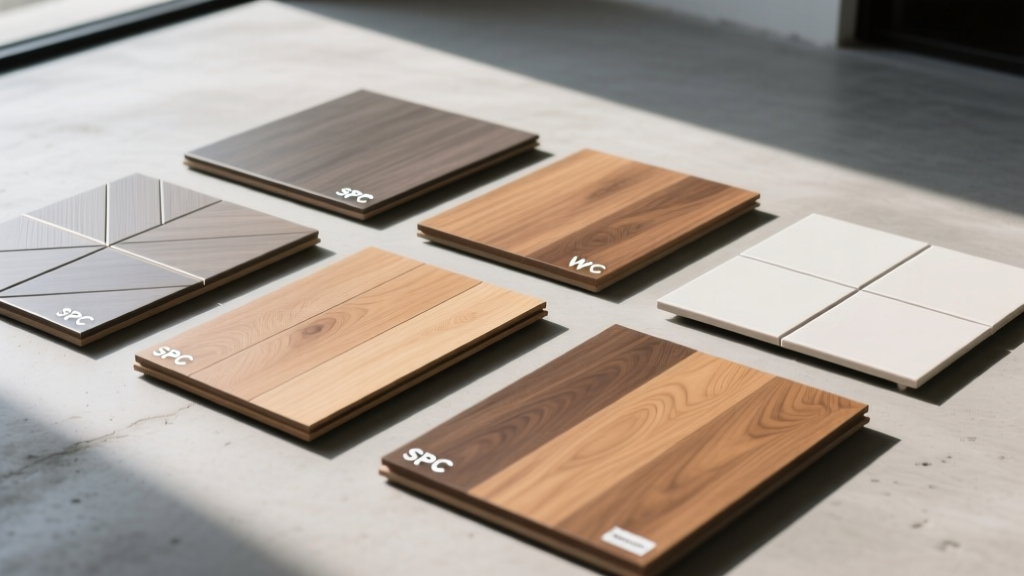
The 2026 Wood-Like Flooring Selection Matrix
Selecting the right wood-look flooring requires moving beyond aesthetics to evaluate core composition, moisture tolerance, and subfloor requirements. The market has shifted heavily toward rigid core polymers and advanced high-density fiberboards (HDF). Below is the foundational matrix for comparing the primary wood like flooring options available this year.
| Material Type | Core Composition | Moisture Tolerance | Subfloor Tolerance | Best Application |
|---|---|---|---|---|
| SPC (Stone Plastic Composite) | Limestone powder + PVC | 100% Waterproof | Low (Requires flat subfloor) | High-traffic commercial, wet areas |
| WPC (Wood Plastic Composite) | Wood pulp + plastic composites | 100% Waterproof | Medium (Forgives minor dips) | Residential living spaces, bedrooms |
| Laminate | High-Density Fiberboard (HDF) | Water-Resistant (Surface only) | Medium-High | Dry, above-grade residential |
| Engineered Hardwood | Plywood or HDF core + wood veneer | Low (Humidity sensitive) | High (Requires strict prep) | Premium residential, main living areas |
| Porcelain Wood-Look Tile | Kaolin clay + feldspar (fired) | Impervious (<0.5% absorption) | Zero (Must be perfectly level) | Bathrooms, mudrooms, outdoor patios |
Decoding Luxury Vinyl: SPC vs. WPC Cores
When evaluating luxury vinyl plank (LVP), the core layer dictates the floor's structural integrity and underfoot comfort. The Resilient Floor Covering Institute (RFCI) classifies these rigid core products based on their polymer makeup.
SPC (Stone Plastic Composite)
SPC features a dense limestone-PVC core. It is virtually indestructible under heavy point loads (e.g., stiletto heels, heavy appliances) and exhibits zero thermal expansion in direct sunlight. However, its rigidity is its Achilles' heel: SPC will "telegraph" or crack if installed over an uneven subfloor. The industry standard for subfloor prep is no more than 3/16-inch deviation over a 10-foot radius. If your concrete slab has significant divots, SPC requires extensive self-leveling compound application before installation.
WPC (Wood Plastic Composite)
WPC incorporates a foaming agent and wood-like polymers, creating a thicker, softer core. It excels in acoustic dampening and underfoot comfort, making it ideal for second-story bedrooms or multi-family residential units where IIC (Impact Insulation Class) ratings matter. WPC is more forgiving of minor subfloor imperfections but is susceptible to denting under extreme static loads.
Do not confuse core thickness with the wear layer. The wear layer is the clear urethane topcoat that resists scratches. For residential spaces, specify a minimum 12-mil wear layer. For homes with large dogs or commercial applications, mandate a 20-mil to 28-mil wear layer with a ceramic bead or aluminum oxide finish.
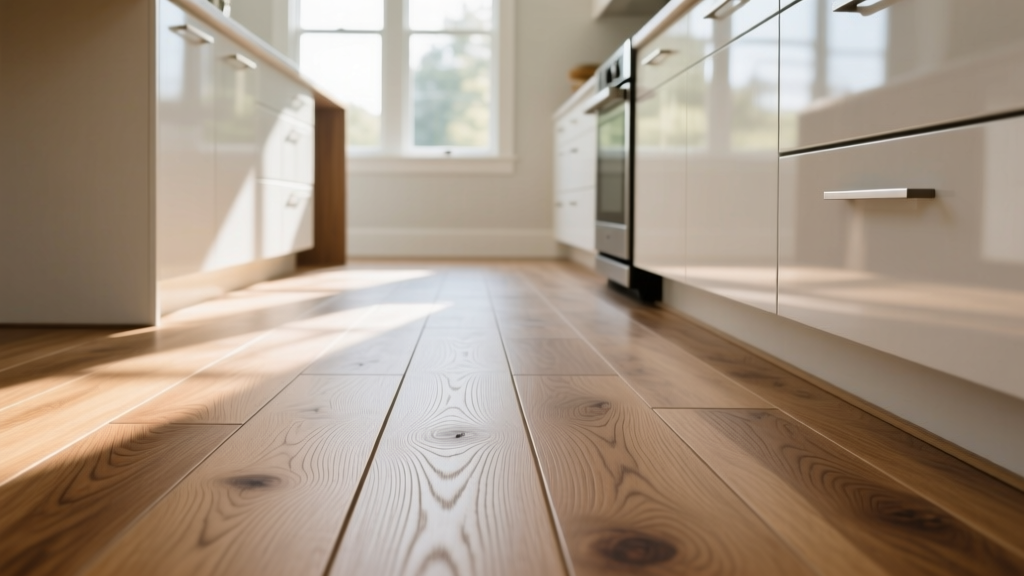
Laminate Flooring: Navigating AC Ratings and Moisture
Modern laminate flooring utilizes high-resolution photographic layers sealed under a clear melamine resin. While older laminate swelled instantly upon water contact, 2026 models feature hydrophobic edge treatments and tighter locking mechanisms that offer up to 72 hours of surface water resistance.
To evaluate laminate durability, rely strictly on the Abrasion Class (AC) rating system established by the European Producers of Laminate Flooring (EPLF):
- AC3 (Moderate Residential): Suitable for bedrooms and low-traffic living rooms.
- AC4 (Heavy Residential / Light Commercial): The minimum recommended spec for main living areas, hallways, and kitchens.
- AC5 (Heavy Commercial): Features a highly textured, abrasive surface. Often too rough for bare feet in residential settings but excellent for retail spaces.
Failure Mode Alert: Laminate fails primarily at the seams. If water bypasses the surface tension and enters the click-lock joint, the HDF core will absorb moisture and swell irreversibly. Never use steam mops or wet-swab laminate flooring.
Engineered Hardwood & Porcelain Tile: The Premium Alternatives
For buyers who demand authentic materials but need dimensional stability, engineered hardwood and porcelain tile represent the premium tier of wood like flooring options.
Engineered Hardwood Veneer Thickness
According to guidelines from the National Wood Flooring Association (NWFA), the lifespan of engineered wood is dictated by the lamella (top veneer) thickness. Products with a 0.6mm to 1.2mm veneer are "wear-only" and cannot be sanded. To ensure the floor can be refinished at least once during its lifecycle, specify a minimum 2mm wear layer, with 3mm to 4mm being the premium standard. Ensure the core is multi-ply Baltic birch rather than HDF for superior moisture stability.
Porcelain Wood-Look Tile
Porcelain tile offers the highest scratch and moisture resistance of any wood-look material. When selecting, look for "rectified" edges. Rectification means the tile edges are mechanically ground to exact 90-degree angles, allowing for ultra-narrow grout lines (1/16-inch or 3/32-inch) that mimic the tight seams of real hardwood. Verify the PEI (Porcelain Enamel Institute) rating; PEI Class III is sufficient for residential, while Class IV is required for heavy residential or commercial use.
The 4-Step Decision Framework
Use this sequential framework to eliminate incompatible materials quickly:
- Assess Grade Level: Is the space below grade (basement)? Solid hardwood is immediately disqualified due to hydrostatic pressure and ground moisture. Choose SPC, WPC, or porcelain tile.
- Measure Subfloor Flatness: Use a 10-foot straight edge. If deviations exceed 3/16-inch, eliminate SPC and glue-down LVT unless you budget $2-$4 per square foot for self-leveling underlayment. WPC or floating laminate are better choices for uneven substrates.
- Evaluate Radiant Heat: If installing over hydronic or electric radiant heating, verify the manufacturer's maximum surface temperature limit (usually 80°F to 85°F). Engineered hardwood and SPC perform best; WPC can trap heat and degrade, while thick porcelain tile requires higher energy output to heat the mass.
- Calculate Total Cost of Ownership (TCO): Factor in the cost of transitions, stair noses, and underlayment. A $3/sqft SPC plank often requires a premium cork underlayment ($1.50/sqft) to achieve acceptable acoustic ratings, pushing the real material cost to $4.50/sqft.
2026 Cost & Installation Breakdown
Pricing reflects current 2026 material averages for mid-to-high-tier residential products, excluding subfloor remediation.
| Material | Material Cost (per sq. ft.) | Professional Install (per sq. ft.) | Underlayment/Prep | Total Estimated Range |
|---|---|---|---|---|
| SPC Vinyl Plank | $2.50 - $5.50 | $1.50 - $2.50 | $0.50 - $1.00 | $4.50 - $9.00 / sq. ft. |
| WPC Vinyl Plank | $3.50 - $7.00 | $1.50 - $2.50 | Often attached | $5.00 - $9.50 / sq. ft. |
| Water-Resistant Laminate | $2.00 - $4.50 | $1.50 - $2.25 | $0.40 - $0.80 | $3.90 - $7.55 / sq. ft. |
| Engineered Hardwood | $6.00 - $12.00 | $3.00 - $5.00 | $0.50 - $1.50 | $9.50 - $18.50 / sq. ft. |
| Porcelain Wood-Look Tile | $3.50 - $9.00 | $5.00 - $9.00 | $1.00 - $2.50 | $9.50 - $20.50 / sq. ft. |
Expert Troubleshooting & Edge Cases
Direct, unfiltered UV light and extreme temperature fluctuations will cause WPC and lower-grade SPC planks to expand, push against walls, and buckle. For rooms with floor-to-ceiling southern-facing windows, you must use an SPC product specifically rated for high-UV/solar exposure, or transition to porcelain wood-look tile which is entirely immune to UV degradation and thermal expansion.
The Acclimation Myth: Unlike solid hardwood, which requires 5-7 days of acclimation to the home's ambient humidity, rigid core SPC and WPC flooring do not require temperature acclimation to expand or contract. However, the adhesives used for glue-down LVT installations require the room to be maintained at 65°F-85°F for 48 hours prior to and after application to ensure proper polymer cross-linking.
Transition Moldings: A common failure in floating wood-like floors is the omission of expansion breaks. Both SPC and laminate require a T-molding transition at every doorway or any continuous run exceeding 40 feet in length. Failing to install these breaks will result in the floor tearing itself apart at the locking mechanisms during seasonal humidity shifts.
Written by
Marcus ChenMarcus Chen is a licensed structural engineer (PE) and building materials analyst with over 12 years of experience across residential, commercial, and industrial construction. He holds a Master of Science in Civil Engineering from UC Berkeley and spent six years at Thornton Tomasetti before transitioning to independent consulting and technical writing. Marcus specializes in material selection for seismic-prone regions, concrete reinforcement strategies, and lifecycle cost analysis. His work has been cited by the American Concrete Institute (ACI) and the Structural Engineers Association of California (SEAOC). When he is not on a job site or at his desk, you will find him hiking the Sierra Nevada or restoring a 1920s craftsman bungalow in Oakland, CA.
More from Marcus Chen
View all
Construction Cost
How Much Did the Eiffel Tower Cost to Build?
How much did the Eiffel Tower cost to build in 1889? We adjust for inflation and compare its budget to modern skyscraper construction.
Aug 4, 2026

Fire Resistance
What Is a Fire Resistant Material? Testing & Certification Guide
Discover what is a fire resistant material through ASTM and UL testing. Learn how fire ratings, certifications, and assemblies work in construction.
Aug 4, 2026

Construction Cost
How Much Did the Burj Khalifa Cost to Build?
How much did the Burj Khalifa cost to build? We break down the $1.5B project and extract 5 money-saving strategies for your next build.
Jul 30, 2026