Dimensional Lumber Sizes: Nominal vs Actual by Top Brands
Decode dimensional lumber sizes across top brands. Compare nominal vs actual dimensions, moisture shrinkage, and grading specs for Weyerhaeuser and Boise Cascade.
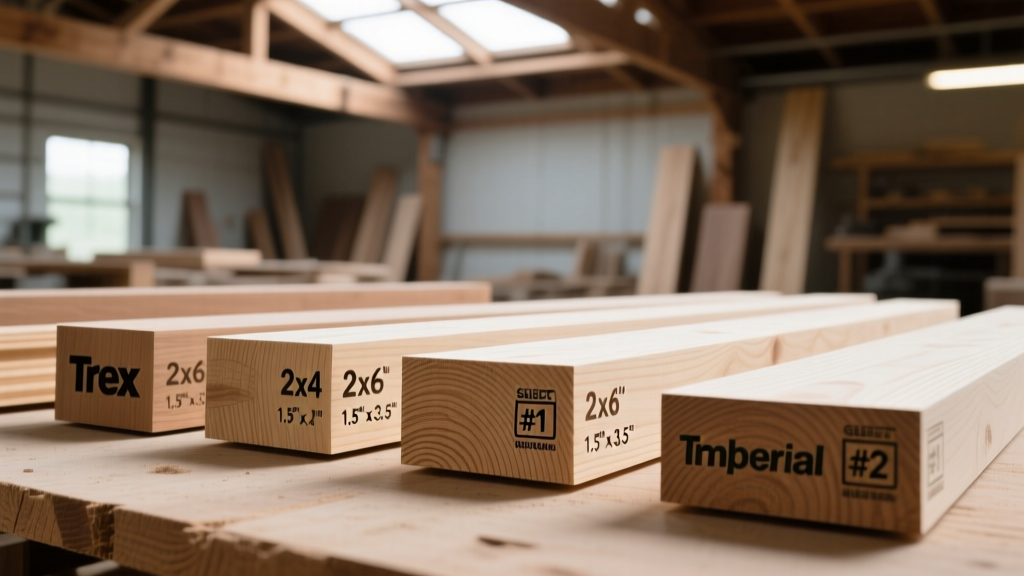
The Nominal vs. Actual Size Matrix: Why Brands Cut It Down
Architectural drawings and framing plans universally specify nominal dimensions, but the physical material delivered to the job site operates on a fundamentally different measurement standard. For contractors, estimators, and material buyers, understanding the exact dimensional lumber sizes produced by major North American manufacturers is critical for avoiding framing discrepancies, material shortages, and structural misalignments. The discrepancy originates from the historical milling process: a rough-sawn "2x4" is planed and surfaced to achieve a uniform, workable finish, removing approximately 1/2 inch from the total width and thickness.
Today, North American softwood lumber is dominated by integrated producers like Weyerhaeuser, Boise Cascade, and West Fraser. While all adhere to the baseline sizing standards enforced by the American Lumber Standard Committee (ALSC), each brand employs proprietary planing, trimming, and grading technologies. These manufacturing nuances result in micro-variations in actual dimensions, edge easing profiles, and moisture content tolerances that directly impact high-volume framing operations and automated wall panelization.
The 1/2-Inch Rule of Thumb (and Where It Fails)
The standard industry heuristic is that nominal lumber is 1/2 inch smaller in actual dimension (e.g., a 2x4 is 1.5" x 3.5"). However, this rule only applies to S-DRY (Surfaced Dry) lumber. If a mill ships S-GRN (Surfaced Green) lumber to account for post-planing shrinkage, the actual dimensions are intentionally milled 1/32" to 1/16" larger. Always verify the moisture stamp before finalizing automated cutting jigs.
Comprehensive Dimensional Lumber Size Chart
The following matrix details the exact physical dimensions you will receive on-site, contrasting standard dry milling with green allowances recognized by the Western Wood Products Association (WWPA) and regional grading agencies.
| Nominal Size | Actual S-DRY (Max 19% MC) | Actual S-GRN (Over 19% MC) | Primary Structural Use |
|---|---|---|---|
| 2 x 4 | 1.5" x 3.5" | 1-9/16" x 3-9/16" | Wall studs, plates, joists |
| 2 x 6 | 1.5" x 5.5" | 1-9/16" x 5-5/8" | Exterior walls, floor joists |
| 2 x 8 | 1.5" x 7.25" | 1-9/16" x 7-3/8" | Rafters, headers, joists |
| 2 x 10 | 1.5" x 9.25" | 1-9/16" x 9-3/8" | Heavy floor joists, beams |
| 2 x 12 | 1.5" x 11.25" | 1-9/16" x 11-3/8" | Stair stringers, long-span joists |
| 4 x 4 | 3.5" x 3.5" | 3-9/16" x 3-9/16" | Posts, light structural columns |
| 6 x 6 | 5.5" x 5.5" | 5-5/8" x 5-5/8" | Heavy timber posts, beam bearing |
Brand Deep-Dive: Milling Tolerances and Edge Profiles
Not all 1.5" x 3.5" lumber is identical. The planing process dictates the final surface quality, edge radius, and dimensional tolerance. High-volume production facilities utilize continuous feed planers that can introduce micro-deviations if not strictly calibrated.
Weyerhaeuser Premium Framing Lumber
Weyerhaeuser’s Premium line is engineered specifically for high-end residential and commercial framing where drywall finish is paramount. Their planing mills utilize advanced abrasive surfacing heads that produce an exceptionally smooth face. Crucially, Weyerhaeuser applies a pronounced "eased edge" (a rounded corner profile) to their 2x4 and 2x6 stock. This eased edge reduces drywall tearing during installation and minimizes splintering for framing crews. Their dimensional tolerance is held to ±1/64" on thickness, making it highly predictable for automated wall panel manufacturers.
Boise Cascade Alliance and SPF Lines
Boise Cascade focuses heavily on the Spruce-Pine-Fir (SPF) and Hem-Fir species groups under their Alliance branding. Their competitive advantage lies in precision end-trimming. Boise Cascade utilizes optimized sawing and clipping technology that ensures the ends of the lumber are perfectly square to within 1/32" over an 8-foot length. For contractors utilizing pneumatic nailers and metal connector plates, this square-end precision ensures tight bearing joints at rim boards and top plates, reducing the need for on-site re-cutting.
West Fraser Structural Framing
As a massive producer of SPF lumber, West Fraser prioritizes structural yield and grading speed. Their dimensional lumber sizes strictly adhere to the Southern Pine Inspection Bureau (SPIB) and NLGA (National Lumber Grades Authority) standards. West Fraser stock often features a slightly sharper edge profile compared to Weyerhaeuser, which provides excellent bite for structural connectors but requires careful handling to prevent edge-crushing when strapped tightly in transit.
Moisture Content: The Hidden Dimensional Variable
The physical size of dimensional lumber is inextricably linked to its moisture content (MC) at the time of surfacing. The USDA Forest Products Laboratory notes that wood shrinks primarily tangentially and radially as it drops below the fiber saturation point (roughly 30% MC).
- S-DRY (Surfaced Dry): Lumber surfaced to its final nominal-actual dimensions when the moisture content was 19% or less. This is the standard for interior framing and dry climates. It will remain dimensionally stable in conditioned spaces.
- S-GRN (Surfaced Green): Lumber surfaced when the moisture content was above 19%. Mills intentionally cut S-GRN lumber slightly oversized (as shown in the matrix above) so that when it dries to 19% or less in the field, it shrinks down to the standard S-DRY actual dimensions.
- MC 15: A premium designation indicating the lumber was surfaced at a maximum of 15% moisture content. This is critical for finish carpentry, cabinetry backing, and millwork where even minor post-installation shrinkage will cause joint failure or fastener popping.
Decoding the Grade Stamp: Size and Quality Intersections
The ink stamp on every piece of dimensional lumber is a dense data matrix. While most framers look only for the species and grade (e.g., SPF #2), the stamp also dictates the dimensional standard the mill adhered to during production.
A standard stamp reading SPF NO.2 S-DRY 1.5" x 3.5" confirms the exact physical footprint. However, if the stamp includes STUD, the lumber is graded specifically for vertical load-bearing applications and may have slightly relaxed visual defect allowances on the wide face, though the dimensional tolerances remain identical to #2 grade. For engineered applications like truss chords, buyers must specify MSR (Machine Stress Rated) lumber, which is non-destructively tested for stiffness (MOE) and stress (MOR), and is surfaced to highly rigorous dimensional tolerances to ensure it fits seamlessly into automated truss pressing jigs.
Procurement Strategy: Ordering by the Unit and Bundle
Dimensional lumber is rarely sold by the piece in commercial construction; it is procured by the "unit" or "bundle." Understanding brand-specific bundling matrices is essential for accurate takeoffs and crane-load planning.
Standard WWPA Bundle Configurations
In the Western and Northern regions, mills adhering to WWPA standards typically bundle 2x4x8 lumber in units of 294 pieces. This specific number is not arbitrary; it is calculated based on a standard bundle width of 48 inches and a height that allows for standard forklift tine clearance and strapping tension.
| Nominal Size | Length | Pieces per Unit (Standard West) | Board Feet per Unit |
|---|---|---|---|
| 2 x 4 | 8 ft | 294 | 1,568 BF |
| 2 x 6 | 8 ft | 189 | 1,512 BF |
| 2 x 8 | 8 ft | 147 | 1,568 BF |
| 2 x 10 | 8 ft | 119 | 1,586 BF |
Regional Variations and Southern Pine
Conversely, Southern Yellow Pine (SYP) producers often utilize different bundle configurations due to the higher density and weight of the species. A standard unit of SYP 2x4x8 may contain 343 pieces. Estimators pulling data from national cost databases must adjust their unit-conversion factors based on the geographic origin of the lumber specified in the structural plans. Failing to account for the 294 vs. 343 piece discrepancy can result in a 16% material shortage on large-scale framing packages.
Expert Sourcing Tips for Framing Packages
When drafting your material procurement list, apply the following technical specifications to ensure you receive the correct dimensional lumber sizes and moisture states for your specific application:
- Specify End-Use on the PO: Do not just order "SPF #2 2x4". Add the qualifier "S-DRY Eased Edge" for interior partition walls to protect drywall, or "S-DRY Square End" for top plates and rim boards where bearing surface is critical.
- Verify the Surfacing Stamp: Upon delivery, inspect the grade stamp on a random sample of 10 boards. If your plans require S-DRY but the stamp reads S-GRN, reject the bundle. Installing S-GRN in a conditioned space will guarantee severe shrinkage and callback repairs.
- Account for Kerf and Waste in Takeoffs: While the actual width of a 2x4 is 3.5", remember that cross-cutting the board with a 10-inch miter saw removes an additional 1/8" to 3/16" of material per cut. Advanced framing techniques that utilize 24-inch on-center spacing and 2-stud corners reduce the total linear footage required, mitigating the impact of these micro-dimension losses.