Types of Engineered Wood Beams: 2026 Cost & Value Guide
Compare the 2026 costs, span capacities, and hidden installation expenses of LVL, PSL, Glulam, and LSL engineered wood beams.

The Financial Case for Engineered Timber
Selecting the right structural beam is no longer just a matter of checking span tables against dead and live loads. In 2026, the total installed cost of a structural system depends heavily on material availability, required crane tonnage, proprietary connection hardware, and finishing labor. While traditional dimensional lumber (like built-up 2x12s) is limited to shorter spans and prone to warping, engineered wood products offer predictable structural performance. However, the upfront material cost varies wildly depending on the specific manufacturing process. Understanding the true cost and long-term value of the primary types of engineered wood beams is critical for accurate project budgeting and value engineering.
2026 Pricing Matrix: The 5 Primary Beam Types
The following matrix breaks down the baseline material costs and structural profiles for the most common engineered beams. Note that material costs are per linear foot (PLF) for standard residential/light-commercial grades and exclude taxes, delivery, and connection hardware.
| Beam Type | Material Cost (PLF) | Max Typical Span | Best Application | Primary Cost Driver |
|---|---|---|---|---|
| LVL (Laminated Veneer Lumber) | $3.80 - $6.50 | 60 ft (multi-ply) | Concealed headers, rim boards, floor beams | Ply thickness and wood species (Douglas Fir vs. SPF) |
| PSL (Parallel Strand Lumber) | $5.50 - $9.50 | 65 ft | Heavy point loads, large open-concept spans | Resin density and preservative treatments |
| Glulam (Glued Laminated Timber) | $7.50 - $16.00+ | 100+ ft | Exposed architectural beams, commercial roofs | Appearance grade (Industrial vs. Architectural) |
| LSL (Laminated Strand Lumber) | $2.80 - $4.50 | 30 ft | Short spans, tall wall studs, rim boards | Strand size and resin type (PMDI vs. Phenolic) |
| I-Joists (Used as headers/beams) | $2.20 - $4.00 | 45 ft | Floor systems, light-duty interior headers | Web material (OSB vs. LVL) and flange depth |
Deep-Dive Cost & Value Analysis by Beam Type
Laminated Veneer Lumber (LVL)
LVL is manufactured by peeling logs into thin veneers, drying them, and bonding them with structural adhesives under heat and pressure. Leading products like Boise Cascade Versa-Lam and LP SolidStart LVL dominate this space.
- Cost Efficiency: LVL offers the highest strength-to-dollar ratio for concealed applications. A standard 1.75" x 11.25" LVL beam costs roughly $4.50 PLF, providing bending stiffness (E) comparable to steel but at a fraction of the weight.
- Value Proposition: Because LVL is dimensionally stable, it eliminates the costly drywall callbacks associated with nail pops and corner cracking caused by the shrinkage of traditional built-up dimensional lumber headers.
- Edge Case / Risk: LVL is highly susceptible to surface checking and delamination if left exposed to weather during the framing stage. If your site has a history of framing delays, factor in the cost of heavy-duty polyethylene wrapping or switch to a weather-resistant PSL.
Parallel Strand Lumber (PSL)
PSL, commonly known by the brand name Weyerhaeuser Parallam, is made from long, thin strands of wood laid parallel to the beam's length and bonded with structural resin.
- Cost Efficiency: PSL commands a 20% to 40% premium over LVL. A 5.25" x 12" PSL beam can easily exceed $8.00 PLF.
- Value Proposition: PSL excels in high-shear, high-point-load scenarios. If you are designing a large open-concept living space requiring a single central column supporting a massive roof load, PSL's superior compression-perpendicular-to-grain values prevent bearing crush, eliminating the need for expensive steel bearing plates.
- Edge Case / Risk: When using pressure-treated PSL for exterior applications or high-moisture zones (like covered porches), the copper-based preservatives (like ACQ or CA-C) will rapidly corrode standard zinc-plated joist hangers. You must budget for hot-dipped galvanized or stainless-steel connection hardware, which increases connection costs by up to 300%.
Glued Laminated Timber (Glulam)
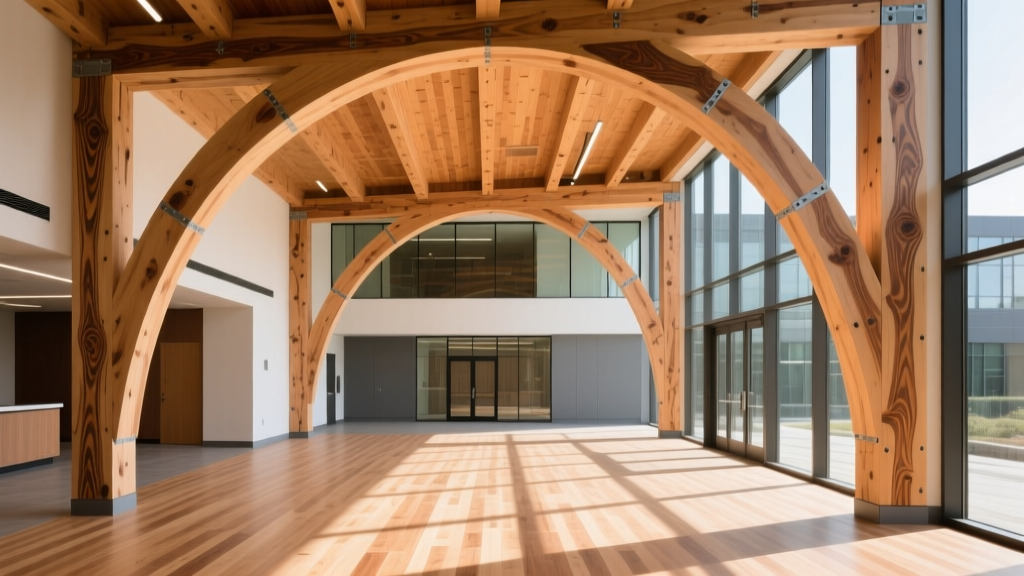
Glulam consists of dimensional lumber laminations bonded with moisture-resistant adhesives. It is the premier choice for exposed timber framing and commercial mass timber projects.
- Cost Efficiency: Material costs are high, ranging from $7.50 PLF for standard Industrial grades to over $16.00 PLF for Premium Architectural grades with tight-knot restrictions and sanded finishes.
- Value Proposition: The true ROI of Glulam is realized in finishing labor. By specifying an Architectural grade Glulam beam from manufacturers like Anthony Forest Products, you eliminate the need to wrap the beam in drywall. Saving $8 to $12 per linear foot in framing, taping, mudding, and painting labor often makes exposed Glulam cheaper than a concealed LVL beam on a total-installed-cost basis.
- Edge Case / Risk: Glulam is manufactured with a built-in camber (upward curve) to offset dead-load deflection. If a contractor incorrectly installs the beam upside down, the camber will exacerbate deflection, leading to severe floor bouncing or roof ponding. Always verify the 'TOP' stamp on the beam during installation.
Laminated Strand Lumber (LSL)
LSL, such as Weyerhaeuser TimberStrand, uses shorter wood strands (typically 12 inches long) oriented parallel to the beam axis.
- Cost Efficiency: LSL is the most budget-friendly engineered option, often priced 15% to 25% lower than LVL.
- Value Proposition: While not ideal for long-span primary floor beams, LSL is unmatched for rim boards, short-span garage headers, and tall wall studs (up to 24 feet). Its homogeneous composition allows for deep, clean routing for plumbing and electrical lines without compromising structural integrity, saving MEP subcontractors hours of on-site modifications.
Hidden Installation Costs That Skew the Budget
Budgeting solely on PLF material costs is the most common cause of structural framing overruns. When value engineering your beam selection, you must account for the following hidden installation variables:
- Crane Rentals: Glulam and PSL beams are often manufactured in continuous lengths up to 60 or 80 feet. A 60-foot Glulam beam may weigh over 3,000 lbs, requiring a 40-ton or 50-ton mobile crane. At $250 to $400 per hour (with a 4-hour minimum), crane mobilization can add $1,500+ to a single beam's installation cost. Splicing two shorter LVL beams on-site with structural bolts may be cheaper overall.
- Proprietary Hangers: Concealed face-mount hangers (like the Simpson Strong-Tie HUC series) are often required for exposed Glulam beams to hide the hardware. These hangers cost $45 to $90 each, compared to $8 for standard top-flange LVL hangers, and require precise field-welding or specialized structural screws.
- Bearing Stiffeners: Engineered I-joists and some LVL configurations require web stiffeners at bearing points to prevent web buckling. Failing to include these in the framing labor estimate leads to costly change orders.
Value Engineering Decision Framework
Use this If-Then logic to select the most cost-effective beam for your specific structural scenario, referencing span tables from the APA - The Engineered Wood Association and the American Wood Council (AWC):
- IF the beam is fully concealed behind drywall AND the span is under 40 feet THEN specify LVL. It provides the optimal balance of high bending strength and low material cost.
- IF the beam will be exposed to the elements during a prolonged construction phase OR requires extreme point-load capacity THEN specify PSL. The premium material cost is offset by its weather resistance and elimination of steel bearing plates.
- IF the beam is a primary architectural feature in a living space or commercial lobby THEN specify Glulam. The material premium is entirely recovered by eliminating drywall finishing labor and achieving a high-end aesthetic.
- IF you need a rim board, a short-span header (under 12 feet), or tall continuous studs THEN specify LSL. It is the most economical choice for compression and short-span shear applications.
Long-Term ROI: Fire Resistance and Insurance
Beyond immediate construction costs, engineered wood beams—particularly heavy timber Glulam and large-format PSL—offer significant lifecycle value through fire resistance and insurance premiums. According to the USDA Forest Products Laboratory Wood Handbook, heavy timber chars at a predictable rate of approximately 1.5 inches per hour. This char layer insulates the inner core of the beam, allowing it to maintain structural integrity during a fire without the sudden, catastrophic failure associated with unprotected steel beams.
For commercial and multi-family residential projects in 2026, specifying large-section engineered timber can qualify the building for the 'Heavy Timber' construction classification under the International Building Code (IBC). This classification frequently results in a 5% to 15% reduction in builder's risk and long-term property insurance premiums, providing a compounding ROI that easily justifies the initial material premium of Glulam over steel or LVL alternatives.
Written by
Priya KapoorPriya Kapoor is a real estate market analyst and construction economics researcher with expertise in housing affordability, development feasibility, and infrastructure investment. She holds a Master of Regional Planning from Cornell University and previously worked as a senior analyst at CBRE's Investment Properties group, where she modeled returns for $4B in mixed-use development pipelines. Priya now runs an independent research practice advising developers, municipalities, and REITs on construction cost forecasting and market timing. She publishes the quarterly "BuildMat Market Pulse" report tracking material price indices across 12 commodity categories. Based in Austin, TX, Priya serves on the board of Habitat for Humanity Austin and is a marathon runner.
More from Priya Kapoor
View all
Construction Cost
Cost to Build a 1600 Sq Ft Home in 2026: Full Breakdown
Accurate 2026 cost to build a 1600 sq ft home—material, labor, and regional pricing breakdowns included. Plan your budget with real-time estimates.
Aug 11, 2026

Wood & Lumber
Name the Types of Wood for Pressure Treatment and Preservation
Learn how to name the types of wood best suited for pressure treatment. Compare species treatability, chemical retention levels, and 2026 preservation costs.
Aug 4, 2026

Stone & Masonry
Stone Veneer Suppliers Lindenhurst: 2026 Cost Analysis
Analyze 2026 stone veneer costs in Lindenhurst, NY. Compare local supplier pricing, delivery fees, and Suffolk County installation labor rates.
Aug 4, 2026