Guitar Types of Wood: A Luthier's Tonewood Comparison Review
Compare the top guitar types of wood for lutherie. We review Sitka spruce, rosewood, and mahogany tonewoods by density, Janka hardness, and tone.

Beyond Construction: The Extreme Lumber Grading of Lutherie
In the broader building materials industry, lumber grading focuses on structural load-bearing capacity, knot frequency, and moisture content for framing and finish carpentry. However, when evaluating guitar types of wood (commonly referred to as tonewoods), the grading criteria shift dramatically toward acoustic resonance, cellular uniformity, and aesthetic figuring. While a standard construction-grade Sitka Spruce 2x4 might cost a few dollars, a master-grade, quarter-sawn Sitka Spruce soundboard set commands premium pricing due to strict requirements for grain lines per inch (TPI), minimal runout, and visible medullary rays.
This comparison review analyzes the primary wood species used in acoustic and electric guitar manufacturing from a materials science perspective. By examining specific gravity, Janka hardness, and the modulus of elasticity, we can objectively map how raw lumber properties translate into acoustic performance and structural longevity under high-tension string loads.
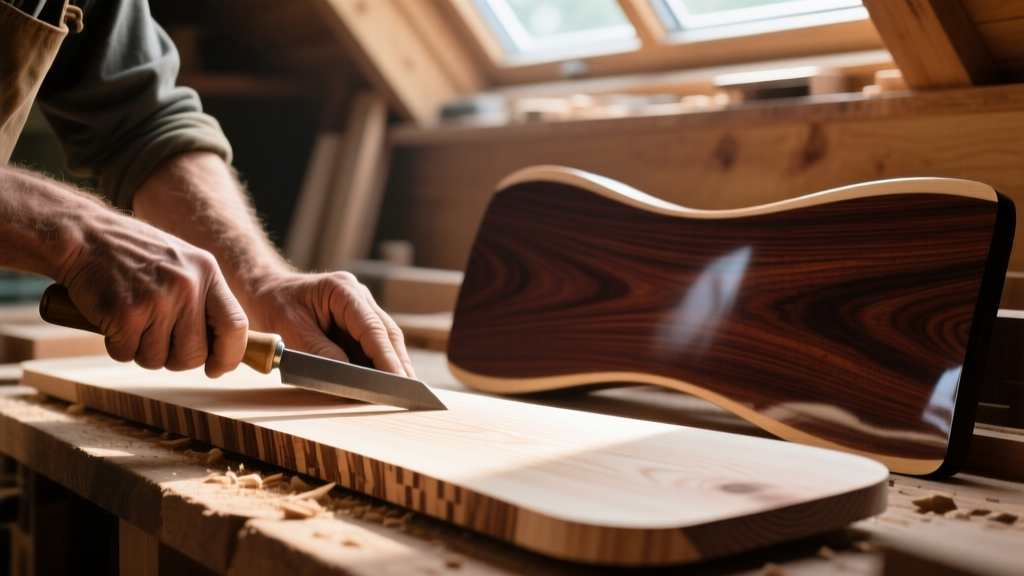
The Physics of Tonewood: Stiffness-to-Weight Ratios
The fundamental requirement for any guitar soundboard (the top piece of lumber that vibrates to project sound) is a high stiffness-to-weight ratio. In materials engineering, this is measured by the modulus of elasticity (MOE) divided by the specific gravity (SG). A soundboard must be light enough to be set into motion by the microscopic energy of a vibrating guitar string, yet stiff enough to resist collapsing under the 150 to 200 pounds of cumulative down-bearing tension exerted by steel strings.
Key Material Metrics for Luthiers
- Specific Gravity (SG): Determines the raw mass of the wood. Lower SG in soundboards allows for higher velocity of sound propagation.
- Janka Hardness (lbf): Measures resistance to indentation. Critical for fretboards and bridge plates, but largely irrelevant for soundboards.
- Velocity of Sound: The speed at which acoustic waves travel through the cellular structure of the wood. High-velocity woods yield louder, more responsive instruments.
Soundboard Lumbers: The Engine of Acoustic Resonance
The soundboard is responsible for roughly 80% of an acoustic guitar's tonal character. The lumber selected here dictates the instrument's dynamic range, sustain, and harmonic complexity.
Sitka Spruce (Picea sitchensis)
Sitka spruce is the undisputed industry standard for steel-string acoustic guitars. Harvested primarily from the Pacific Northwest and Alaska, it possesses a uniquely high stiffness-to-weight ratio. According to The Wood Database, Sitka features an average specific gravity of 0.40 and a Janka hardness of 510 lbf. Its tight, straight grain structure allows it to handle heavy flatpicking without "breaking up" or distorting harmonically at high volumes. Master-grade sets require a minimum of 15-20 grain lines per inch and strict quarter-sawing to expose the cross-grain medullary rays (often called "silk"), which provides lateral stability and prevents the top from splitting.
Western Red Cedar (Thuja plicata)
With a significantly lower Janka hardness (350 lbf) and specific gravity (0.34), Western Red Cedar is much softer and less dense than spruce. This lower mass allows the soundboard to reach its maximum vibrational amplitude at much lower energy inputs. Consequently, cedar is the premier choice for classical nylon-string guitars and fingerstyle steel-string players. The trade-off is a lower headroom; when strummed aggressively, cedar tops compress and lose harmonic clarity, producing a muddy fundamental note.
Back and Side Woods: Reflection and Overtone Coloring
While the top generates the sound, the back and sides act as the acoustic chamber's reflective walls. The density of these woods determines how much acoustic energy is absorbed versus reflected back through the soundhole.
Comparison Matrix: Primary Back and Side Tonewoods
| Wood Species | Specific Gravity | Janka Hardness (lbf) | Tonal Profile & Overtone Behavior | 2026 Luthier Set Price (USD) |
|---|---|---|---|---|
| Indian Rosewood | 0.75 | 2,440 | Complex, dark, scooped mids. High overtone reflection with a long reverb-like decay. | $150 - $350 |
| Honduran Mahogany | 0.54 | 800 | Warm, dry, fundamental-heavy. Absorbs high overtones, emphasizing a woody midrange punch. | $120 - $250 |
| Hard Maple | 0.63 | 1,450 | Highly reflective, transparent. Adds no coloration; projects the exact sound of the top wood. | $80 - $180 |
| Sapele | 0.64 | 1,410 | Similar to mahogany but brighter. High treble shimmer with a tight, focused low-end response. | $70 - $140 |
Indian Rosewood (Dalbergia latifolia) remains the benchmark for high-end acoustic instruments. As noted in The Wood Database, its high density and interlocked grain create a highly reflective interior that yields a complex, reverberant tone with pronounced bass and treble, often described as a "scooped" EQ curve. Conversely, Honduran Mahogany is highly porous and relatively lightweight. It absorbs overtones, resulting in a dry, direct sound that excels in blues and vocal accompaniment where midrange clarity is required to cut through a mix.
Fretboard and Neck Woods: Structural Stability Under Tension
The neck and fretboard of a guitar operate in a hostile mechanical environment. A steel-string acoustic neck must resist approximately 180 lbs of constant upward bowing force, mitigated only by a steel truss rod. Therefore, the lumber used here must prioritize dimensional stability and high shear strength over acoustic resonance.
Ebony vs. Richlite: The Modern Fretboard Shift
African Ebony (Diospyros crassiflora) has historically been the gold standard for fretboards due to its extreme density (SG 0.96) and 3,080 lbf Janka hardness, providing a glassy, frictionless surface that resists fingernail divots and fret wear. However, CITES (Convention on International Trade in Endangered Species) regulations and severe supply chain bottlenecks have forced the industry to adapt.
To combat supply issues, major manufacturers like Taylor and Martin have heavily integrated Richlite—a paper-and-phenolic-resin composite engineered to mimic the density and machining properties of ebony. From a materials science perspective, Richlite offers zero moisture absorption, entirely eliminating the fret sprout and neck warping associated with natural ebony during seasonal humidity drops.
2026 Tonewood Market Pricing and Sourcing Realities
The pricing of instrument-grade lumber operates entirely independently of the commercial construction timber market. While framing lumber is priced by the thousand board feet (MBF), tonewood is priced by the individual "set" (the matched pieces required for one instrument).
The premium paid for tonewood is driven by the quarter-sawing requirement. In standard milling, logs are plain-sawn to maximize yield. In lutherie, the log must be quartered and cut radially so the growth rings intersect the face of the board at a 90-degree angle. This yields a massive amount of waste but ensures the wood shrinks and swells only in thickness, not in width, preventing the soundboard from tearing itself apart during seasonal humidity shifts. According to the USDA Forest Products Laboratory Wood Handbook, quarter-sawn lumber exhibits significantly higher dimensional stability and radial stiffness compared to flat-sawn alternatives, a non-negotiable requirement for acoustic soundboards.
Lutherie Decision Framework: Matching Wood to Player Profile
Selecting the right guitar types of wood requires aligning the material's physical properties with the end-user's mechanical input. Use the following framework to specify lumber for custom builds or production runs:
- Scenario A: Aggressive Bluegrass Flatpicking
Requirement: High headroom, structural rigidity, rapid note decay to prevent muddiness at high tempos.
Specification: Sitka Spruce top (high MOE) paired with Hard Maple or Mahogany back/sides (controlled overtone reflection). - Scenario B: Dynamic Fingerstyle and Classical
Requirement: Immediate responsiveness to low-energy input, complex harmonic bloom, wide dynamic range.
Specification: Western Red Cedar or Engelmann Spruce top (low mass) paired with Indian Rosewood back/sides (high overtone reflection and long sustain). - Scenario C: Studio Tracking and Vocal Accompaniment
Requirement: Midrange focus, lack of low-end boom, fundamental note clarity to sit neatly in a dense audio mix.
Specification: Mahogany top paired with Mahogany back/sides (an "all-mahogany" build that heavily dampens high-frequency overtones and emphasizes the fundamental frequency).
Understanding guitar tonewoods through the lens of structural lumber grading, cellular density, and mechanical tension reveals that lutherie is as much an exercise in materials engineering as it is in art. By matching specific gravity and stiffness metrics to the physical demands of the player, builders can reliably predict and manipulate the acoustic outcome of the instrument.
Written by
Priya KapoorPriya Kapoor is a real estate market analyst and construction economics researcher with expertise in housing affordability, development feasibility, and infrastructure investment. She holds a Master of Regional Planning from Cornell University and previously worked as a senior analyst at CBRE's Investment Properties group, where she modeled returns for $4B in mixed-use development pipelines. Priya now runs an independent research practice advising developers, municipalities, and REITs on construction cost forecasting and market timing. She publishes the quarterly "BuildMat Market Pulse" report tracking material price indices across 12 commodity categories. Based in Austin, TX, Priya serves on the board of Habitat for Humanity Austin and is a marathon runner.
More from Priya Kapoor
View all
Construction Cost
Cost to Build a 1600 Sq Ft Home in 2026: Full Breakdown
Accurate 2026 cost to build a 1600 sq ft home—material, labor, and regional pricing breakdowns included. Plan your budget with real-time estimates.
Aug 11, 2026

Wood & Lumber
Name the Types of Wood for Pressure Treatment and Preservation
Learn how to name the types of wood best suited for pressure treatment. Compare species treatability, chemical retention levels, and 2026 preservation costs.
Aug 4, 2026

Stone & Masonry
Stone Veneer Suppliers Lindenhurst: 2026 Cost Analysis
Analyze 2026 stone veneer costs in Lindenhurst, NY. Compare local supplier pricing, delivery fees, and Suffolk County installation labor rates.
Aug 4, 2026