Types of Wood Siding Compared: Cedar, Redwood & Pine
Compare the top types of wood siding including cedar, redwood, pine, and acetylated wood. Get 2026 costs, lifespan data, and installation specs.

The Hierarchy of Wood Siding Species
Selecting exterior cladding requires balancing upfront material costs against decades of maintenance, dimensional stability, and decay resistance. The types of wood siding available to builders and homeowners range from traditional old-growth softwoods to chemically modified timber. Understanding the cellular structure and grading rules of each species is the only way to predict long-term performance on a building envelope.
| Species / Type | Recommended Grade | Material Cost (per sq. ft.) | Expected Lifespan | Maintenance Cycle |
|---|---|---|---|---|
| Western Red Cedar | Select Tight Knot (STK) | $7.50 - $12.00 | 30 - 50 Years | 3 - 5 Years (Stain) |
| California Redwood | Clear Heart (CH) | $11.00 - $18.00 | 40 - 60 Years | 4 - 6 Years (Stain) |
| Eastern White Pine | Clear, Finger-Jointed | $3.50 - $6.00 | 20 - 30 Years | 5 - 7 Years (Paint) |
| Spruce/Fir (Whitewood) | Construction Common | $2.50 - $4.50 | 15 - 20 Years | 3 - 5 Years (Paint) |
| Acetylated Wood | Radiata Pine (Modified) | $10.00 - $15.00 | 50+ Years | 5 - 8 Years (Coating) |
Deep Dive: Species Performance & Edge Cases
Western Red Cedar: The Tannin Trap
Western Red Cedar remains the benchmark for wood siding due to its natural thujaplicins, which act as organic fungicides. According to the Western Red Cedar Lumber Association, the species offers superior dimensional stability, shrinking and swelling significantly less than pine or fir when exposed to moisture gradients.
Grade Selection: For stained applications, specify Select Tight Knot (STK). The knots are small and tightly integrated, preventing the 'halo' effect where sap bleeds through the stain. For painted applications, downgrade to Select Knotty or use a specialized tannin-blocking primer. Avoid 'Construction Common' grades for visible elevations; these contain sapwood, which lacks the natural decay resistance of the heartwood and is highly susceptible to rot.
Edge Case: Cedar installed in high-humidity, shaded environments (like the north elevation of a woodland property) will develop surface mildew if finished with film-forming acrylic stains. Always use penetrating alkyd/oil-based stains (such as Cabot Australian Timber Oil or TWP 1500 Series) for cedar, as they do not trap moisture beneath a surface film.
California Redwood: Premium Cost, Premium Stability
Redwood is the most dimensionally stable softwood in North America. Its open cellular structure allows it to absorb and release moisture without severe cupping or checking. However, availability has tightened, pushing 2026 pricing to premium levels.
Grade Selection: You must specify 'Heart' grades (Clear Heart or Construction Heart). The heartwood contains the extractives that provide Class 1 decay resistance. 'Sap' grades (like Clear All Heart vs. Clear Sap) will rot at the same rate as untreated pine if left exposed to ground splash or continuous moisture.
Edge Case: Redwood is highly reactive to iron. Using standard electroplated nails or even basic galvanized fasteners will cause severe black tannin streaking within weeks. Type 304 stainless steel is the absolute minimum requirement; Type 316 is mandatory within 5 miles of a saltwater coastline.
Eastern White Pine & Whitewood: The Budget Compromise
Pine and mixed whitewood (spruce/fir) lack natural decay resistance and have high tangential shrinkage rates. They are strictly paint-grade materials. Solid pine boards wider than 6 inches are prone to severe cupping as the outer growth rings attempt to flatten out.
The Finger-Jointed Advantage: For painted pine siding, specify finger-jointed (FJ) and edge-glued boards. The manufacturing process randomizes the grain direction and eliminates the structural memory that causes solid boards to warp. FJ pine holds paint exceptionally well because the end-grains are encapsulated in structural adhesives, preventing moisture wicking.
Acetylated Wood (e.g., Accoya): The Modern Alternative
Acetylation modifies the wood's free hydroxyl groups into acetyl groups using acetic anhydride. This reduces the wood's equilibrium moisture content (EMC) by up to 50%, making it virtually immune to rot and insect attack without the use of toxic biocides. It carries a 50-year above-ground warranty and machines like premium hardwood, making it an increasingly popular choice for modern architectural profiles where extreme precision is required.
Fastener and Primer Specifications
The most common cause of wood siding failure is not the wood itself, but the corrosion of fasteners and the improper sealing of end-grains. The American Wood Protection Association sets strict standards for wood in contact with corrosive elements, which extends to the hardware used to secure it.
Cedar and Redwood contain water-soluble tannins. If you apply a standard latex primer, the tannins will migrate through the paint film, creating yellow/brown stains. You must prime bare cedar and redwood with a high-solids alkyd/oil-based primer (e.g., Zinsser Cover Stain) or a dedicated stain-blocking acrylic (e.g., Benjamin Moore Fresh Start Exterior Wood Primer). Apply two coats of primer to all end-cuts before installation.
- Fastener Type: Hot-dipped galvanized (HDG) nails meet minimum code, but Type 304 Stainless Steel ring-shank nails are the professional standard. Never use electroplated 'bright' nails.
- Nail Placement: For bevel siding, nails must be placed exactly 1 inch above the overlap line. Driving a nail through two overlapping layers pins the top board to the bottom board, guaranteeing a split when the bottom board shrinks during dry weather.
- End-Sealing: Every field cut must be sealed with a penetrating end-grain sealer or heavy primer. End-grain absorbs moisture 20 to 50 times faster than face-grain.
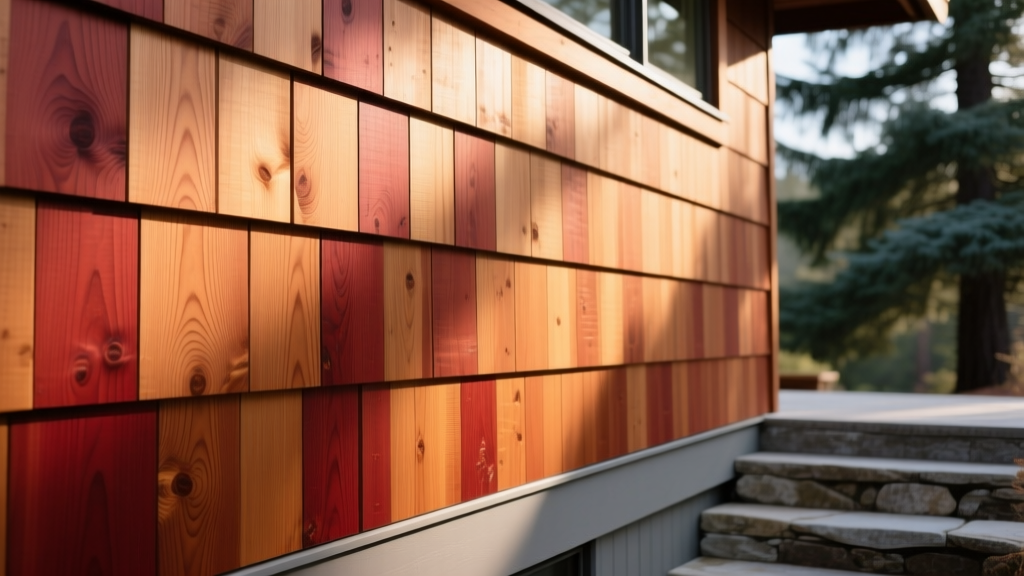
Profile Selection & Dimensional Tolerances
According to the USDA Forest Products Laboratory, the profile you choose dictates how water is managed across the wall assembly. Furthermore, board width limitations must be respected to prevent mechanical failure.
Bevel (Lap) Siding
The most common profile, featuring a tapered cross-section. It sheds water effectively but creates a shadow line. Limitation: Do not use bevel siding wider than 8 inches (actual face exposure). Wider boards will cup at the bottom edge as the exposed face dries faster than the back face, eventually pulling the nails through the wood.
Board and Batten
A vertical application using wide boards covered by narrow battens. This profile accommodates wider boards (up to 12 inches) because the batten physically restrains the edges of the main board from cupping. It requires a minimum 1/2-inch air gap behind the boards (a rainscreen assembly) to allow the back face to dry at the same rate as the front.
Tongue and Groove (T&G)
Often used for soffits or modern horizontal applications. T&G is highly susceptible to moisture trapping if installed without a rainscreen gap. If water penetrates the tongue, it has no escape route, leading to concealed rot. Always install T&G siding over a dimpled drainage mat or furring strips.
30-Year Lifecycle Cost Framework
Evaluating types of wood siding strictly on initial material cost is a financial error. A true comparison requires factoring in the cost of scaffolding, scraping, priming, and top-coating over a 30-year period.
| Material | Initial Install Cost (Material + Labor) | Maintenance Events (30 Yrs) | Estimated Maintenance Cost | 30-Year Total Cost |
|---|---|---|---|---|
| Whitewood (Painted) | $8.00 / sq. ft. | 5 Full Repaints | $22.00 / sq. ft. | $30.00 / sq. ft. |
| Cedar (Stained) | $14.00 / sq. ft. | 6 Re-stains | $18.00 / sq. ft. | $32.00 / sq. ft. |
| Redwood (Stained) | $22.00 / sq. ft. | 5 Re-stains | $15.00 / sq. ft. | $37.00 / sq. ft. |
| Acetylated (Coated) | $19.00 / sq. ft. | 3 Re-coats | $9.00 / sq. ft. | $28.00 / sq. ft. |
While whitewood is the cheapest to install, the labor cost of scraping and repainting every 5 to 6 years makes it the most expensive option over three decades. Acetylated wood and premium cedar, despite higher upfront costs, yield a lower total cost of ownership due to extended maintenance intervals and superior substrate longevity.
Final Decision Matrix
Use this framework to finalize your specification based on project constraints:
- Choose Pine/Whitewood if: The project has a strict initial budget cap, the siding will be painted a dark color (requiring high-hide acrylics), and the homeowner is committed to a strict 5-year repainting schedule.
- Choose Western Red Cedar if: The design calls for a natural wood aesthetic, penetrating stains are preferred over paint, and local suppliers stock high-grade STK or Clear material.
- Choose Redwood if: Budget is secondary to extreme dimensional stability, the architectural style requires wide board-and-batten profiles, and premium 'Heart' grades are accessible.
- Choose Acetylated Wood if: The project demands a 50-year structural warranty, requires complex milled profiles with tight tolerances, and the goal is to minimize lifetime maintenance scaffolding costs.
Written by
David NakamuraDavid Nakamura is a licensed architect (AIA) and construction technology writer focused on sustainable building methods, mass timber engineering, and high-performance building envelopes. He holds a Master of Architecture from the University of Washington and is a certified Passive House Consultant (CPHC). David spent eight years at the Seattle firm Mithun, where he led the design of three LEED Platinum projects, before founding his own practice specializing in net-zero residential design. He serves on the editorial advisory board of GreenBuilder Magazine and has authored peer-reviewed papers on cross-laminated timber (CLT) connections for the Journal of Structural Engineering. In his spare time, David teaches woodworking at Pratt Fine Arts Center and kayaks the Puget Sound.
More from David Nakamura
View all
Construction Cost
Labor Cost to Build a Deck Per Sq Ft: 2026 Installation Guide
Discover the exact labor cost to build a deck per sq ft in 2026. This installation guide breaks down contractor rates, complexity factors, and hidden fees.
Aug 4, 2026

Construction Cost
How Much Does It Cost to Build a 3 Bedroom House? Financing Guide
Learn exactly how much it costs to build a 3 bedroom house and explore 2026 financing options, construction loan types, and budget frameworks for your build.
Aug 4, 2026

Construction Cost
Cost to Build a Tennis Court: 2026 Guide
How much does it cost to build a tennis court in 2026? Breakdowns for asphalt, concrete, and synthetic surfaces plus fencing and lighting.
Jul 30, 2026