Types of Wood Filler: Matching Compounds to Wood Species
Discover the best types of wood filler for every hardwood species. Learn chemical compatibility, stain matching, and expert application techniques.

The Chemistry of Wood Fillers: Why Species Matching Matters
Selecting the correct wood filler is not a one-size-fits-all decision; it is a chemical and anatomical matching process. Wood is a hygroscopic, anisotropic material that expands, contracts, and exudes natural compounds based on its species. When repairing a gouge, knot hole, or checking split, the filler must mimic the mechanical properties of the surrounding timber while remaining chemically compatible with your final finish. According to finishing guidelines published by the USDA Forest Products Laboratory, mismatching a filler's binder to the wood's cellular structure is the leading cause of finish rejection, filler sinkage, and halo-effect staining.
To achieve invisible repairs, woodworkers and contractors must understand the four primary binder chemistries used in modern fillers and how they interact with specific wood anatomies—from the open pores of red oak to the resin canals of southern yellow pine.
The 4 Primary Types of Wood Filler (Comparison Matrix)
Before matching a filler to a species, you must understand the baseline performance metrics of the four dominant chemical formulations available on the market.
| Filler Type | Base Binder | Shrinkage Rate | Stainability | Best Use Case | Avg. Cost (2026) |
|---|---|---|---|---|---|
| Water-Based | Cellulose / Wood Flour | 15% - 30% | Excellent (Absorbs stain) | Interior closed-grain woods, nail holes | $12 - $18 / pint |
| Solvent-Based | Nitrocellulose / Lacquer | 5% - 10% | Poor (Resists stain) | Fast-dry repairs, pre-finished matching | $10 - $15 / pint |
| Epoxy (2-Part) | Bisphenol-A Resin | < 1% | None (Must be tinted) | Structural repairs, deep voids, exotics | $45 - $65 / quart |
| Polyurethane | Moisture-curing PU | 0% (Expands slightly) | Moderate | Exterior applications, rot repair | $20 - $25 / tube |
Species-Specific Filler Selection Guide
The cellular structure and extractive content of a wood species dictate which filler chemistry will yield a permanent, invisible repair. Below is the definitive species-to-filler mapping guide.
1. Open-Grain Hardwoods (Red Oak, Ash, Mahogany, Hickory)
Open-grain species feature large, continuous pores (vessels) that require high-solids fillers to prevent deep sinkage. Water-based cellulose fillers (like standard TimberMate) will shrink drastically in deep oak pores, requiring 3 to 4 application coats.
- Recommended Filler: Solvent-based lacquer fillers (e.g., Famowood Original) or specialized paste wood grain fillers. For deep structural checks, use a low-viscosity 2-part epoxy.
- Pro-Tip for Red Oak: Red oak lacks tyloses (the cellular plugs found in white oak), making it highly porous. If using a water-based filler, thin it by 10% with water to allow it to wick deep into the vessels before it skins over, then overfill by 20% to account for evaporation shrinkage.
2. Closed-Grain Hardwoods (Hard Maple, Cherry, Birch, Poplar)
Closed-grain woods have tight, dense cellular structures with minimal surface porosity. The primary challenge here is not shrinkage, but stain blotchiness. Because these woods absorb stain unevenly, a filler that absorbs stain differently than the surrounding wood will create a glaring "halo" effect.
- Recommended Filler: High-quality water-based wood fillers (e.g., TimberMate or Elmer's ProBond). These contain fine wood flour that mimics the end-grain absorption of maple and cherry.
- Pro-Tip for Cherry: Cherry darkens naturally with UV exposure over time. Use a water-based filler that is slightly lighter than the current wood color, as the surrounding cherry will oxidize and darken to match the repair over 6 to 12 months.
3. Softwoods & Resinous Woods (Pine, Fir, Cedar, Spruce)
Softwoods present a unique chemical hurdle: resin exudation. Woods like Southern Yellow Pine and Douglas Fir contain active resin canals. When subjected to heat (like direct sunlight) or friction from sanding, these resins bleed to the surface and will dissolve water-based and standard solvent-based fillers, causing them to detach from the void.
- Recommended Filler: 2-part epoxy (e.g., System Three T-88) or shellac-based stick fillers for minor cosmetic dents.
- Preparation Requirement: You must seal the resin canals before filling. Wipe the void with denatured alcohol, apply a 1-lb cut of dewaxed shellac (like Zinsser SealCoat) to lock in the pitch, and then apply your epoxy or polyurethane filler.
4. Exotic & Oily Hardwoods (Teak, Ipe, Rosewood, Ebony)
Exotic species are prized for their density and natural oils (extractives). Teak contains tectones and natural silica; Ipe contains lapachol. These natural oils act as a chemical release agent, preventing standard water-based and solvent-based fillers from achieving a mechanical bond. Furthermore, the American Wood Council notes that the extreme density of these species leaves no room for filler expansion.
- Recommended Filler: 2-part structural epoxy. You must pre-tint the epoxy with universal colorants or dry pigment powders to match the heartwood exactly, as epoxy will not accept penetrating stains.
- Preparation Requirement: Wipe the repair area aggressively with acetone or naphtha immediately before mixing the epoxy. This temporarily strips the surface oils, giving you a 15-minute window to apply the filler before the oils migrate back to the surface.
⚠ The "Shrinkage and Sink" Failure Mode
The most common failure in wood filling is "sinkage"—where the filler dries below the surface plane of the wood. This occurs when the solvent or water carrier evaporates, leaving only the solid binder behind. Rule of Thumb: If your filler shrinks more than 5% (typical of water-based products), you must overfill the void by creating a distinct convex dome above the wood surface. Never attempt to trowel a water-based filler perfectly flush in a single coat; it will inevitably sink below the finish line upon curing.
Staining and Finishing: The Ultimate Compatibility Test
A filler is only as good as its ability to disappear under a finish. The interaction between filler chemistry and topcoat chemistry dictates the final aesthetic.
The Golden Rule of Staining: Water-based fillers absorb water-based and oil-based stains. Solvent-based (lacquer) fillers resist almost all stains. Epoxy resists all stains. Polyurethane fillers absorb oil-based stains but repel water-based stains.
If you are using a dark penetrating stain (like Minwax Dark Walnut or Varathane Kona) on an open-grain wood, do not use a pre-colored solvent filler. The stain will not penetrate the lacquer binder, leaving a light, unblended spot. Instead, use a raw, untinted water-based filler, apply it, sand it flush, and then apply your stain. The wood flour in the water-based filler will absorb the stain and match the surrounding end-grain.
Expert Application Protocol for Structural and Cosmetic Repairs
Follow this precise sequence for deep voids (greater than 1/4 inch) in hardwood flooring or structural timber to ensure maximum adhesion and zero sinkage.
- Undercut the Void: Use a 1/4-inch chisel or a rotary Dremel tool with a burr bit to undercut the edges of the hole. The cavity should be wider at the bottom than at the surface, creating a mechanical "dovetail" lock for the filler.
- De-dust and Degrease: Vacuum the void with a brush attachment. Wipe the interior with a lint-free cloth dampened with denatured alcohol to remove microscopic dust and surface oils.
- First Coat (The Bonding Layer): For deep holes, thin your first layer of water-based filler with 5-10% water. Force it into the walls of the void using a flexible steel putty knife. Let this cure completely (approx. 2 hours). This acts as a primer.
- Second Coat (The Build Layer): Apply full-bodied filler directly from the container. Overfill the void by at least 1/16th of an inch to create a dome. Allow to cure for 4 to 6 hours depending on ambient humidity.
- Sanding Sequence: Do not use aggressive 80-grit paper on the final pass, as it will dish out the softer filler while leaving the harder surrounding wood intact. Sand flush using a hard block with 120-grit, followed by 180-grit. Always sand with the grain to avoid cross-grain scratches that will highlight the repair under a clear coat.
Frequently Asked Questions
Can I mix sawdust with wood glue to make my own filler?
While mixing PVA wood glue (like Titebond) with sanding dust is a common site-trick, it is generally discouraged for fine woodworking. PVA glue dries with a high plasticity and does not accept stain. The resulting repair will look like a dark, muddy patch under any penetrating stain or clear polyurethane. Reserve this method only for structural, paint-grade applications where aesthetics are irrelevant.
How do I fill a knot hole in live-edge walnut without it cracking later?
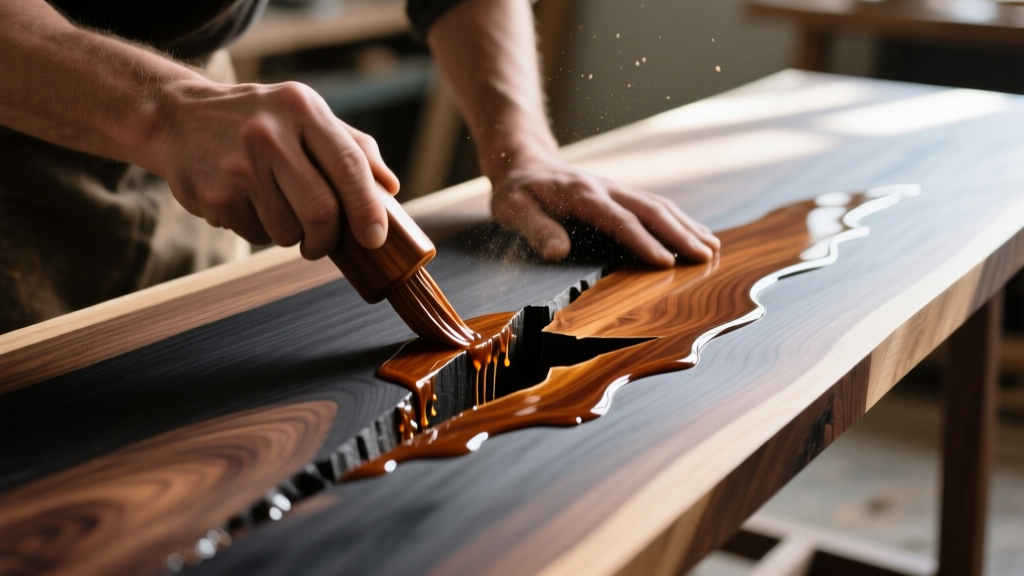
Knots move independently of the surrounding wood due to differences in radial vs. tangential shrinkage rates. Use a flexible, low-modulus 2-part epoxy (such as TotalBoat MakerPoxy or System Three Clear Coat). Tint it with black or brown mica powder. The epoxy will flex slightly with seasonal humidity changes, whereas rigid solvent fillers will crack and pop out of the knot void during winter contraction.
Written by
Priya KapoorPriya Kapoor is a real estate market analyst and construction economics researcher with expertise in housing affordability, development feasibility, and infrastructure investment. She holds a Master of Regional Planning from Cornell University and previously worked as a senior analyst at CBRE's Investment Properties group, where she modeled returns for $4B in mixed-use development pipelines. Priya now runs an independent research practice advising developers, municipalities, and REITs on construction cost forecasting and market timing. She publishes the quarterly "BuildMat Market Pulse" report tracking material price indices across 12 commodity categories. Based in Austin, TX, Priya serves on the board of Habitat for Humanity Austin and is a marathon runner.
More from Priya Kapoor
View all
Construction Cost
Cost to Build a 1600 Sq Ft Home in 2026: Full Breakdown
Accurate 2026 cost to build a 1600 sq ft home—material, labor, and regional pricing breakdowns included. Plan your budget with real-time estimates.
Aug 11, 2026

Wood & Lumber
Name the Types of Wood for Pressure Treatment and Preservation
Learn how to name the types of wood best suited for pressure treatment. Compare species treatability, chemical retention levels, and 2026 preservation costs.
Aug 4, 2026

Stone & Masonry
Stone Veneer Suppliers Lindenhurst: 2026 Cost Analysis
Analyze 2026 stone veneer costs in Lindenhurst, NY. Compare local supplier pricing, delivery fees, and Suffolk County installation labor rates.
Aug 4, 2026