Hardest Type of Wood: Janka Scale Comparison & Use Cases
Discover the hardest type of wood using the Janka scale. Compare Ipe, Lignum Vitae, and Hickory for cost, workability, and structural use cases.

Defining the Hardest Type of Wood: The Janka Standard
When architects, flooring contractors, and structural engineers search for the hardest type of wood, they are quantifying resistance to denting, wear, and abrasion. In the lumber industry, this metric is strictly defined by the Janka hardness test, standardized under ASTM D143. The test measures the force required to embed a 0.444-inch (11.28 mm) steel ball halfway into the wood grain. The resulting figure, expressed in pounds-force (lbf) or Newtons, provides an objective baseline for comparing species.
However, extreme hardness introduces severe trade-offs in workability, tool wear, and structural brittleness. Selecting the right material requires balancing the Janka rating against moisture movement, fastening requirements, and project economics. Below is a comprehensive comparison of the hardest woods available for construction and finish applications.
The Contenders: Top 5 Hardest Wood Species
1. Australian Buloke (Janka: 5,060 lbf)
Widely recognized as the hardest type of wood on the planet, Australian Buloke (Allocasuarina luehmannii) is an ironwood native to Australia. While it holds the top Janka rating, its commercial availability outside of Australia is virtually non-existent due to strict export regulations and limited harvesting. It is primarily used in specialized heavy-duty flooring and tool handles within its native region.
2. Quebracho (Janka: 4,570 lbf)
The name Quebracho translates to 'axe-breaker,' a fitting moniker for Schinopsis brasiliensis. Native to South America, this wood is exceptionally dense (specific gravity of 1.15). It is rarely used for finish carpentry or residential flooring. Instead, its primary applications include heavy structural pilings, marine dock supports, and industrial cross-ties where high decay resistance and extreme compressive strength are required.
3. Lignum Vitae (Janka: 4,390 lbf)
Historically used for the stern tube bearings of submarines and marine shafts due to its natural oils and self-lubricating properties, Lignum Vitae (Guaiacum officinale) is now heavily restricted under CITES Appendix II. Sourcing new timber is nearly impossible; the market relies on reclaimed or salvaged stock, pushing prices well beyond standard construction budgets.
4. Ipe / Brazilian Walnut (Janka: 3,510 lbf)
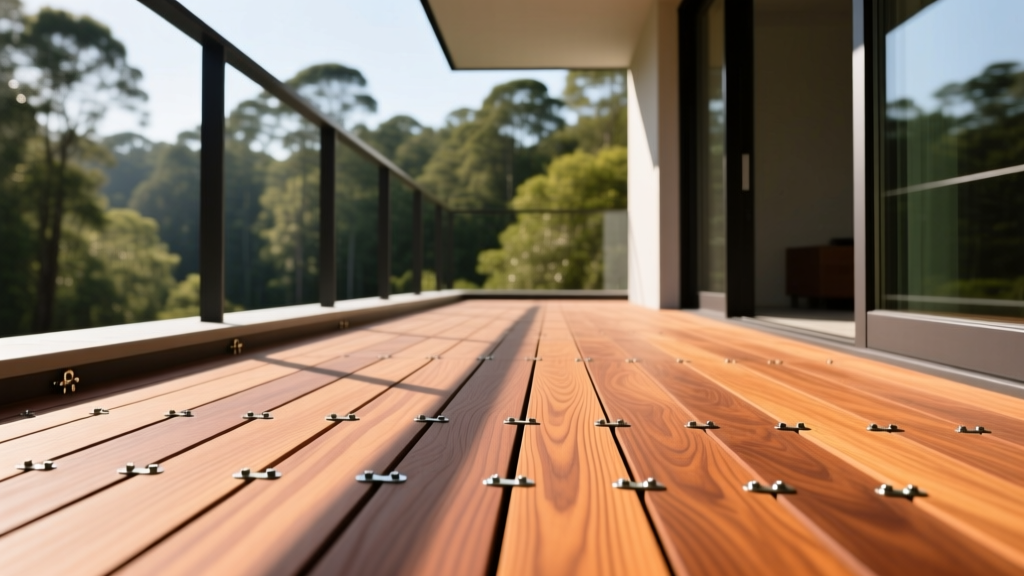
Ipe (Handroanthus spp.) is the practical king of ultra-hard woods. It is the hardest type of wood that is readily available in commercial volumes for exterior decking, boardwalks, and high-traffic commercial flooring. With a Class A fire rating (matching steel and concrete) and natural resistance to rot and insects, Ipe dominates the premium exterior lumber market.
5. Hickory (Janka: 1,820 lbf)
For interior applications and domestic sourcing, Hickory (Carya spp.) is the hardest commercially harvested North American hardwood. It is the benchmark for heavy-duty interior flooring, cabinetry, and tool handles. While its Janka rating is roughly half that of Ipe, it offers a vastly superior strength-to-weight ratio and is significantly easier to mill and finish.
Cost, Availability, and Application Matrix
Pricing reflects early 2026 market averages for surfaced, kiln-dried (or air-dried for exterior species) lumber in standard dimensional sizes. Prices fluctuate based on FSC certification and import tariffs.
| Wood Species | Janka Rating (lbf) | Avg. Cost (per Board Foot) | Primary Use Case | Commercial Availability |
|---|---|---|---|---|
| Australian Buloke | 5,060 | N/A (Export Restricted) | Specialty tool handles | Extremely Low |
| Quebracho | 4,570 | $18.00 - $24.00 | Marine pilings, heavy timber | Low (Specialty Import) |
| Lignum Vitae | 4,390 | $45.00+ (Reclaimed) | Marine bearings, mallets | Very Low (CITES Restricted) |
| Ipe (Brazilian Walnut) | 3,510 | $12.00 - $18.00 | Exterior decking, boardwalks | High (FSC Certified Available) |
| Hickory (Pecan) | 1,820 | $5.50 - $8.50 | Interior flooring, cabinetry | Very High (Domestic US) |
The Workability Penalty: Tool Wear and Milling
Warning: Tool Degradation on Ultra-Hard Species
Milling woods with a Janka rating above 3,000 lbf accelerates tool wear exponentially. Standard High-Speed Steel (HSS) planer blades will dull within 50 to 100 linear feet when surfacing Ipe or Quebracho. Contractors must use carbide-tipped router bits and saw blades. Even with carbide, expect to sharpen or replace blades after every 800 to 1,000 board feet. Furthermore, the silica content naturally present in species like Ipe acts as an abrasive, necessitating specialized dust collection systems to prevent respiratory hazards and motor burnout.
Fastening and Installation Protocols
You cannot drive a standard nail or screw directly into the hardest types of wood without causing the fastener to shear or the wood to split. The compressive strength perpendicular to the grain is simply too high to allow for displacement. According to the National Wood Flooring Association (NWFA) and exterior decking manufacturers, specific fastening protocols must be followed.
- Pre-Drilling is Mandatory: For Ipe, a #8 or #10 stainless steel screw requires a 15/64-inch or 13/64-inch pilot hole. The pilot hole must be exactly the diameter of the screw's root (minor diameter) to ensure thread engagement without creating outward hydrostatic pressure that splits the board.
- Clearance Holes for the Top Board: When face-fastening, the top board must have a clearance hole (slightly wider than the screw's major diameter) so the threads only bite into the underlying joist, pulling the two pieces tightly together.
- Hidden Fastener Systems: For premium decking, hidden clip systems (such as Tiger Claw or Eb-Ty) routed into the board edges are preferred. This eliminates face-plugs and prevents the moisture traps that lead to localized end-grain checking.
- End-Grain Sealing: Ultra-dense woods are highly susceptible to end-grain checking as moisture escapes rapidly from the exposed longitudinal cells. Apply a commercial wax-based end sealer (like Anchorseal) immediately upon cutting, especially on boards wider than 6 inches.
Hardness vs. Structural Strength: A Critical Distinction
A common engineering misconception is equating the 'hardest type of wood' with the 'strongest type of wood.' Hardness (Janka) measures localized surface indentation. It does not dictate Modulus of Rupture (MOR - bending strength) or Modulus of Elasticity (MOE - stiffness).
'While Ipe boasts a Janka rating nearly double that of White Oak, its Modulus of Elasticity (approx. 3,150,000 psi) is only marginally higher. For structural beams where deflection limits govern the design, laminated veneer lumber (LVL) or dense structural softwoods like Douglas Fir-Larch often provide superior span capabilities at a fraction of the weight and cost.' — USDA Forest Products Laboratory, Wood Handbook
Therefore, specifying Quebracho or Buloke for structural framing is an inefficient use of capital. These species are heavy, difficult to connect, and offer diminishing returns in bending strength compared to engineered wood products. Reserve ultra-hard woods for applications where surface abrasion, impact resistance, and biological decay are the primary failure modes.
Acclimation and Moisture Content Thresholds
Dense tropical hardwoods have tightly packed cellular structures, which slows moisture exchange but does not eliminate it. When installing Ipe or Hickory flooring, acclimation is non-negotiable.
Interior Flooring (Hickory)
Hickory is notoriously reactive to humidity swings. It must be acclimated to the home's Equilibrium Moisture Content (EMC), typically between 6% and 9%. Installers should leave a minimum 3/4-inch expansion gap at the perimeter. Failure to do so will result in catastrophic cupping or buckling during summer humidity spikes, as the high density of the wood generates immense expansive force.
Exterior Decking (Ipe)
Ipe is typically air-dried to a moisture content of 12% to 15%. Unlike interior flooring, exterior wood will continually cycle with ambient weather. To manage tangential and radial shrinkage (Ipe shrinks about 6.6% radially and 8.0% tangentially from green to oven-dry), use shiplap or hidden clip systems that allow for 1/8-inch to 3/16-inch lateral movement between boards. Never install Ipe tightly edge-to-edge.
Summary: Choosing the Right Hardwood
The hardest type of wood for your project depends entirely on the application environment. For heavy-traffic exterior commercial decking, Ipe remains the undisputed standard, balancing extreme Janka hardness with viable supply chains. For interior residential flooring requiring maximum dent resistance from pets and foot traffic, domestic Hickory provides the best economic and workable solution. Reserve the exotic ultra-hardwoods like Lignum Vitae and Quebracho for specialized marine or heavy industrial applications where their unique physical properties justify the procurement and fabrication costs.
Written by
James ThorntonJames Thornton is a construction industry veteran with 25 years of hands-on experience in wood framing, lumber grading, and residential building codes. He started as a framing carpenter in rural Oregon, earned his ICC Residential Building Inspector certification, and eventually became a senior plan reviewer for the City of Portland Bureau of Development Services. James holds a B.S. in Wood Science & Technology from Oregon State University and is a certified lumber grader through the West Coast Lumber Inspection Bureau (WCLIB). He has inspected over 3,000 residential construction sites and authored the city's internal guide on advanced framing techniques (2x6 at 24" O.C.). James lives in Bend, OR, where he builds custom timber-frame cabins and competes in lumberjack sports.
More from James Thornton
View all
Insulation
Best Home Insulation Materials: Complete 2026 Guide
Compare top home insulation materials for 2026. Find R-values, installed costs per square foot, and best uses for fiberglass, spray foam, and mineral wool.
Aug 4, 2026

Sustainable Building
Certify Your Green Building Material for LEED and WELL
Step-by-step guide to certifying a green building material for LEED v5 and WELL v2. Master EPDs, HPDs, and VOC limits for 2026 project specifications.
Aug 4, 2026

Stone & Masonry
Veneer Stacked Stone Panels: Interior Design & Style Showcase
Discover how veneer stacked stone panels transform interiors. Explore modern design profiles, material pairings, and technical installation specs.
Aug 4, 2026