Types of Walnut Wood: Selection Framework for Millwork
Compare types of walnut wood including Black, English, and Claro. Use this selection framework to choose the right species for millwork and flooring.

The Walnut Selection Matrix: Matching Species to Application
Specifying walnut for architectural millwork, custom cabinetry, or high-end flooring requires moving beyond the generic "walnut" label. The commercial market encompasses several distinct species and hybrids, each with unique density profiles, grain characteristics, and pricing structures. Selecting the wrong variant can result in blown budgets, finishing failures, or inadequate structural performance for the intended application.
This selection framework breaks down the primary types of walnut wood available to North American builders and woodworkers, providing exact mechanical properties, 2026 market pricing, and specific application protocols to ensure your material specification aligns with your project parameters.
Black Walnut (Juglans nigra): The North American Standard
Eastern Black Walnut is the baseline against which all other commercial walnuts are measured. Sourced primarily from the Ohio River Valley and the central hardwood region, it is the default choice for 90% of domestic walnut millwork.
- Janka Hardness: 1,010 lbf
- Specific Gravity (Basic): 0.51
- Crushing Strength: 7,580 lbf/in²
- Current Market Pricing (4/4 FAS): $9.50 – $13.00 per board foot
Black walnut heartwood ranges from a pale brown to a deep, rich chocolate, often with darker brown streaks. The sapwood is sharply demarcated and pale yellowish-white. According to the Wood Database, Black Walnut exhibits excellent dimensional stability, with a radial shrinkage of 5.5% and tangential shrinkage of 7.8%, giving it a highly favorable T/R ratio of 1.4. This low movement ratio makes it an exceptional choice for wide-panel cabinet doors and long-run baseboards where seasonal gapping is a primary concern.
Many commercial mills steam Black Walnut lumber to darken the pale sapwood, attempting to blend it with the heartwood. While this increases the usable yield of the board, steamed sapwood does not accept stain or oil finishes identically to natural heartwood. Under UV exposure, the steamed sapwood will fade and reveal a distinct color mismatch over time. For clear-finished premium millwork, specify "unsteamed" or "air-dried" Black Walnut and plan for sapwood removal.
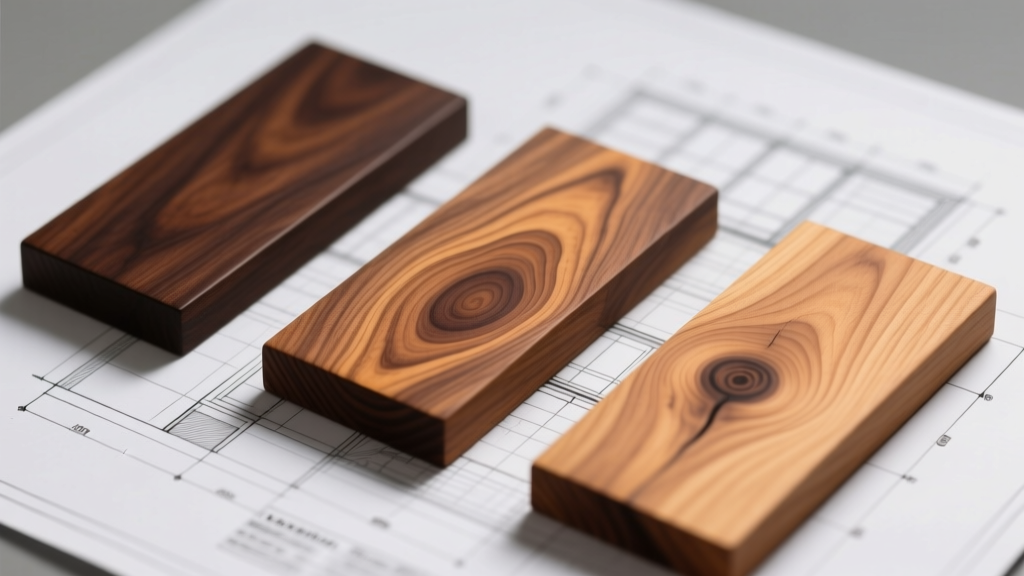
English Walnut (Juglans regia): The European Elegance
Often referred to as European Walnut or Circassian Walnut, this species is prized for its complex, highly figured grain patterns and slightly lighter, purplish-brown hue. It is the primary source of high-end architectural veneers and luxury gunstocks.
- Janka Hardness: 1,220 lbf
- Specific Gravity (Basic): 0.56
- Current Market Pricing (4/4 FAS): $14.00 – $19.00 per board foot
English Walnut is generally harder and denser than its American counterpart. The grain is frequently interlocked or wavy, producing stunning fiddleback, mottled, or burl figures. Because it is primarily grown in orchards for nut production, large, clear, solid-sawn lumber is rare and commands a heavy premium. Specify English Walnut for executive boardroom paneling, luxury yacht interiors, or as a book-matched veneer over MDF substrates for large-scale wall treatments where solid wood movement would be problematic.
Claro Walnut (Juglans hindsii): The Figured Showpiece
Native to California and Oregon, Claro Walnut is celebrated for its dramatic marbling, intense chatoyance, and vibrant streaks of red, gold, and black. It is rarely used for full-room millwork due to its cost and intense visual weight; instead, it serves as an accent material.
- Janka Hardness: 1,130 lbf
- Specific Gravity (Basic): 0.54
- Current Market Pricing (Figured/Burl): $25.00 – $60.00+ per board foot
Claro Walnut is frequently used as the rootstock for grafted English Walnut orchards. The graft union produces massive, highly figured burls that are harvested for live-edge slabs, reception desks, and luxury inlays. When specifying Claro, buyers are purchasing visual impact rather than structural predictability. The interlocked grain can cause severe tearout during planing and routing; specify that your millwork fabricator uses helical cutterheads and takes light passes (under 1/32") to preserve the figured surface.
Bastogne Walnut: The Hybrid Powerhouse
Bastogne (often sold under the trademarked name "Paradox") is a sterile hybrid cross between English Walnut and Claro Walnut, originally developed by horticulturist Luther Burbank. It combines the rapid growth rate of the Claro with the dense, workable wood of the English Walnut.
- Janka Hardness: 1,260 lbf
- Specific Gravity (Basic): 0.58
- Current Market Pricing (4/4 FAS): $12.00 – $16.00 per board foot
Bastogne is noticeably heavier and harder than Black Walnut. The heartwood is a medium to dark brown with distinct reddish undertones. It machines exceptionally well and holds sharp edges, making it an excellent choice for high-wear applications like stair treads, heavy-use countertops, and custom flooring where Black Walnut's 1,010 lbf Janka rating might be too soft to resist denting from heavy foot traffic or dropped objects.
Decision Framework: Application Matching Matrix
Use the following matrix to align your project requirements with the optimal walnut species. This prevents over-specifying expensive figured woods for hidden structural components or under-specifying soft woods for high-abrasion zones.
| Application | Recommended Species | Critical Specification Requirement |
|---|---|---|
| Full-Room Cabinetry | Black Walnut | Specify "unsteamed" to ensure uniform UV aging and consistent oil absorption. |
| High-Traffic Flooring | Bastogne / English | Require Janka >1,200 lbf. Specify quartersawn stock to minimize seasonal gapping. |
| Large Wall Paneling | English Walnut (Veneer) | Book-matched veneer over MDF core to prevent checking and warping on large elevations. |
| Live-Edge Slabs / Accents | Claro Walnut | Verify kiln-drying to 8-10% MC; burl crotches harbor high internal tension and hidden moisture pockets. |
| Stair Treads / Handrails | Bastogne / Black Walnut | Use Bastogne for treads (dent resistance); Black Walnut for handrails (superior tactile warmth and workability). |
Sourcing and Grading: The NHLA Walnut Exception
One of the most common procurement errors in architectural woodworking is misunderstanding how walnut is graded. The National Hardwood Lumber Association (NHLA) applies special, more lenient grading rules specifically for Walnut compared to other hardwoods like Oak or Maple.
Managing Sapwood and Yield Expectations
Standard NHLA FAS (First and Seconds) grading requires a minimum of 83.3% clear-face yield. However, Walnut FAS only requires a 66.6% clear-face yield (the same as standard Selects). Furthermore, standard FAS requires the clear cuttings to be on the heartwood, but Walnut FAS permits sapwood on the clear face.
If your project requires 100% heartwood on the visible faces of your millwork, purchasing standard FAS Walnut will result in massive waste factors. You must explicitly specify "FAS, 90%+ Heartwood on one face" to your lumber distributor, which will incur a 15-25% premium over standard FAS pricing but will ultimately lower your net cost by reducing shop waste and sorting labor.
Fastener Reactivity and Finishing Protocols
Walnut contains high levels of tannins and juglone. When these compounds contact iron or mild steel in the presence of moisture, they trigger a severe chemical reaction that produces black, indelible stains (similar to iron gall ink).
- Fastener Specification: Never use standard zinc-plated or galvanized steel fasteners in walnut millwork. Specify 304 or 316 stainless steel, or silicon bronze for all structural fastening, pocket screws, and concealed brackets.
- Clamp Staining: During glue-ups, iron pipe clamps will leave black marks on walnut if the glue squeeze-out contacts the clamp. Use wax paper barriers or switch to aluminum extrusion clamps for walnut assemblies.
Finish Selection for Color Retention
Walnut is unique among dark hardwoods because it actually lightens and warms over time when exposed to UV light, unlike cherry which darkens. To manage this:
- Water-Based Polyurethane: Will lock in the initial cool, dark chocolate color but can impart a "cold" or plastic-like appearance to the grain.
- Oil-Based Polyurethane / Conversion Varnish: Adds an immediate amber shift that mimics the natural long-term UV aging of walnut, providing a richer, warmer aesthetic from day one.
- Penetrating Oils (Tung/Linseed): Enhance the chatoyance and depth of figured Claro and English walnuts better than any film finish, but require strict climate control during the 72-hour cure window to prevent clouding.
Moisture Content and Acclimation Targets
Walnut's excellent dimensional stability does not make it immune to improper acclimation. For interior millwork and cabinetry, specify that your fabricator verifies the lumber moisture content (MC) using a pinless resistance meter before machining.
- Arid / HVAC-Controlled Commercial: 6.0% – 7.5% MC
- Temperate Residential (Northeast/Midwest): 7.5% – 9.0% MC
- Humid / Coastal Residential (South/Pacific NW): 9.0% – 11.0% MC
Never machine walnut directly from a shipping container into a climate-controlled environment. Allow a minimum of 14 days of acclimation in the installation space with the HVAC system running at normal occupancy levels.
By treating walnut not as a monolithic material, but as a spectrum of distinct species with unique mechanical and aesthetic properties, architects and builders can optimize both the budget and the longevity of their high-end interior specifications.
Written by
James ThorntonJames Thornton is a construction industry veteran with 25 years of hands-on experience in wood framing, lumber grading, and residential building codes. He started as a framing carpenter in rural Oregon, earned his ICC Residential Building Inspector certification, and eventually became a senior plan reviewer for the City of Portland Bureau of Development Services. James holds a B.S. in Wood Science & Technology from Oregon State University and is a certified lumber grader through the West Coast Lumber Inspection Bureau (WCLIB). He has inspected over 3,000 residential construction sites and authored the city's internal guide on advanced framing techniques (2x6 at 24" O.C.). James lives in Bend, OR, where he builds custom timber-frame cabins and competes in lumberjack sports.
More from James Thornton
View all
Insulation
Best Home Insulation Materials: Complete 2026 Guide
Compare top home insulation materials for 2026. Find R-values, installed costs per square foot, and best uses for fiberglass, spray foam, and mineral wool.
Aug 4, 2026

Sustainable Building
Certify Your Green Building Material for LEED and WELL
Step-by-step guide to certifying a green building material for LEED v5 and WELL v2. Master EPDs, HPDs, and VOC limits for 2026 project specifications.
Aug 4, 2026

Stone & Masonry
Veneer Stacked Stone Panels: Interior Design & Style Showcase
Discover how veneer stacked stone panels transform interiors. Explore modern design profiles, material pairings, and technical installation specs.
Aug 4, 2026