How to Treat and Preserve Different Types of Wood Walls
Discover the best treatment and preservation methods for different types of wood walls, from log cabins to CLT panels and exterior cladding.

The Vulnerability Matrix: Matching Wall Types to Threats
Wood is a hygroscopic, biodegradable material. When utilized in vertical wall assemblies, its exposure to liquid water, water vapor, ultraviolet (UV) radiation, and wood-destroying organisms (WDOs) varies drastically based on the specific wall typology. Preserving wood requires moving beyond generic sealants and applying chemistry tailored to the assembly's structural mechanics and moisture dynamics.
| Wall Typology | Primary Biological Threat | Primary Physical Threat | Critical Treatment Zone |
|---|---|---|---|
| Solid Log / Heavy Timber | Carpenter bees, wood-boring beetles, decay fungi | UV degradation, checking (splitting) | Exterior exposed faces, end-grains, upward-facing checks |
| Wood-Frame (Stud & Sheathing) | Subterranean termites, mold, dry rot | Capillary moisture, bulk rain intrusion | Bottom plates, sheathing joints, rough openings |
| Mass Timber (CLT / Glulam) | Surface mold during construction phase | Glueline delamination from edge moisture | Panel edges, end-grains, connection hardware pockets |
| Exterior Cladding (Shiplap) | Decay fungi, extractive bleeding | Cupping, dimensional instability | All six sides (back-priming), end joints |
Solid Log and Timber Walls: Deep Penetration Treatments
Solid log walls act as both the structural support and the thermal/moisture envelope. Because the wood is fully exposed to the elements, preservation must address both biological infiltration and surface erosion.
Borate Pre-Treatments for Insect and Fungal Defense
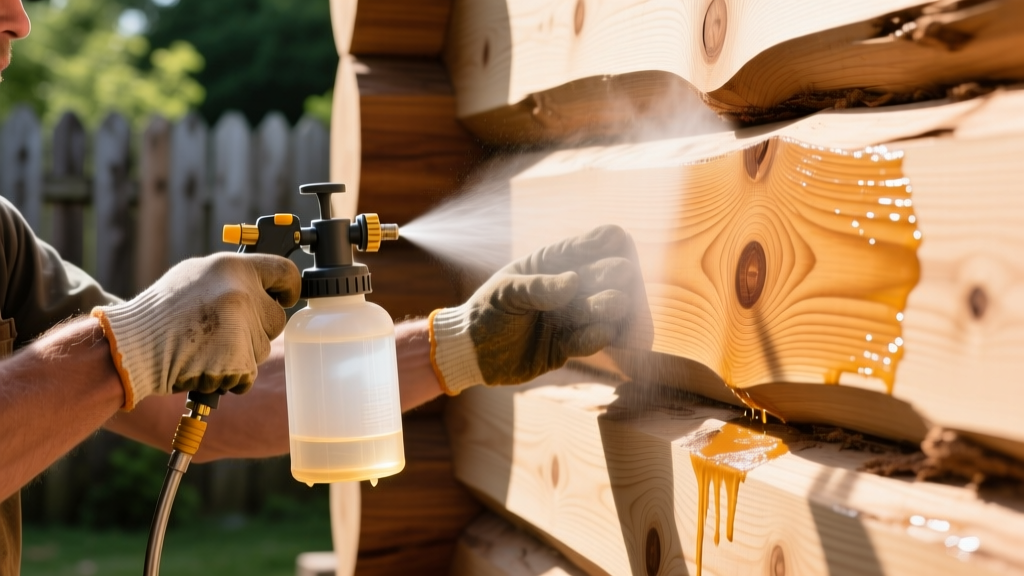
Before applying any UV-protective topcoat, raw or stripped log walls require a deep-penetrating borate treatment. Disodium octaborate tetrahydrate (DOT) is the industry standard. Products like Bora-Care utilize a glycol carrier that pulls the borate deep into the wood cells, providing permanent protection against termites, carpenter ants, and decay fungi. For optimal diffusion, the wood's moisture content (MC) should ideally be above 30%. If treating dry logs (MC below 19%), multiple applications are required to achieve the EPA's mandated retention levels for interior and exterior wood.
Film-Forming vs. Penetrating Finishes
Once the borate has cured, the exterior requires UV and moisture protection. The choice between film-forming and penetrating finishes dictates the maintenance cycle:
- Penetrating Oils (e.g., Timber Pro UV, Logevity): Soak into the wood fibers without creating a surface film. They allow the wood to breathe freely, preventing trapped moisture. Maintenance requires reapplication every 2 to 4 years, but preparation is minimal (just cleaning).
- Film-Forming Finishes (e.g., Sikkens Cetol Log & Siding): Create a flexible, elastomeric membrane on the surface. They offer superior UV resistance and last 5 to 8 years. However, if the log develops a check (crack) that breaches the film, water enters and becomes trapped, leading to rapid localized rot. Rule of thumb: Never apply a film-forming finish to green logs with an MC above 19%.
Wood-Frame and Sheathing Walls: Concealed Preservation
In standard stick-frame construction, the structural wood is concealed behind cladding and drywall. Preservation here relies on pressure-treated lumber, chemical barriers, and advanced water-resistive barriers (WRBs).
AWPA Standards for Sill Plates and Framing
The bottom plate of any exterior wood-frame wall is the highest-risk zone for capillary moisture and termite intrusion. According to the American Wood Protection Association (AWPA), sill plates resting on concrete foundations must be treated to Use Category UC4A (Ground Contact) or UC3B (Above Ground) depending on local code and clearance. Modern micronized copper azole (MCA) and alkaline copper quaternary (ACQ) treatments provide robust decay resistance. Ensure fasteners used with ACQ-treated plates are hot-dipped galvanized or stainless steel to prevent galvanic corrosion.
Fluid-Applied Barriers and Rough Openings
While the studs are protected by the WRB, the sheathing edges and rough openings (windows/doors) are vulnerable. Fluid-applied membranes, such as Prosoco R-Guard FastFlash or Huber's Zip System liquid flash, create a monolithic, rubberized seal that bridges gaps and prevents bulk water from reaching the raw OSB or plywood edges. This is vastly superior to traditional tape-and-housewrap methods, which frequently fail at the folds and staples.
Mass Timber and CLT Walls: Factory vs. Site Treatment
Cross-Laminated Timber (CLT) and Glulam walls represent a shift toward prefabricated, solid-wood envelopes. The primary preservation challenge with mass timber is protecting the gluelines from moisture-induced delamination and managing tannin bleed.
Fresh concrete and certain masonry products are highly alkaline (pH 12+). If CLT panels rest on or connect to uncured concrete without a proper capillary break and chemical-resistant sealant, the alkalinity will break down standard acrylic or polyurethane edge sealants, leading to rapid moisture ingress into the panel core.
Edge Sealing and End-Grain Protection
CLT panels absorb moisture primarily through the end-grain and the lateral edges where the laminations are exposed. During site assembly, any cut edge must be immediately sealed. Polyurethane-based edge sealants or specialized tapes (like Siga Majrex for interior vapor control and Siga Fentrim for exterior air/water sealing) are mandatory. The USDA Forest Products Laboratory emphasizes that mass timber must be allowed to dry to an equilibrium moisture content (EMC) of 12% or less before being enclosed behind vapor-impermeable interior finishes.
Exterior Wood Cladding and Shiplap: UV and Moisture Shielding
Wood cladding (cedar, redwood, thermally modified ash) acts as a sacrificial rain screen. Preservation focuses on dimensional stability and preventing extractive bleeding.
The Six-Sided Back-Priming Protocol
The most common failure in wood shiplap and lap siding is cupping, caused by the back of the board absorbing moisture from the wall cavity while the front dries in the sun. To prevent this, every board must be back-primed on all six sides (face, back, and both edges) before installation. Use a stain-blocking alkyd primer or a specialized acrylic wood primer (e.g., Sherwin-Williams WoodScapes) to seal the wood and prevent water-soluble tannins from bleeding through the topcoat.
Rain Screen Gap Specifications
Wood cladding must never be installed directly against a WRB. A minimum 3/8-inch (10mm) ventilated rain screen gap, created using furring strips or specialized plastic drainage mats (like Keene Driwall), is required. This gap allows hydrostatic pressure to equalize and provides convective drying, effectively doubling the lifespan of the cladding finish.
Decision Framework: Selecting the Right Preservative
Choosing the correct chemical treatment requires a systematic evaluation of the wall's exposure and the wood species:
- Identify the Wood Species: Heartwood of cedar and redwood has natural decay resistance but requires UV protection. Pine and fir have zero natural resistance and mandate borate or copper-based preservatives.
- Assess Moisture Exposure: Will the wood see bulk rain (exterior), capillary rise (sill plates), or only vapor (interior CLT)? Bulk rain requires hydrophobic repellents; capillary rise requires pressure-treated cellular modification.
- Determine Vapor Permeability Needs: If the wood is part of a drying assembly (e.g., a log wall or exterior cladding), use vapor-permeable penetrating oils. If it is an interior structural element, vapor-retarding intumescent fire paints may be appropriate.
- Select the Chemistry: Choose DOT for interior/concealed insect defense, MCA/ACQ for ground-contact framing, and zinc-oxide or transoxide pigmented oils for exterior UV shielding.
Common Preservation Failures and Edge Cases
"The most destructive force to a wood wall is not the rain that hits it, but the moisture that gets trapped inside it by well-intentioned but vapor-impermeable interior paints." — Building Science Corp. Principles of Moisture Management
A frequent edge case occurs when homeowners apply high-gloss, vapor-impermeable latex paints to the interior of log cabins or solid timber walls. During the winter, interior water vapor drives outward through the wood. When it hits the cold exterior surface, it condenses. If the exterior finish is also impermeable, the moisture is trapped within the log, leading to internal decay that is invisible until the wood structurally fails. Always ensure that at least one side of a solid wood wall assembly remains highly vapor-permeable to allow seasonal drying.
Written by
Sarah WhitfieldSarah Whitfield is a chartered quantity surveyor (MRICS) and construction cost analyst with 15 years of experience in material pricing, procurement strategy, and project budgeting. She earned her degree in Construction Management from the University of Reading (UK) and has worked on projects ranging from $2M custom homes to $180M mixed-use developments across North America and Europe. Sarah currently leads cost estimating for BuildMat Insight, maintaining a proprietary database of 4,000+ material price points updated quarterly. She is a frequent contributor to RSMeans cost data panels and has presented at the International Cost Engineering Council (ICEC) congress. Based in Denver, CO, Sarah is an avid trail runner and volunteer mentor for Women in Construction.
More from Sarah Whitfield
View all
Wood & Lumber
What Are the Different Types of Wood? A Builder's Guide
Compare structural softwoods, finish hardwoods, and engineered lumber. Analyze Janka ratings, MOE values, and 2026 pricing for construction.
Aug 4, 2026

Walls & Panels
Steel Framing vs Wood Framing: Corrosion and Moisture Defense
Compare steel framing vs wood framing for moisture resistance. Learn about galvanized coatings, condensation risks, and corrosion protection strategies.
Jul 21, 2026

Stone & Masonry
How to Cut Stone Veneer: Wet Saw vs Grinder Comparison
Compare the best tools for cutting stone veneer. We review wet saws, angle grinders, and chop saws to help you achieve clean, chip-free cuts.
Jul 21, 2026