Best Practices for Installing Different Types of Teak Wood
Master the installation of various types of teak wood. Learn specific fastening, acclimation, and spacing best practices for Burmese and plantation teak.

The Teak Spectrum: Why Species Dictates Installation
Teak (Tectona grandis) is globally revered for its dimensional stability, high natural oil content, and resistance to decay. However, treating all teak as a monolith is a critical installation error. The performance of your decking or flooring hinges on recognizing the distinct mechanical and chemical properties of the specific types of teak wood you are handling. Burmese teak, plantation-grown teak, and alternative 'teaks' (like African or South American) require divergent approaches to fastening, acclimation, and finishing.
Comparative Matrix: Types of Teak Wood
| Teak Variety | Janka Hardness (lbf) | Oil / Silica Content | Movement Coefficient | Primary Use Case |
|---|---|---|---|---|
| Burmese (Old Growth) | 1,000 - 1,155 | Very High / High | Low (Highly Stable) | Marine decking, luxury exterior |
| Plantation (FSC Grown) | 800 - 950 | Moderate / Low | Moderate | Residential decking, interior flooring |
| African (Iroko) | 1,260 | Low / Moderate | Moderate-High | Exterior cladding, heavy-duty decking |
| South American (Cumaru) | 3,330 | Low / Low | High (Prone to checking) | High-traffic commercial decking |
Data sourced from The Wood Database and the USDA Forest Products Laboratory Wood Handbook.
Pre-Installation Acclimation and Moisture Management
Teak is remarkably stable, but it is not immune to hygroscopic movement. Proper acclimation prevents post-installation cupping, gapping, and end-checking.
- Target Moisture Content (MC): For exterior decking, acclimate Burmese teak to an MC of 10-12%. For interior flooring, plantation teak must be acclimated to 6-8% to match the interior HVAC environment.
- Acclimation Timeframe: Stack the boards with 3/4-inch wooden stickers every 16 inches to allow cross-ventilation. Allow 7 to 14 days for exterior stacks, and up to 21 days for interior flooring in climate-controlled spaces.
- End-Grain Sealing: Immediately upon cutting any teak board on-site, apply a commercial wax emulsion sealer (such as Anchorseal) to the exposed end grains. This prevents rapid moisture egress, which is the primary cause of end-checking in dense plantation and South American teaks.
Cutting, Drilling, and Fastening Strategies
The physical density and chemical makeup of teak demand specific hardware and tooling. Using the wrong fasteners will result in catastrophic aesthetic and structural failures.
Tooling Requirements
Because of the high silica content in Burmese and African teak, standard high-speed steel (HSS) bits will blunt within a few dozen holes. Equip your crew with micro-grain carbide-tipped drill bits and 60-tooth or 80-tooth carbide saw blades. When cross-cutting, use a zero-clearance throat plate to minimize tear-out on the interlocked grain.
Fastener Selection
Never use galvanized, zinc-coated, or standard carbon steel fasteners with teak. The natural tannins and oils in teak react with zinc and iron, causing severe black streaking and premature fastener corrosion.
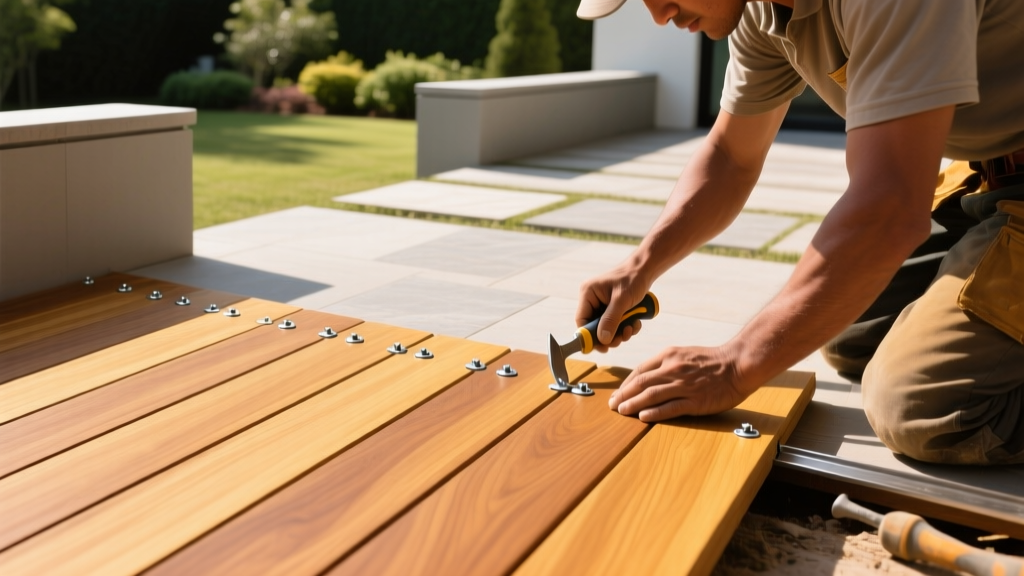
For hidden fastening systems (e.g., Tiger Claw or Eb-Ty), ensure the specific biscuit or clip is rated for the exact thickness of your teak profile (typically 5/4 or 1-inch nominal). Pre-drilling is non-negotiable for face-screwing; drill a pilot hole 80% the diameter of the screw shank to prevent splitting, particularly near the ends of plantation teak boards.
Adhesives for Interior Teak Flooring
When installing types of teak wood as interior engineered or solid flooring, standard PVA (polyvinyl acetate) wood glues will fail. The natural oils (tectoquinones) in teak act as a bond-breaker.
- Solvent Wipe: Immediately before applying adhesive, wipe the back and edges of the teak boards with a clean rag dampened with acetone or denatured alcohol. This temporarily removes surface oils.
- Adhesive Selection: Use a high-quality polyurethane adhesive (like Titebond III or Bona Kemi 850) or a two-part epoxy. These chemistries bite through residual oils and create a waterproof, structural bond.
- Open Time: Apply the adhesive and lay the board within 15 minutes of the solvent wipe. If you wait longer, the teak will bleed natural oils back to the surface, compromising the glue line.
Spacing, Gapping, and Expansion Tolerances
Even with teak's legendary stability, seasonal humidity fluctuations require expansion gaps. The required gap depends on the board width and the specific type of teak wood installed.
| Board Width | Burmese Teak Gap | Plantation Teak Gap | African/South American Gap |
|---|---|---|---|
| 3 to 4 inches | 1/16' to 1/8' | 1/8' | 3/16' |
| 5 to 6 inches | 1/8' to 3/16' | 3/16' to 1/4' | 1/4' to 5/16' |
| Perimeter Walls | Maintain a continuous 1/2' expansion gap around all fixed structures and walls. | ||
Troubleshooting Common Installation Failures
Even experienced crews encounter issues when working with dense tropical hardwoods. Use this diagnostic guide to resolve field problems.
Symptom: Black Streaking Around Fasteners
Cause: Galvanic reaction between teak tannins and non-stainless steel fasteners, or using 304 stainless in a salt-air environment where pitting has occurred.
Fix: Remove the offending fasteners immediately. Clean the black stains using a specialized hardwood deck cleaner containing oxalic acid. Replace with 316 marine-grade stainless steel.
Symptom: Surface Checking (Micro-cracks) on Wide Boards
Cause: Plantation teak dries faster on the surface than the core when exposed to direct UV and wind before finishing, or the boards were installed with an MC below the local equilibrium.
Fix: Apply a penetrating oil finish with UV inhibitors (such as Penofin Hardwood Formula or Ipe Oil) to slow surface moisture loss. For severe checking, sand the surface with 80-grit paper and apply a high-build exterior wood epoxy filler before re-oiling.
Symptom: Adhesive Failure in Interior Flooring
Cause: Failure to solvent-wipe the teak prior to gluing, or using a water-based PVA glue that was repelled by the wood's natural hydrophobic oils.
Fix: Inject a two-part structural epoxy into the hollow voids beneath the loose boards using a syringe. Weight the boards down until the epoxy cures. For future rows, strictly enforce the acetone-wipe protocol.
Final Post-Installation Considerations
Once the types of teak wood you selected are securely fastened, the final step is deciding on surface treatment. Left untreated, all true teaks will weather to a silvery-gray patina within 6 to 12 months due to UV degradation of the surface lignin. If the client desires the original golden-brown hue, a penetrating oil finish must be applied within 48 hours of installation, and reapplied annually. Avoid film-forming finishes like polyurethane or varnish on exterior teak decking; they will peel and blister as the wood expands and contracts, requiring intensive chemical stripping to maintain.
Written by
Marcus ChenMarcus Chen is a licensed structural engineer (PE) and building materials analyst with over 12 years of experience across residential, commercial, and industrial construction. He holds a Master of Science in Civil Engineering from UC Berkeley and spent six years at Thornton Tomasetti before transitioning to independent consulting and technical writing. Marcus specializes in material selection for seismic-prone regions, concrete reinforcement strategies, and lifecycle cost analysis. His work has been cited by the American Concrete Institute (ACI) and the Structural Engineers Association of California (SEAOC). When he is not on a job site or at his desk, you will find him hiking the Sierra Nevada or restoring a 1920s craftsman bungalow in Oakland, CA.
More from Marcus Chen
View all
Construction Cost
How Much Did the Eiffel Tower Cost to Build?
How much did the Eiffel Tower cost to build in 1889? We adjust for inflation and compare its budget to modern skyscraper construction.
Aug 4, 2026

Fire Resistance
What Is a Fire Resistant Material? Testing & Certification Guide
Discover what is a fire resistant material through ASTM and UL testing. Learn how fire ratings, certifications, and assemblies work in construction.
Aug 4, 2026

Construction Cost
How Much Did the Burj Khalifa Cost to Build?
How much did the Burj Khalifa cost to build? We break down the $1.5B project and extract 5 money-saving strategies for your next build.
Jul 30, 2026