Hardwood Floor Types of Wood: Janka Hardness & Cost Guide
Compare the top hardwood floor types of wood by Janka hardness, dimensional stability, and 2026 installed costs to choose the right species.
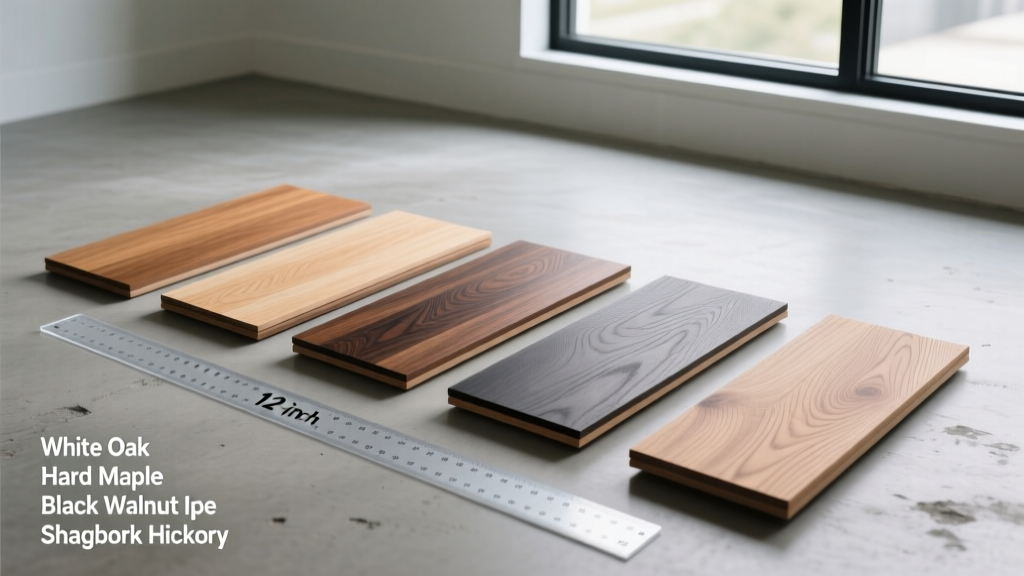
The Science of Hardwood Selection: Beyond Aesthetics
Selecting the ideal wood species for flooring requires looking past grain patterns and stain colors. The long-term performance of solid and engineered hardwood is dictated by cellular density, dimensional stability, and finishing compatibility. According to the USDA Forest Products Laboratory Wood Handbook, wood is a hygroscopic material that constantly exchanges moisture with its environment. This means the specific species you choose will dictate how much your floor expands, contracts, and resists physical denting over decades of use.
While the Janka hardness test measures the force required to embed a 0.444-inch steel ball halfway into the wood, it does not measure dimensional stability. A wood species can be exceptionally hard yet highly prone to cupping in humid environments. This guide breaks down the most common domestic and exotic hardwood floor types of wood, analyzing their structural properties, 2026 market costs, and specific failure modes.
Comprehensive Hardwood Species Comparison Matrix
The following matrix provides a baseline comparison of the most widely specified hardwood species in residential and light commercial construction. Costs reflect 2026 national averages for materials and professional installation (site-finished solid hardwood).
| Wood Species | Janka Hardness (lbf) | Dimensional Stability | Avg Installed Cost (sq ft) | Best Application |
|---|---|---|---|---|
| White Oak | 1,360 | Excellent | $10.00 - $15.00 | High-traffic areas, kitchens, radiant heat |
| Red Oak | 1,290 | Good | $8.50 - $12.50 | Standard residential living spaces |
| Hard Maple | 1,450 | Average | $9.00 - $13.00 | Basketball courts, modern minimalist interiors |
| Hickory | 1,820 | Poor | $11.00 - $16.00 | Rustic aesthetics, low-moisture environments |
| Brazilian Cherry (Jatoba) | 2,350 | Good | $16.00 - $24.00 | Luxury residential, formal dining areas |
| Acacia | 2,300 | Average | $12.00 - $18.00 | High-dent resistance, varied grain aesthetics |
Deep Dive: Domestic Hardwoods
White Oak vs. Red Oak: The Industry Benchmarks
White oak has dominated the flooring market due to its superior water resistance and compatibility with modern wide-plank trends. The cellular structure of white oak contains tyloses—balloon-like outgrowths that plug the vascular tissue, making the wood virtually impermeable to liquids. Red oak lacks tyloses, meaning water spills can quickly wick into the open pores, causing black tannin stains.
Red oak remains a cost-effective alternative, but its pronounced open grain requires more aggressive sanding and filling to achieve the smooth, matte finishes currently trending in architectural design.
Hard Maple: The Dense Minimalist
With a Janka rating of 1,450 lbf, hard maple (sugar maple) is denser than oak. However, its closed-grain structure creates specific finishing challenges. Maple does not absorb penetrating stains evenly, often resulting in severe blotching when dark stains are applied. For this reason, maple is almost exclusively finished with clear coats or light, opaque pigments.
Failure Mode Alert: Maple is highly susceptible to "ambering" (yellowing) when finished with oil-based polyurethane due to UV exposure. To maintain its bright, pale aesthetic, specify a two-part water-based commercial finish (e.g., Bona Traffic HD or Basic Coatings StreetShoe).
Hickory: Maximum Durability, High Moisture Risk
Hickory is the hardest commercially available domestic species at 1,820 lbf. It resists denting from heavy furniture and pet claws better than any other domestic wood. However, its extreme density makes it difficult to mill and sand, increasing labor costs. More critically, hickory has a high tangential shrinkage rate (8.7% compared to white oak's 5.6%). This means hickory is highly reactive to humidity fluctuations and is prone to cupping and gapping if installed in environments without strict climate control (35-55% relative humidity).
Deep Dive: Exotic Hardwoods
Brazilian Cherry (Jatoba) and UV Reactivity
Jatoba is prized for its exceptional hardness (2,350 lbf) and deep reddish-brown color. However, installers and homeowners must account for its extreme photosensitivity. Freshly milled Jatoba is often a pale tan or salmon color. Upon exposure to UV light, it oxidizes and darkens to a rich burgundy within weeks. Area rugs placed on newly installed Jatoba will leave permanent light patches if not moved frequently during the first six months of installation.
Dimensional Stability and Moisture: The Hidden Failure Point
The National Wood Flooring Association (NWFA) identifies moisture-related failures as the leading cause of hardwood floor callbacks. Dimensional stability is measured by comparing a wood's tangential shrinkage (parallel to the growth rings) to its radial shrinkage (perpendicular to the growth rings). Woods with a high tangential-to-radial ratio are more likely to cup.
- Quarter-Sawn vs. Plain-Sawn: Quarter-sawn white oak is cut perpendicular to the growth rings, exposing the medullary rays. This cut reduces tangential shrinkage by nearly 50% compared to plain-sawn boards, making it the mandatory choice for wide-plank installations (over 7 inches) or over radiant heating systems.
- Engineered Hardwood: For below-grade installations (basements) or directly over concrete slabs, solid hardwood is strictly prohibited due to moisture vapor transmission. Engineered hardwood utilizes a cross-plywood core that neutralizes the natural expansion of the top veneer, providing structural stability in high-moisture environments.
Decision Framework: Matching Species to Project Parameters
Use the following framework to select the correct hardwood species based on your specific structural and environmental constraints:
Scenario A: High Moisture / Concrete Subfloor / Below Grade
Decision: Engineered Hardwood only.
Best Species: Engineered White Oak or Engineered European Oak.
Rationale: The plywood core prevents cupping from concrete moisture vapor. Ensure a minimum 3mm wear layer to allow for at least one future sanding.
Scenario B: Radiant Floor Heating System
Decision: Solid Quarter-Sawn or Engineered Hardwood.
Best Species: Quarter-Sawn White Oak, American Cherry, or Engineered Maple.
Rationale: Woods with low dimensional movement and high thermal conductivity perform best. Avoid Hickory and solid wide-plank Maple, as the localized heat will cause severe gapping and checking.
Scenario C: Large Dogs / High Impact Traffic
Decision: Solid Hardwood with a textured finish.
Best Species: Hickory, Brazilian Cherry, or Wire-Brushed White Oak.
Rationale: While Hickory and Jatoba resist denting, any wood will eventually scratch. Specifying a wire-brushed or hand-scraped texture camouflages micro-scratches and pet claw marks far better than a smooth, high-gloss finish.
Frequently Asked Questions
Does a higher Janka rating mean the floor will not scratch?
No. The Janka test measures dent resistance (compressive strength), not scratch resistance (surface shear). A Brazilian Cherry floor (2,350 Janka) will resist heavy furniture dents better than Red Oak (1,290 Janka), but both will scratch equally if subjected to abrasive grit or dog claws. Scratch resistance is dictated by the hardness and elasticity of the applied polyurethane finish, not the wood species itself.
Why is white oak more expensive than red oak in 2026?
White oak commands a 15% to 25% premium over red oak due to surging demand for its neutral, cooler undertones and superior water resistance. Additionally, white oak grows slower and is heavily exported for use in the whiskey and wine barrel cooperage industry, constraining the supply of high-grade flooring lumber.
Written by
David NakamuraDavid Nakamura is a licensed architect (AIA) and construction technology writer focused on sustainable building methods, mass timber engineering, and high-performance building envelopes. He holds a Master of Architecture from the University of Washington and is a certified Passive House Consultant (CPHC). David spent eight years at the Seattle firm Mithun, where he led the design of three LEED Platinum projects, before founding his own practice specializing in net-zero residential design. He serves on the editorial advisory board of GreenBuilder Magazine and has authored peer-reviewed papers on cross-laminated timber (CLT) connections for the Journal of Structural Engineering. In his spare time, David teaches woodworking at Pratt Fine Arts Center and kayaks the Puget Sound.
More from David Nakamura
View all
Construction Cost
Labor Cost to Build a Deck Per Sq Ft: 2026 Installation Guide
Discover the exact labor cost to build a deck per sq ft in 2026. This installation guide breaks down contractor rates, complexity factors, and hidden fees.
Aug 4, 2026

Construction Cost
How Much Does It Cost to Build a 3 Bedroom House? Financing Guide
Learn exactly how much it costs to build a 3 bedroom house and explore 2026 financing options, construction loan types, and budget frameworks for your build.
Aug 4, 2026

Construction Cost
Cost to Build a Tennis Court: 2026 Guide
How much does it cost to build a tennis court in 2026? Breakdowns for asphalt, concrete, and synthetic surfaces plus fencing and lighting.
Jul 30, 2026