Comparing Types of Wood Instruments for Professional Lumber Testing
Compare top types of wood instruments for lumber testing, including moisture meters, calipers, and resistographs, with 2026 pricing and accuracy specs.

The Critical Role of Precision Instruments in Lumber Selection
In the commercial construction and fine carpentry trades, relying on visual inspection to grade timber is a liability. When evaluating the various types of wood instruments available for professional lumber grading, it is essential to distinguish between surface-level estimators and calibrated diagnostic tools. Wood is a hygroscopic, anisotropic material; its dimensional stability, load-bearing capacity, and finish adhesion are entirely dictated by internal moisture gradients and cellular density. According to the USDA Forest Products Laboratory Wood Handbook, a mere 1% change in moisture content (MC) below the fiber saturation point can result in a 0.2% to 0.3% dimensional shift tangentially. In a 20-foot run of white oak flooring, this translates to nearly a half-inch of cumulative expansion or contraction.
This comparison review dissects the primary diagnostic instruments used by lumber inspectors, structural engineers, and master carpenters in 2026. We evaluate specific models, accuracy tolerances, and real-world applications to help you build a reliable testing toolkit.
Pin vs. Pinless Moisture Meters: The Core Diagnostic Debate
Moisture meters are the most ubiquitous types of wood instruments on any job site. However, selecting the wrong technology for your specific lumber profile leads to catastrophic callbacks. The industry divides these tools into two distinct categories: pin-type (resistance) and pinless (electromagnetic capacitance).
Pin-Type Meters: The ASTM D4442 Benchmark
Pin-type meters measure the electrical resistance between two insulated electrodes driven into the wood fibers. Because water conducts electricity, lower resistance correlates to higher moisture. The Delmhorst J-2000 (approx. $385) remains the industry standard for kiln operators and flooring inspectors. Its insulated pins allow users to take differential readings at 1/4-inch, 1/2-inch, and 1-inch depths, revealing internal moisture gradients that cause case-hardening and honeycombing.
- Accuracy: ±0.2% MC between 6% and 30%.
- Best Use Case: Kiln-dried hardwoods, identifying moisture gradients in thick timbers (4/4 to 12/4 stock).
- Limitation: Destructive testing; leaves permanent holes in finish-grade lumber.
Pinless Meters: Electromagnetic Wave Propagation
Pinless meters utilize high-frequency electromagnetic waves to measure the dielectric constant of the wood. The Wagner Meters Orion 950 (approx. $459) utilizes dual-depth scanning (0.25" and 0.75") to instantly map surface-to-core differentials without marring the wood. This is critical when inspecting pre-finished engineered lumber or antique beams where surface damage is unacceptable.
- Accuracy: ±0.5% MC, highly dependent on correct specific gravity (SG) input.
- Best Use Case: Rapid scanning of large board-feet, pre-finished cabinetry, and non-destructive structural inspections.
- Limitation: Cannot measure moisture gradients deeper than 0.75 inches; surface condensation will skew readings artificially high.
Dimensional and Density Testing Instruments
Moisture is only half the equation. Verifying the exact dimensions and cellular density of lumber ensures structural compliance and proper joinery. The Wood Database highlights that specific gravity (SG) directly correlates to fastener withdrawal strength and Janka hardness.
Digital Calipers and Micrometers
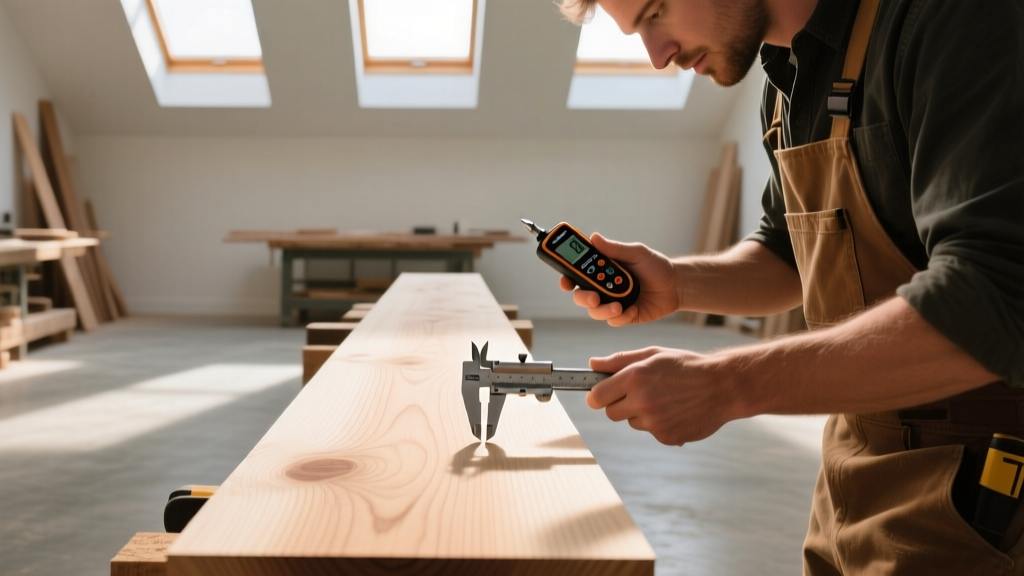
For precision milling and verifying actual dimensions versus nominal dimensions (e.g., confirming a "2x4" is exactly 1.5" x 3.5" after planing), standard tape measures are insufficient. The Mitutoyo 500-196-30 AOS Digimatic Caliper ($135) offers a resolution of 0.0005" (0.01mm) and an accuracy of ±0.001". Its Absolute Origin (AOS) sensor eliminates the need to reset the zero point upon startup, saving critical time during high-volume lumber grading.
Portable Hardness and Density Testers
While the Janka hardness test (ASTM D143) is traditionally a laboratory procedure requiring a universal testing machine, field inspectors verifying the density of reclaimed timber or exotic decking (like Ipe, SG 1.04) use portable durometers and Pilodyn wood testers. The Proceq Pilodyn 6J ($2,800) fires a calibrated pin into the wood at a precise spring force; the penetration depth inversely correlates to wood density and structural integrity.
Advanced Structural and Decay Detection Instruments
When assessing existing structural timber for rot, internal checking, or insect damage, surface instruments are useless. This requires invasive micro-drilling technology.
The Resistograph: Micro-Drilling Resistance
The IML RESI PD-500 (approx. $4,500) is the gold standard for structural engineers evaluating glulam beams, heavy timber trusses, and utility poles. It drives a 1.5mm diameter needle into the wood at a constant feed rate, measuring the drilling resistance and friction. The resulting digital profile instantly maps internal voids, decay pockets, and latewood/earlywood transitions. A sudden drop in resistance on the graph indicates internal rot that is completely invisible from the exterior.
2026 Instrument Comparison Matrix
| Instrument Type | Model Example | 2026 Price Range | Primary Metric | Best Application |
|---|---|---|---|---|
| Pin Moisture Meter | Delmhorst J-2000 | $380 - $420 | Electrical Resistance | Kiln drying, gradient mapping |
| Pinless Moisture Meter | Wagner Orion 950 | $450 - $480 | Dielectric Capacitance | Finish carpentry, rapid scanning |
| Digital Caliper | Mitutoyo 500-196-30 | $125 - $145 | Dimensional (0.0005") | Milling verification, joinery |
| Wood Density Tester | Proceq Pilodyn 6J | $2,700 - $3,000 | Pin Penetration Depth | Reclaimed timber, exotic decking |
| Resistograph | IML RESI PD-500 | $4,200 - $4,800 | Drilling Resistance | Structural beam decay detection |
Decision Framework: Matching the Instrument to Your Workflow
Do not purchase instruments based on brand prestige; purchase them based on your specific material workflow. Follow this decision tree to optimize your capital allocation:
- For Framing and Structural Rough-In: Use a Pinless Meter. You need to scan hundreds of board-feet of SPF (Spruce-Pine-Fir) rapidly to ensure MC is below 19% before enclosing walls. Speed and non-destructive testing are paramount.
- For Hardwood Flooring and Cabinetry: Use a Pin-Type Meter with insulated pins. You must verify that the core of the 3/4" oak flooring is within 2% MC of the plywood subfloor to prevent seasonal cupping and gapping.
- For Historic Renovation and Timber Framing: Deploy a Resistograph. Visual inspection cannot detect internal brown rot in 200-year-old Douglas Fir beams. Micro-drilling provides the structural data required by the local building authority.
- For Millwork and Custom Molding: Rely on Digital Calipers. Verifying the exact tongue-and-groove dimensions to the thousandth of an inch prevents cumulative errors over long runs of custom paneling.
Frequently Asked Questions (FAQ)
Can I use a pinless moisture meter on pressure-treated lumber?
No. Pressure-treated lumber (especially ACQ or Copper Azole formulations) contains high concentrations of dissolved metallic salts and residual moisture from the treatment process. These salts artificially inflate the dielectric constant, causing pinless meters to display erroneously high readings, often maxing out the scale. Always use a pin-type meter with insulated pins for pressure-treated wood, or wait until the wood has fully dried and acclimated.
Do wood temperature and ambient humidity affect digital meter readings?
Yes. Wood temperature significantly alters electrical resistance. If the lumber temperature is below freezing or above 100°F (38°C), pin-type meters will skew low or high, respectively. Premium meters like the Delmhorst J-2000 feature internal thermistors that automatically apply temperature correction algorithms. For pinless meters, extreme surface condensation from high ambient humidity will short-circuit the electromagnetic field, requiring you to wipe the board surface with a dry cloth before testing.
How deep can a standard pinless moisture meter actually read?
Most professional pinless meters penetrate between 0.25 inches and 0.75 inches (6mm to 19mm) into the wood surface. If you are testing 8x8 structural timbers, a pinless meter will only tell you the moisture content of the outer shell. To map the core moisture of thick timbers, you must use a pin-type meter with extra-long, Teflon-coated electrodes driven into pre-drilled holes, or rely on oven-dry testing protocols.
Written by
David NakamuraDavid Nakamura is a licensed architect (AIA) and construction technology writer focused on sustainable building methods, mass timber engineering, and high-performance building envelopes. He holds a Master of Architecture from the University of Washington and is a certified Passive House Consultant (CPHC). David spent eight years at the Seattle firm Mithun, where he led the design of three LEED Platinum projects, before founding his own practice specializing in net-zero residential design. He serves on the editorial advisory board of GreenBuilder Magazine and has authored peer-reviewed papers on cross-laminated timber (CLT) connections for the Journal of Structural Engineering. In his spare time, David teaches woodworking at Pratt Fine Arts Center and kayaks the Puget Sound.
More from David Nakamura
View all
Construction Cost
Labor Cost to Build a Deck Per Sq Ft: 2026 Installation Guide
Discover the exact labor cost to build a deck per sq ft in 2026. This installation guide breaks down contractor rates, complexity factors, and hidden fees.
Aug 4, 2026

Construction Cost
How Much Does It Cost to Build a 3 Bedroom House? Financing Guide
Learn exactly how much it costs to build a 3 bedroom house and explore 2026 financing options, construction loan types, and budget frameworks for your build.
Aug 4, 2026

Construction Cost
Cost to Build a Tennis Court: 2026 Guide
How much does it cost to build a tennis court in 2026? Breakdowns for asphalt, concrete, and synthetic surfaces plus fencing and lighting.
Jul 30, 2026