Hardwood Floor Underlayment Options for Structural Subfloors
Compare structural hardwood floor underlayment options. Learn how cork, rubber, and felt affect load distribution, moisture, and joist deflection.

The Structural Role of Underlayment Beyond Acoustics
When evaluating hardwood floor underlayment options, most contractors focus on Impact Insulation Class (IIC) and Sound Transmission Class (STC) ratings. However, from a structural engineering perspective, the underlayment acts as a critical shear plane and compressive buffer between the dimensional lumber joists and the rigid hardwood wear layer. The wrong underlayment can exacerbate subfloor deflection, accelerate fastener fatigue, and trap moisture against structural wood members.
According to the APA - The Engineered Wood Association, standard floor assemblies must meet an L/360 live-load deflection limit. While the subfloor (typically 3/4-inch tongue-and-groove plywood or OSB) handles the primary bending stress, the underlayment dictates how point loads—such as piano legs or heavy kitchen islands—are distributed to the fasteners holding the hardwood. If the underlayment exhibits high compressive creep, the hardwood will micro-deflect independently of the subfloor, leading to squeaks and nail pop-outs within 12 to 18 months.
Hardwood Floor Underlayment Options: Material Comparison Matrix
Selecting the correct material requires balancing compressive strength (measured in pounds per square inch, or psi) with moisture permeance. The following matrix breaks down the primary options used in structural wood framing.
| Material Type | Compressive Strength | Standard Thickness | Perm Rating (Moisture) | Best Structural Application | Avg. Cost (per sq. ft.) |
|---|---|---|---|---|---|
| Recycled Rubber (e.g., Regupol) | 60 - 90 psi | 3/32" to 1/4" | 0.1 (Vapor Barrier) | High point-load areas, 19.2" or 24" O.C. joists | $0.55 - $0.75 |
| Dense Cork (e.g., Amorim) | 15 - 25 psi | 1/4" to 3/8" | 1.2 (Vapor Retarder) | Standard 16" O.C. joists, glue-down or nail-down | $0.40 - $0.60 |
| 15 lb. Asphalt-Saturated Felt | 10 - 15 psi | 1/16" | 0.8 (Vapor Retarder) | Traditional nail-down over CDX plywood | $0.15 - $0.25 |
| Closed-Cell Polyethylene Foam | 3 - 8 psi | 1/8" to 3/16" | 0.05 (Vapor Barrier) | Floating floors only (Avoid for structural nail-down) | $0.20 - $0.35 |
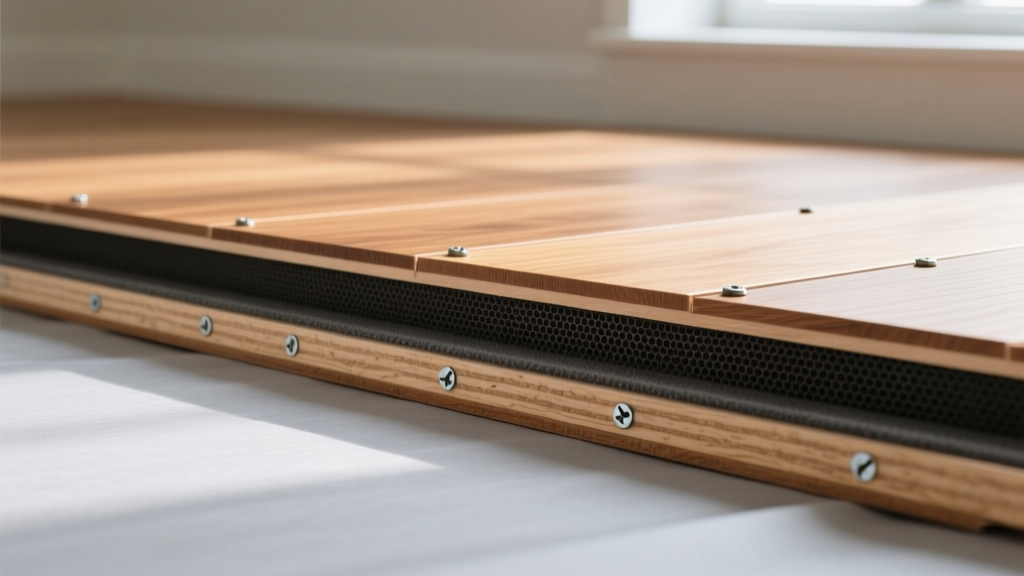
Compressive Creep and Point Load Deflection
The most common structural failure in nail-down hardwood installations is fastener fatigue caused by compressive creep. When a 200-pound point load is applied to a hardwood plank, the force is transferred through the wood, through the underlayment, and into the subfloor.
Closed-cell foam underlayments, while excellent for acoustic dampening in floating laminate installations, lack the compressive rigidity required for structural nail-down hardwood. Under sustained point loads, foam compresses permanently. The National Wood Flooring Association (NWFA) explicitly warns against using highly compressible underlayments for nail-down solid hardwood, as the vertical micro-movement shears the holding power of 1.5-inch to 2-inch flooring cleats. For nail-down applications over wood framing, rubber or high-density cork are the only structurally viable options that also provide acoustic benefits.
Moisture Permeance and Subfloor Preservation
Wood structural panels (OSB and plywood) are highly susceptible to edge swelling and fungal decay if exposed to sustained moisture vapor. The underlayment serves as the primary moisture management layer between the subfloor and the hardwood.
CRITICAL DISTINCTION: Vapor Retarder vs. Vapor Barrier
A vapor retarder (perm rating between 0.7 and 1.0) slows moisture transmission while allowing the wood assembly to "breathe" and dry out. A vapor barrier (perm rating < 0.1) stops moisture entirely. Installing a 6-mil polyethylene vapor barrier over a wood subfloor traps construction moisture and ambient humidity against the OSB or plywood, leading to subfloor delamination and joist rot. Always use a Class II vapor retarder (like 15 lb. felt or specialized paper-backed cork) over wood subfloors.
Data from the USDA Forest Products Laboratory confirms that wood structural panels require the ability to dry toward the interior of the building in mixed-humid climates. Asphalt-saturated felt (Aquabar "B") remains the benchmark for nail-down installations because its 0.8 perm rating protects the subfloor from minor moisture spikes without creating a trapped condensation plane.
Subfloor and Joist Spacing Decision Framework
Use the following framework to specify the correct underlayment based on your structural framing parameters.
Scenario A: 16-inch O.C. Joists with 3/4-inch CDX Plywood
This is a highly rigid assembly with minimal deflection. The primary concern is moisture management and basic friction reduction to prevent squeaks.
- Specification: 15 lb. asphalt-saturated felt or 1/4-inch standard cork.
- Fastener Schedule: 1.5-inch cleats or staples every 6 to 8 inches along the tongue.
- Rationale: The plywood provides ample holding power. Felt offers the most cost-effective moisture retardation and friction reduction without altering the structural plane.
Scenario B: 19.2-inch or 24-inch O.C. Joists with 3/4-inch OSB or AdvanTech
Wider joist spacing increases the deflection arc of the subfloor between supports. OSB, in particular, has a lower shear modulus than plywood, making it more prone to edge-swelling and fastener loosening under dynamic loads.
- Specification: 3/32-inch high-density recycled rubber (e.g., Regupol SonusCore).
- Fastener Schedule: 2-inch ring-shank nails or specialized flooring cleats every 4 to 6 inches.
- Rationale: Rubber provides a high-friction grip that locks the hardwood to the subfloor, preventing the independent movement that causes squeaks in wider-spaced joist bays. Its 60+ psi compressive strength ensures point loads are transferred directly to the subfloor without crushing the underlayment.
Diagnosing Underlayment-Related Structural Failures
When existing hardwood floors fail, the underlayment is often the hidden culprit. Identify the failure mode to correct the structural specification on remediation projects.
Cause: Compressive creep of foam or low-density cork underlayment. The hardwood is moving vertically against the subfloor, grinding the fasteners.
Fix: Remove affected boards. Replace with 3/32-inch structural rubber underlayment and re-fasten using 2-inch ring-shank nails to maximize withdrawal resistance in the subfloor.
Cause: Use of an impermeable vapor barrier (like 6-mil poly) over a wood subfloor, trapping crawl space moisture against the bottom of the hardwood while the top remains dry.
Fix: Remove the poly barrier. Install a Class II vapor retarder (15 lb. felt) and ensure crawl space ventilation or encapsulation meets local building codes.
Cause: Using an underlayment that is too thick (e.g., 1/2-inch acoustic cork) for a nail-down application. The thick, compressible layer acts as a fulcrum, snapping the fasteners under rolling loads.
Fix: Limit underlayment thickness to a maximum of 1/4-inch for nail-down solid hardwood. If high acoustic performance is required, transition to a glue-down engineered hardwood over the thick cork.
Specifying the correct underlayment requires treating the floor as a unified structural assembly. By matching the compressive strength and permeance of the underlayment to the specific joist spacing, subfloor material, and fastener schedule, you ensure the long-term structural integrity and performance of the hardwood installation.
Written by
Priya KapoorPriya Kapoor is a real estate market analyst and construction economics researcher with expertise in housing affordability, development feasibility, and infrastructure investment. She holds a Master of Regional Planning from Cornell University and previously worked as a senior analyst at CBRE's Investment Properties group, where she modeled returns for $4B in mixed-use development pipelines. Priya now runs an independent research practice advising developers, municipalities, and REITs on construction cost forecasting and market timing. She publishes the quarterly "BuildMat Market Pulse" report tracking material price indices across 12 commodity categories. Based in Austin, TX, Priya serves on the board of Habitat for Humanity Austin and is a marathon runner.
More from Priya Kapoor
View all
Construction Cost
Cost to Build a 1600 Sq Ft Home in 2026: Full Breakdown
Accurate 2026 cost to build a 1600 sq ft home—material, labor, and regional pricing breakdowns included. Plan your budget with real-time estimates.
Aug 11, 2026

Wood & Lumber
Name the Types of Wood for Pressure Treatment and Preservation
Learn how to name the types of wood best suited for pressure treatment. Compare species treatability, chemical retention levels, and 2026 preservation costs.
Aug 4, 2026

Stone & Masonry
Stone Veneer Suppliers Lindenhurst: 2026 Cost Analysis
Analyze 2026 stone veneer costs in Lindenhurst, NY. Compare local supplier pricing, delivery fees, and Suffolk County installation labor rates.
Aug 4, 2026