What Type of Wood for Raised Beds? A Structural & Load-Bearing Guide
Discover what type of wood for raised beds prevents bowing and rot. Learn structural sizing, span limits, and load-bearing species for long-lasting builds.

The Physics of Raised Bed Failure: Retaining Wall Dynamics
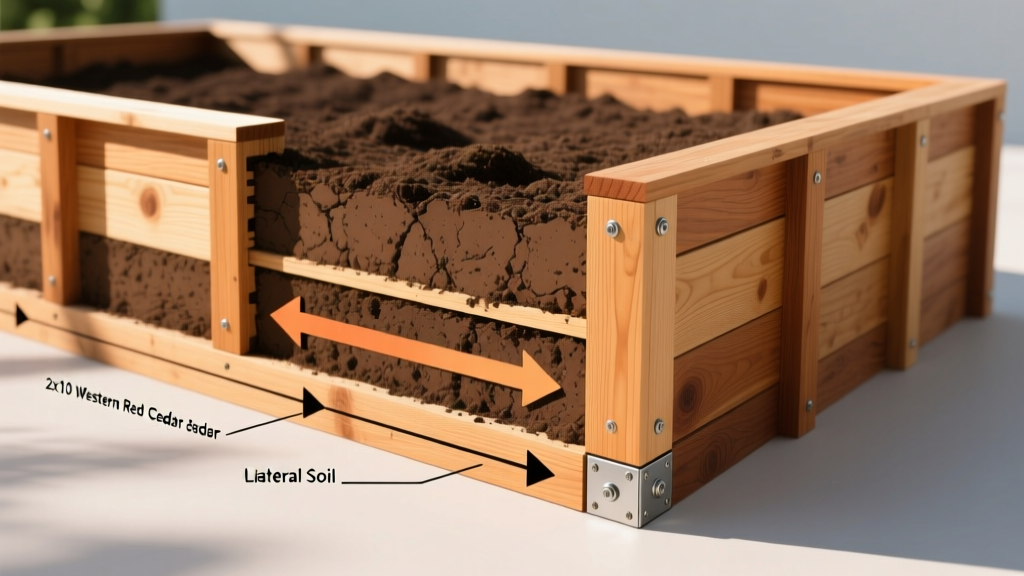
When evaluating what type of wood for raised beds is best, most guides focus exclusively on rot resistance. From a structural engineering perspective, however, a raised garden bed is fundamentally a retaining wall. The primary cause of catastrophic bed failure is not decay, but lateral earth pressure causing mid-span deflection, fastener shear, and corner joint blowout.
Saturated garden soil is exceptionally heavy. According to geotechnical standards, wet loam or clay can weigh between 100 and 120 pounds per cubic foot (pcf). In a raised bed that is 24 inches high, the lateral pressure at the very bottom edge approaches 240 pounds per square foot (psf). This hydrostatic-style pressure pushes outward relentlessly, testing the bending strength (Modulus of Rupture) of your lumber and the shear strength of your fasteners.
Wood Species Ranked by Structural Capacity & Decay Resistance
Choosing the right species requires balancing the Modulus of Elasticity (MOE)—which dictates stiffness and resistance to bowing—with natural decay resistance. Below is a structural comparison of the top lumber choices for heavy-load garden applications.
| Wood Species | Bending Strength (Fb) | Natural Decay Resistance | Est. Cost (per LF) |
|---|---|---|---|
| Black Locust | 20,100 psi (Exceptional) | Class 1 (25+ years in ground) | $8.00 - $12.00 |
| White Oak | 15,200 psi (Very High) | Class 2 (15-20 years) | $5.50 - $7.50 |
| UC4B Pressure-Treated Pine | 12,500 psi (High) | Chemical (AWPA Ground Contact) | $1.80 - $2.50 |
| Western Red Cedar | 7,500 psi (Moderate) | Class 2 (10-15 years) | $3.50 - $5.00 |
Deep Dive: The Structural Reality of Cedar vs. Pressure-Treated
Western Red Cedar is the most popular choice for garden beds due to its aesthetics and natural tannins. However, its relatively low bending strength (Fb) means it is highly susceptible to mid-span bowing on walls longer than 6 feet. If you choose cedar for structural applications, you must either reduce the span length or increase the lumber depth.
Conversely, Southern Yellow Pine treated to AWPA Use Category UC4B (Heavy-Duty Ground Contact) offers superior structural stiffness. The preservative retention level for UC4B is 0.60 pcf (copper azole or ACQ), which is specifically engineered for critical structural components in direct soil contact. For large, high-load agricultural or commercial beds, UC4B pine provides the highest strength-to-cost ratio.
Dimensional Lumber Sizing and the 'Depth Squared' Rule
The most common structural mistake in raised bed construction is using 2x6 lumber for beds that are 18 to 24 inches tall. In structural engineering, the bending resistance of a rectangular beam is governed by its section modulus ($S = bd^2/6$). Because the depth ($d$) is squared, increasing the height of the board exponentially increases its ability to resist lateral soil pressure.
- 2x6 (Actual 1.5" x 5.5"): Maximum unbraced span of 4 feet for beds over 12 inches tall. High risk of deflection.
- 2x8 (Actual 1.5" x 7.25"): Maximum unbraced span of 6 feet. Suitable for most standard 18-inch tall residential beds.
- 2x10 (Actual 1.5" x 9.25"): Maximum unbraced span of 8 feet. Provides nearly 3.5 times the bending resistance of a 2x6. Mandatory for 24-inch tall beds without cross-bracing.
- 2x12 (Actual 1.5" x 11.25"): Maximum unbraced span of 10 feet. Overkill for most applications but excellent for deep-root crop beds (e.g., daikon radishes, deep carrots) where soil depth exceeds 30 inches.
For comprehensive data on lumber design values and load durations, the USDA Forest Products Laboratory Wood Handbook remains the definitive structural reference for wood in high-moisture environments.
Fasteners and Corner Joint Structural Integrity
The corners of a raised bed act as moment-resisting joints. The lateral pressure pushing the long walls outward places immense tensile and shear stress on the corner fasteners. Standard galvanized decking screws (e.g., #9 or #10) are brittle and possess low shear strength; they will snap as the wood swells and soil pressure peaks in early spring.
Required Fastener Specifications
- Diameter and Length: Use minimum 3/8-inch diameter structural screws, at least 4 inches long. Brands like GRK RSS or Simpson Strong-Drive SDWS are engineered with high shear strength and aggressive threading to pull the joint tight and hold it against lateral thrust.
- Corrosion Resistance: Western Red Cedar and White Oak contain high levels of tannic acid, while pressure-treated lumber contains copper-based preservatives. Both will rapidly corrode standard zinc-plated or hot-dipped galvanized fasteners. You must use Type 304 or Type 316 Stainless Steel structural screws, or fasteners with a specialized polymer coating rated for ACQ and copper azole contact.
- Joint Reinforcement: For beds taller than 18 inches, fasteners alone are insufficient. Install heavy-gauge steel corner brackets (such as OZCO or Simpson Strong-Tie outdoor wood connectors) bolted through the lumber with 1/2-inch carriage bolts to transfer the lateral load into the bracket rather than relying solely on wood screw shear.
Step-by-Step Structural Bracing for Beds Over 8 Feet
If your raised bed exceeds 8 feet in length, the lumber will inevitably bow over time, regardless of the species or thickness used. You must introduce structural bracing to counteract the lateral earth pressure. Follow these steps to install 'deadman' anchors and cross-ties.
- Calculate Mid-Span: Measure the total length of the long wall. Mark the exact center point (e.g., at the 5-foot mark on a 10-foot bed).
- Install Cross-Ties (For beds 4 feet wide or less): Cut a 2x4 or 2x6 board to the exact internal width of the bed. Position it horizontally across the mid-span mark, 2 inches below the top rail. Secure it using 5-inch structural screws driven from the outside of the long walls into the ends of the cross-tie. This puts the cross-tie in tension, holding the walls together.
- Install Deadman Anchors (For beds wider than 4 feet): If a cross-tie would obstruct gardening access, use a deadman anchor. Drive a 2-foot length of 2x4 or steel T-post vertically into the soil directly outside the mid-span of the long wall, burying it at least 12 inches deep. Use two 4-inch stainless steel structural screws to pin the horizontal bed wall directly into the vertical deadman post.
- Add a Top Cap Rail: Install a continuous 2x4 top cap screwed down into the tops of the vertical walls every 16 inches. This creates a continuous load path and adds significant rigidity to the entire structure, preventing the top edges from flaring outward.
Frequently Asked Questions: Structural Lumber for Garden Beds
Can I use Douglas Fir for raised beds?
Douglas Fir has excellent structural bending strength (Fb of 13,000 psi), making it highly resistant to bowing. However, its heartwood has only moderate decay resistance (Class 3). If used in direct soil contact without a heavy-duty physical moisture barrier (like HDPE plastic lining the interior walls), Douglas Fir will typically succumb to fungal decay within 4 to 7 years. It is structurally sound but chemically vulnerable.
Does lining the bed with plastic affect structural integrity?
Lining the interior walls with 6-mil polyethylene or HDPE dimple board does not add structural strength, but it drastically alters the moisture dynamics. By preventing the soil from holding moisture directly against the wood fibers, you can extend the lifespan of lower-grade woods like Douglas Fir or standard UC4A treated pine. Ensure you leave the bottom open for drainage to prevent the bed from becoming a waterlogged basin, which would actually increase the hydrostatic pressure against the walls.
What is the maximum height for a wood raised bed without engineering?
For standard dimensional lumber (2x8 or 2x10) and standard corner joinery, 36 inches is the practical maximum height. Beyond 3 feet, the lateral earth pressure at the base exceeds 360 psf. At this height, the bed transitions from a simple garden structure to a true engineered retaining wall, requiring deeper footings, larger timber (e.g., 6x6 landscape timbers), or reinforced concrete deadmen to prevent catastrophic structural failure. For more on soil management in taller structures, refer to Oregon State University Extension guidelines on raised bed gardening.
Written by
Marcus ChenMarcus Chen is a licensed structural engineer (PE) and building materials analyst with over 12 years of experience across residential, commercial, and industrial construction. He holds a Master of Science in Civil Engineering from UC Berkeley and spent six years at Thornton Tomasetti before transitioning to independent consulting and technical writing. Marcus specializes in material selection for seismic-prone regions, concrete reinforcement strategies, and lifecycle cost analysis. His work has been cited by the American Concrete Institute (ACI) and the Structural Engineers Association of California (SEAOC). When he is not on a job site or at his desk, you will find him hiking the Sierra Nevada or restoring a 1920s craftsman bungalow in Oakland, CA.
More from Marcus Chen
View all
Construction Cost
How Much Did the Eiffel Tower Cost to Build?
How much did the Eiffel Tower cost to build in 1889? We adjust for inflation and compare its budget to modern skyscraper construction.
Aug 4, 2026

Fire Resistance
What Is a Fire Resistant Material? Testing & Certification Guide
Discover what is a fire resistant material through ASTM and UL testing. Learn how fire ratings, certifications, and assemblies work in construction.
Aug 4, 2026

Construction Cost
How Much Did the Burj Khalifa Cost to Build?
How much did the Burj Khalifa cost to build? We break down the $1.5B project and extract 5 money-saving strategies for your next build.
Jul 30, 2026