Safe Treated Lumber Raised Garden Selection Guide & Grades
Discover the exact AWPA grades, chemical taxonomies, and safety profiles for selecting treated lumber raised garden beds for edible crops.
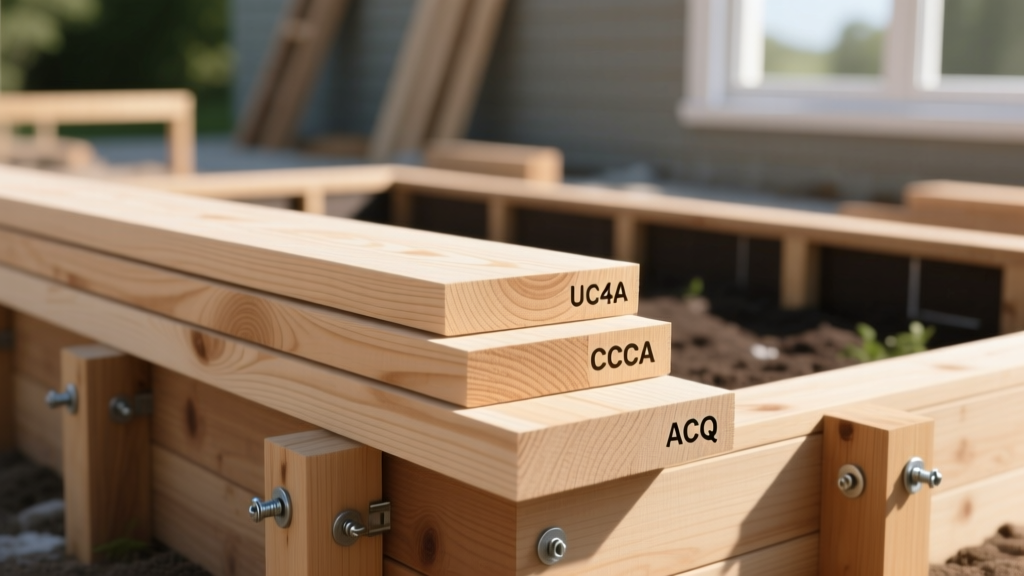
The Chemical Taxonomy: MCA vs. ACQ Preservatives
Selecting the correct treated lumber for raised garden beds requires understanding the specific chemical preservatives injected into the wood matrix. Since the phase-out of Chromated Copper Arsenate (CCA) for residential use, the North American market has standardized on two primary copper-based alternatives: Micronized Copper Azole (MCA) and Alkaline Copper Quaternary (ACQ). Both rely on copper as the primary fungicide, but their co-biocides and carrier systems dictate their performance and corrosion profiles.
Micronized Copper Azole (MCA-C): This formulation suspends micronized copper particles in water, paired with tebuconazole and propiconazole co-biocides. MCA is generally less corrosive to metal fasteners than ACQ and retains a more natural wood color, weathering to a warm silver-gray. It is the dominant choice for residential garden beds due to its lower corrosivity and widespread availability at big-box retailers.
Alkaline Copper Quaternary (ACQ): ACQ dissolves copper in an alkaline solution and uses quaternary ammonium compounds as the secondary biocide. While highly effective against decay fungi and termites, the high alkalinity makes ACQ significantly more corrosive to standard steel and aluminum. If you select ACQ for your garden build, you must exclusively use G185 hot-dipped galvanized or 316 stainless steel fasteners to prevent catastrophic structural failure at the joints.
Decoding AWPA Use Categories for Soil Retention
The most common error in raised bed construction is purchasing 'Above Ground' treated lumber. The American Wood Protection Association (AWPA) classifies treated wood by Use Categories (UC), which dictate the minimum preservative retention levels measured in pounds per cubic foot (pcf). Because a raised garden bed holds damp soil directly against the interior wood face, the lumber is subjected to continuous moisture and microbial activity, mimicking direct burial.
| AWPA Category | Designation | MCA Retention (pcf) | Garden Bed Suitability |
|---|---|---|---|
| UC3B | Above Ground | 0.15 | Fail - Will rot in 2-3 years |
| UC4A | Ground Contact | 0.20 | Marginal - Acceptable for dry climates |
| UC4B | Heavy Ground Contact | 0.31 | Pass - Mandatory for soil-filled beds |
According to the AWPA standards guidelines, any wood in direct contact with soil or fresh water must meet a minimum of UC4A. However, for a raised garden bed where the interior face is constantly exposed to moist, biologically active potting mix, UC4B (Heavy Ground Contact) is the required specification. UC4B lumber contains roughly double the copper retention of UC3B, ensuring a structural lifespan of 15 to 20 years against brown rot and white rot fungi.
Heavy Metal Leaching and Edible Crop Safety
The primary concern with using treated lumber for food production is copper leaching. Copper is an essential micronutrient for plants, but excessive concentrations can cause phytotoxicity and accumulate in human diets. Research published by university extension programs and reviewed by the EPA's wood preservative registration guidelines indicates that copper leaching from modern MCA and ACQ lumber is minimal and largely confined to the first 2 inches of soil adjacent to the wood.
To mitigate any risk of copper uptake in edible crops, implement the following soil and barrier protocols:
- pH Buffering: Copper solubility increases exponentially in acidic environments. Maintain your garden bed soil pH between 6.5 and 7.0. At a neutral pH, copper binds tightly to organic matter and clay particles, rendering it biologically unavailable to plant roots.
- Physical Barriers: Line the interior walls of the raised bed with 6-mil high-density polyethylene (HDPE) plastic sheeting. Secure the HDPE to the top rim of the wood using stainless steel cap washers. This creates an impermeable hydrostatic barrier that completely eliminates soil-to-wood contact, halting leaching and extending the wood's lifespan by preventing moisture ingress.
- Root Zone Management: Avoid planting root crops (carrots, radishes, potatoes) within 4 inches of the bed's perimeter. Utilize the perimeter zones for shallow-rooted herbs or leafy greens instead.
Dimensional Selection and Hydrostatic Bracing
Soil exerts immense hydrostatic pressure on the sidewalls of a raised bed, particularly when saturated by heavy irrigation or rainfall. Selecting the correct nominal dimensions and integrating structural bracing is critical to prevent the walls from bowing or bursting at the fastener joints.
Standard Dimensional Profiles
- 2x6 (Actual 1.5' x 5.5'): Yields a bed depth of 5.5 inches per tier. Ideal for shallow-rooted crops like lettuce and strawberries. Requires minimal bracing for lengths up to 8 feet.
- 2x8 (Actual 1.5' x 7.25'): The industry standard for raised beds. Stacking two tiers yields 14.5 inches of depth, accommodating tomatoes, peppers, and dwarf root vegetables. High lateral pressure requires mid-span bracing on any run exceeding 6 feet.
- 2x10 and 2x12: Used for single-tier deep beds (9.25' to 11.25' deep) required for full-size root crops or ADA-compliant wheelchair-accessible heights. These wide boards are highly susceptible to cupping and warping as they dry; always secure them with structural timber screws every 16 inches.
Fastener and Bracing Specifications
Never use standard decking screws for raised bed corners. The shear strength of drywall or decking screws is insufficient for wet soil loads. Use 1/2-inch hot-dipped galvanized carriage bolts or #10 structural timber screws (minimum 3.5 inches long) at every corner joint. For beds longer than 8 feet, install 2x4 cross-braces or aluminum tie-rods spanning the width of the bed at the 4-foot and 8-foot marks to neutralize the outward bowing force.
Material Procurement and End-Cut Treatment
When purchasing UC4B treated lumber, you will inevitably need to make cross-cuts to fit your specific garden dimensions. The moment you cut a treated board, you expose untreated end-grain, which acts as a wick for moisture and a direct entry point for decay fungi.
Every cut end, drilled hole, or routed notch must be field-treated with a copper naphthenate solution (commonly sold under the brand name Copper Green). Apply the preservative liberally with a brush until the end-grain stops absorbing the liquid. Failure to treat end-cuts will void the manufacturer's limited warranty and reduce the lifespan of the corner joints by up to 60%. Allow the copper naphthenate to cure for 24 hours before installing the HDPE liner and adding soil.