Hardwood Floorboards Taxonomy: Species & Grade Selection Guide
Master the hardwood floorboards taxonomy. Compare solid vs engineered types, decode NWFA grades, Janka hardness, and milling cuts.
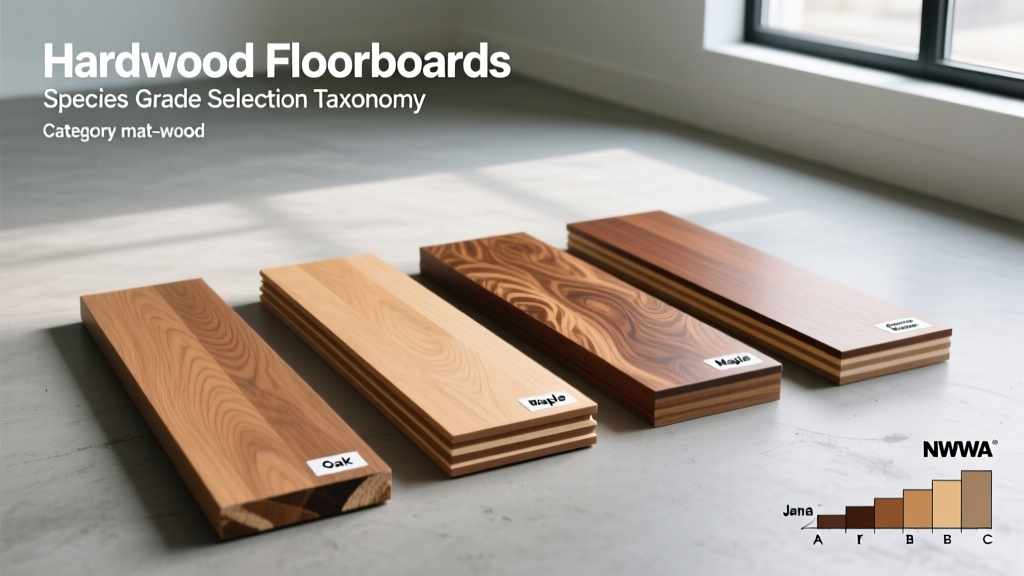
Core Classification: Solid vs. Engineered Hardwood Floorboards
The foundational split in the hardwood floorboards taxonomy is structural. Selecting between solid and engineered formats dictates your installation parameters, subfloor compatibility, and long-term maintenance lifecycle. Solid hardwood floorboards are milled from a single piece of timber, typically 3/4-inch thick, allowing for 4 to 6 full sanding cycles over a 50-year lifespan. However, their unidirectional grain structure makes them highly susceptible to hygroscopic expansion and contraction.
Engineered hardwood floorboards utilize a composite core—usually 5 to 11 cross-laminated plies of Baltic birch or high-density fiberboard (HDF)—topped with a solid wood wear layer ranging from 1.2mm to 6mm. This cross-ply construction neutralizes the wood's natural tendency to warp, providing dimensional stability that solid planks cannot achieve.
| Parameter | Solid Hardwood (3/4') | Engineered Hardwood (5/8' to 3/4') |
|---|---|---|
| Core Composition | Single-piece solid timber | Cross-ply Baltic birch or HDF |
| Wear Layer Thickness | Full 3/4' body | 1.2mm to 6mm (sawn veneer) |
| Sanding Cycles | 4 - 6 cycles | 0 - 3 cycles (depends on wear layer) |
| Subfloor Compatibility | Plywood/OSB (nail/staple down) | Concrete, Plywood, Radiant Heat (glue/float) |
| Max Recommended Width | 5 inches (without specific glue-assist) | 10+ inches (highly stable) |
Species Taxonomy & The Janka Hardness Benchmark
The Janka hardness test measures the force (in pounds-force, lbf) required to embed a 0.444-inch steel ball halfway into the wood. This metric is the primary indicator of a species' resistance to denting and wear, though it does not correlate perfectly with scratch resistance, which is dictated by the factory-applied finish (e.g., UV-cured aluminum oxide). According to the USDA Forest Products Laboratory Wood Handbook, cellular density and extractive content heavily influence these ratings.
Domestic vs. Exotic Performance Matrix
| Species | Janka Hardness (lbf) | Dimensional Stability | Best Application | Avg. Material Cost (per sq ft) |
|---|---|---|---|---|
| American Cherry | 950 | High | Formal dining, low-traffic bedrooms | $8.00 - $11.00 |
| Red Oak | 1,290 | Moderate | Standard residential, traditional aesthetics | $5.50 - $8.50 |
| White Oak | 1,360 | High | Wide-plank, modern designs, high-moisture zones | $7.00 - $12.00 |
| Hard Maple | 1,450 | Moderate | Basketball courts, high-traffic residential | $8.00 - $10.00 |
| Hickory | 1,820 | Low | Mudrooms, heavy commercial, rustic aesthetics | $7.50 - $11.00 |
| Brazilian Cherry | 2,350 | High | Luxury residential, exotic color requirements | $12.00 - $18.00 |
NWFA Visual Grading Standards
The National Wood Flooring Association (NWFA) standardizes the visual grading of hardwood floorboards. It is a common misconception that grading reflects structural integrity; in reality, it strictly categorizes visual character, color variation, and allowable natural defects.
- Clear Grade: Milled from the heartwood. Features minimal color variation, no open knots, and very few character marks. Yields a uniform, formal appearance. Most expensive due to low yield per log.
- Select Grade: Allows for slight color variations between heartwood and sapwood, small tight knots, and minor mineral streaks. The standard for high-end residential projects seeking a natural but refined look.
- #1 Common Grade: Exhibits prominent color variations, tight and open knots, wormholes, and distinct mineral streaks. Ideal for rustic, farmhouse, or heavily character-driven designs.
- #2 Common Grade: The most rustic classification. Permits large knots, significant sapwood/heartwood contrast, and varied board lengths. Often used in commercial spaces or heavy-distress artisan collections.
Milling Geometry: Plain, Quarter, and Rift Sawn
The angle at which the log is cut relative to the growth rings fundamentally alters the board's visual grain pattern, dimensional stability, and cost.
- Plain Sawn (Flat Sawn): Cut tangential to the growth rings (0-30 degree angle). Produces the classic 'cathedral' grain pattern. It is the most cost-effective milling method with the highest log yield, but it is the least dimensionally stable, prone to cupping in wide formats.
- Quarter Sawn: The log is quartered and cut perpendicular to the growth rings (60-90 degree angle). In White Oak, this exposes the medullary rays, creating striking 'tiger stripe' flecks. Quarter-sawn boards shrink primarily in thickness rather than width, making them exceptionally stable for wide-plank and radiant heat applications.
- Rift Sawn: Cut at a 30-60 degree angle to the rings. Produces a tight, linear, vertical grain pattern with no flecking. It generates the most waste during milling, making rift-sawn hardwood floorboards the most expensive option, highly sought after for ultra-modern, minimalist interiors.
'When specifying wide-plank flooring over hydronic radiant heating systems, quarter-sawn or rift-sawn White Oak is mandatory. The restricted tangential movement prevents the board edges from lifting or gapping as the system cycles through heating and cooling phases.'
Subfloor & Environmental Decision Framework
Use this conditional logic to specify the correct hardwood floorboard format for your project environment:
You must use Engineered Hardwood. Solid hardwood cannot be nailed to concrete. The engineered boards must be glued down using a moisture-cured urethane adhesive that also acts as a vapor retarder. Concrete moisture emission must test below 3 lbs/1,000 sq ft/24 hours via ASTM F1869 calcium chloride testing, or below 75% RH via ASTM F2170 in-situ probe testing.
IF Environment = Radiant Heat System:Use Engineered Hardwood (minimum 4mm wear layer) or Quarter/Rift-Sawn Solid Hardwood. Avoid solid Hickory or Maple, as their high density and cellular structure impede heat transfer and increase the risk of checking (micro-cracking). Keep the surface temperature of the floor strictly below 80°F (27°C).
IF Plank Width > 7 Inches:Avoid Plain-Sawn Solid Hardwood. The tangential shrinkage will cause severe cupping across a 7-inch span during winter dry spells. Specify Engineered Hardwood or Quarter-Sawn Solid Hardwood, and utilize a glue-assist installation method (beads of elastomeric adhesive on the subfloor beneath the nail line) to lock the center of the board down.
Acclimation & Installation Variables
Hardwood floorboards are hygroscopic; they absorb and release moisture until they reach equilibrium with the surrounding environment (Equilibrium Moisture Content, or EMC). Improper acclimation is the leading cause of post-installation failure.
- Solid Hardwood Acclimation: Requires 7 to 14 days in the installation environment. The HVAC system must be fully operational, maintaining an interior relative humidity (RH) between 35% and 55%, and a temperature between 60°F and 80°F.
- Engineered Hardwood Acclimation: Typically requires 3 to 5 days, though some modern cross-ply products with sealed factory finishes require zero acclimation if the interior climate is already within the manufacturer's specified parameters. Always verify the specific Technical Data Sheet (TDS).
- Fastening: Solid 3/4' boards require cleats or staples driven at a 45-degree angle through the tongue, spaced every 6 to 8 inches. Engineered boards installed over wood subfloors can be blind-nailed, but glue-assist or full-spread adhesive is required for widths exceeding 5 inches.
2026 Cost & Lifecycle Summary
When budgeting for hardwood floorboards, material costs represent only 40% to 50% of the total project expenditure. Installation, subfloor prep, and finishing complete the financial picture.
| Cost Category | Solid Hardwood (Site-Finished) | Pre-Finished Engineered Hardwood |
|---|---|---|
| Material (Avg. Select Grade) | $7.00 - $10.00 / sq ft | $9.00 - $15.00 / sq ft |
| Subfloor Prep & Leveling | $1.50 - $3.00 / sq ft | $1.50 - $3.00 / sq ft |
| Installation Labor | $4.00 - $6.00 / sq ft (nail down) | $3.50 - $5.50 / sq ft (glue/float) |
| Sanding & Finishing | $4.00 - $6.00 / sq ft | $0.00 (Factory pre-finished) |
| Total Estimated Installed Cost | $16.50 - $25.00 / sq ft | $14.00 - $23.50 / sq ft |
By understanding the precise taxonomy of hardwood floorboards—from the cellular density measured by the Janka scale to the geometric implications of rift-sawing—specifiers and homeowners can eliminate guesswork. Matching the structural format, species stability, and milling cut to the specific subfloor and environmental conditions ensures a floor that performs flawlessly for decades.