Best Type of Wood for Raised Garden Beds: A Grade & Quality Guide
Discover the best type of wood for raised garden beds. Compare lumber grades, heartwood ratings, and structural limits for long-lasting, safe garden boxes.

The Hidden Factor in Garden Bed Longevity: Lumber Grades
When researching the best type of wood for raised garden beds, most guides stop at species selection—recommending cedar, redwood, or treated pine. However, species is only half the equation. A #3 grade Western Red Cedar board with high sapwood content will rot faster than a properly graded, ground-contact treated Southern Yellow Pine board. To build a raised bed that survives beyond a single season without bowing, leaching harmful chemicals, or succumbing to fungal decay, you must understand lumber grading standards, heartwood percentages, and preservative treatment categories.
Decoding Treatment Grades: Ground Contact vs. Above Ground
If you opt for pressure-treated lumber due to budget constraints, you must verify the American Wood Protection Association (AWPA) Use Category stamped on the end tag. The moist, microbially active soil inside a raised bed mimics direct earth burial, demanding specific chemical retention levels.
- UC3B (Above Ground): Designed for deck railings and fascia. Chemical retention is too low for soil contact. If used for garden beds, UC3B lumber will typically exhibit severe decay at the soil line within 3 to 4 years.
- UC4A (Ground Contact): The minimum acceptable grade for raised beds. It contains higher concentrations of copper-based preservatives (like Micronized Copper Azole, MCA-C) to resist fungal decay and termite attack when in direct contact with damp soil.
- UC4B (Heavy Duty Ground Contact): Recommended for beds built in poorly drained soils or regions with high termite pressure. It offers the highest preservative retention for residential applications.
Untouched & Natural: Grading Rot-Resistant Species
For organic gardeners avoiding chemical treatments, Western Red Cedar, Coastal Redwood, and Black Locust are the premier choices. But their rot resistance is not uniform; it is strictly dictated by the ratio of heartwood to sapwood in the lumber grade you purchase. Sapwood, the outer living layer of the tree, contains no natural decay-resistant extractives and will rot almost as quickly as untreated pine.
| Lumber Grade | Heartwood Requirement | Estimated Lifespan in Soil | 2026 Avg. Cost (2x6) |
|---|---|---|---|
| Clear All Heart (CAH) | 100% Heartwood | 12–20+ Years | $14.00 - $18.50 / lin. ft. |
| Select Tight Knot (STK) | Min. 80% Heartwood | 8–12 Years | $9.50 - $12.00 / lin. ft. |
| Construction Common | Unspecified (Often 40-60%) | 3–5 Years | $6.00 - $8.50 / lin. ft. |
Source: Pricing reflects Q1 2026 regional averages for premium hardwood and softwood suppliers. For detailed decay resistance metrics, refer to the USDA Forest Products Laboratory Wood Handbook.
Dimensional Lumber & Structural Grades for Tall Beds
A common failure mode in raised garden beds is mid-span bowing and fastener pull-out. Wet garden soil is incredibly heavy, weighing approximately 100 to 120 pounds per cubic foot. A standard 4x8 foot bed that is 24 inches high holds roughly 64 cubic feet of soil, generating over 7,000 pounds of total mass and immense lateral hydrostatic pressure against the side walls.
If you are building beds taller than 18 inches, the structural grade of your dimensional lumber is critical:
- #2 Grade (Standard & Better): The recommended minimum for 2x8 and 2x10 side walls. It allows for tight knots but restricts large edge knots that compromise the board's bending strength (Fb). It will resist lateral bowing when properly braced with interior cross-ties or 2x4 stakes driven into the ground every 4 feet.
- #3 Grade (Utility): Often sold as "economy" cedar or pine. It contains larger knots, slope of grain deviations, and wane (bark edges). Under the continuous lateral load of saturated soil, #3 grade boards will deflect, eventually snapping the fasteners at the corner joints.
- Select Structural: Overkill for most residential beds, but necessary if you are building massive, terraced retaining-wall-style garden beds exceeding 36 inches in height without deadman anchors.
Moisture Content & Surfacing: S-GRN vs. S-DRY
Check the grade stamp for the moisture content at the time of surfacing. This dictates how the wood will behave once exposed to the sun and the wet soil inside the bed.
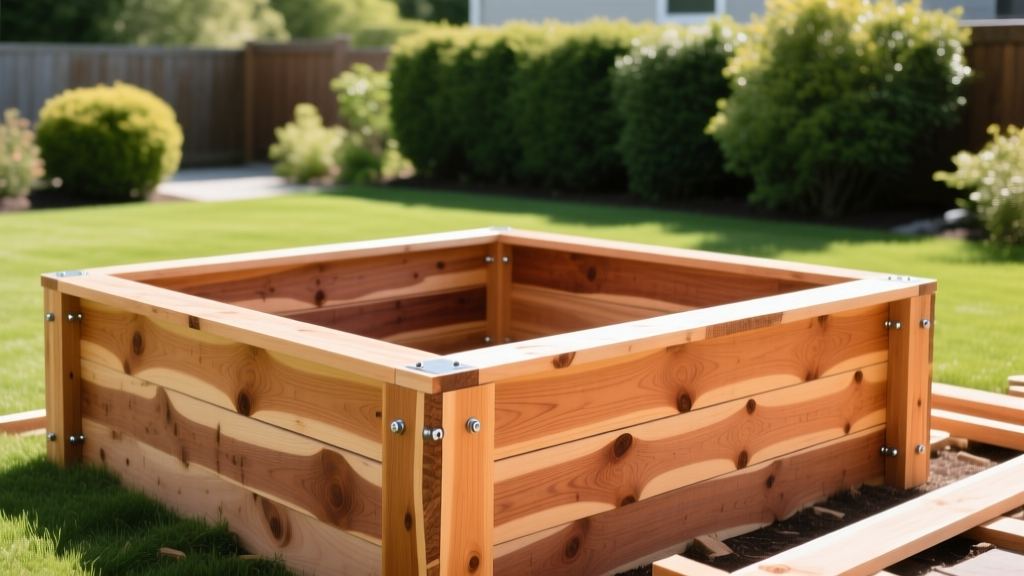
S-DRY (Surfaced Dry) or MC15: Moisture content is 19% or less (often kiln-dried to 15%). This lumber is dimensionally stable. Joints will remain tight, and the boards are less likely to cup when one side is exposed to dry air and the other to wet soil.
Step-by-Step Purchasing Framework
When you arrive at the lumber yard, follow this exact sequence to ensure you are buying the right type of wood for raised garden beds:
- Read the End Tags First: If buying treated pine, verify the tag explicitly states UC4A or UC4B. If the tag says UC3B or is meant for "Above Ground" decking, put it back.
- Inspect for Sapwood (Natural Woods): Look at the ends of the cedar or redwood boards. The heartwood is the darker, reddish-brown core. The sapwood is the pale, creamy white outer ring. Reject boards where the white sapwood makes up more than 20% of the cross-section.
- Check the Crown and Cup: Sight down the length of the board. A slight crown (bow along the edge) is manageable and should be installed with the crown facing UP (outward), allowing soil pressure to push it flat. Severe twisting or spiraling boards will ruin your corner joints.
- Match the Fasteners to the Grade: Modern copper treatments (MCA/ACQ) are highly corrosive to standard metals. You must use Hot-Dipped Galvanized (HDG) or polymer-coated structural screws (e.g., GRK RSS or Simpson Strong-Tie). Never use standard zinc-plated deck screws; they will corrode and snap within 18 months when reacting with the copper preservatives and damp soil.
For comprehensive guidelines on soil preparation and structural bed layouts, the Oregon State University Extension Raised Bed Gardening Guide provides excellent regional adaptations for soil weight and drainage.
Frequently Asked Questions
Can I line the inside of a treated wood raised bed to make it safer?
Yes, but you must use the right material. Stapling 6-mil black polyethylene plastic to the interior walls creates a physical barrier between the soil and the wood. However, you must puncture the plastic at the bottom to allow for drainage, otherwise, the bed will become a waterlogged bog, accelerating root rot and increasing lateral pressure on the wood walls. A better alternative is using a heavy-duty, permeable geotextile landscape fabric that lines the sides but allows water to pass through.
Is Black Locust worth the premium cost for garden beds?
If you plan to stay in your home for 25+ years, yes. Black Locust (Robinia pseudoacacia) is a dense, domestic hardwood with a Janka hardness rating of 1,700 lbf. Its natural rot resistance rivals tropical hardwoods like Ipe, but it is grown in North America. While it costs upwards of $22 per linear foot for rough-sawn 2x6 boards, it requires zero chemical treatments and will easily outlast a 25-year mortgage in direct soil contact.
Why did my cedar garden bed rot at the bottom but stay pristine at the top?
This is the classic hallmark of "Construction Common" or lower-grade cedar. The top of the bed was likely heartwood, which resisted the elements. The bottom boards, however, contained high percentages of sapwood. Because sapwood lacks the natural thujaplicins (decay-resistant compounds) found in cedar heartwood, it quickly succumbs to the constant moisture and soil microbes at the ground line. Always specify "Clear All Heart" for the bottom two tiers of any raised bed.
Written by
Sarah WhitfieldSarah Whitfield is a chartered quantity surveyor (MRICS) and construction cost analyst with 15 years of experience in material pricing, procurement strategy, and project budgeting. She earned her degree in Construction Management from the University of Reading (UK) and has worked on projects ranging from $2M custom homes to $180M mixed-use developments across North America and Europe. Sarah currently leads cost estimating for BuildMat Insight, maintaining a proprietary database of 4,000+ material price points updated quarterly. She is a frequent contributor to RSMeans cost data panels and has presented at the International Cost Engineering Council (ICEC) congress. Based in Denver, CO, Sarah is an avid trail runner and volunteer mentor for Women in Construction.
More from Sarah Whitfield
View all
Wood & Lumber
What Are the Different Types of Wood? A Builder's Guide
Compare structural softwoods, finish hardwoods, and engineered lumber. Analyze Janka ratings, MOE values, and 2026 pricing for construction.
Aug 4, 2026

Walls & Panels
Steel Framing vs Wood Framing: Corrosion and Moisture Defense
Compare steel framing vs wood framing for moisture resistance. Learn about galvanized coatings, condensation risks, and corrosion protection strategies.
Jul 21, 2026

Stone & Masonry
How to Cut Stone Veneer: Wet Saw vs Grinder Comparison
Compare the best tools for cutting stone veneer. We review wet saws, angle grinders, and chop saws to help you achieve clean, chip-free cuts.
Jul 21, 2026