Visual Selection Framework: Matching Lumber Using Types of Wood Photos
Master lumber selection and species verification on-site. Learn how to use high-res types of wood photos to identify grain, pores, and grade.

Architectural specifications and structural engineering plans demand precise lumber species, yet job-site substitutions remain a costly liability in commercial and high-end residential construction. When a mill or distributor swaps White Oak for Red Oak, or Douglas Fir for Hemlock, the consequences range from catastrophic moisture failure to severe aesthetic mismatches. Relying solely on stamped grade marks is insufficient; stamps verify grade, not species. To bridge this gap, procurement managers and site superintendents must implement a visual selection framework, leveraging high-resolution types of wood photos to verify anatomical markers before lumber is integrated into the building envelope or interior finish.
The Economic Impact of Species Substitution in 2026
Supply chain volatility continues to drive opportunistic species substitution in the lumber market. In Q1 2026, the price spread between structurally similar but botanically distinct species has widened. For example, specifying Douglas Fir (Douglas-fir) when Hem-Fir is delivered can result in a 20% to 25% overpayment if the contractor is billed at the Fir rate. More critically, substituting a non-durable species for an exterior application specified as White Oak can lead to premature rot, as White Oak contains tyloses that block water infiltration, whereas Red Oak does not. According to the USDA Forest Products Laboratory Wood Handbook, understanding these microscopic anatomical differences is the only definitive way to verify species integrity without chemical testing.
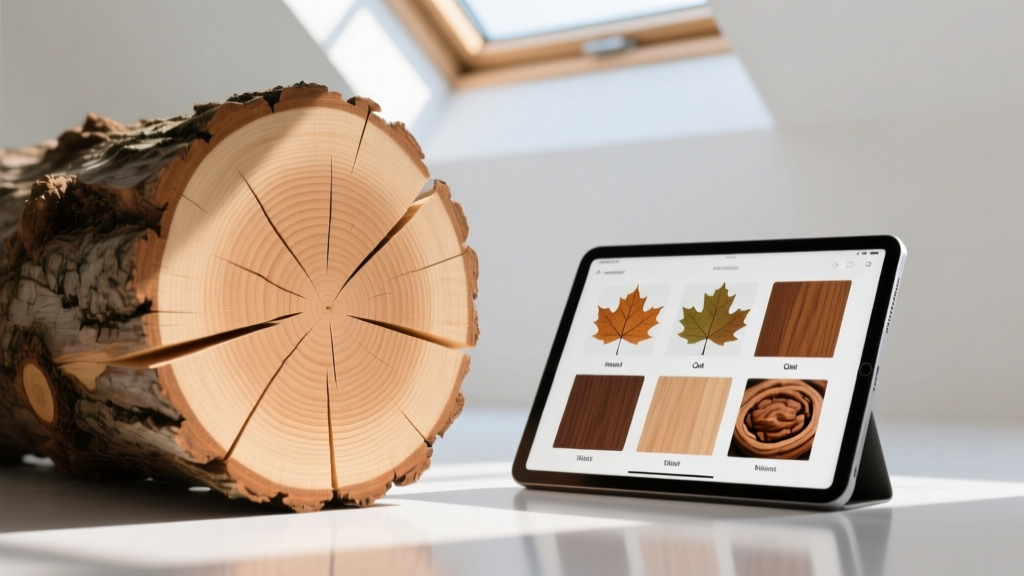
The Visual Selection Matrix: End-Grain Analysis
The most reliable diagnostic feature in any database of types of wood photos is the end-grain cross-section. Face-grain and edge-grain can be misleading due to milling variations and surface treatments, but the end-grain reveals the vascular structure of the tree. When verifying a lumber delivery, site personnel should use a 10x to 20x macro loupe or a smartphone macro lens to capture the end-grain and compare it against reference imagery.
| Species | Pore Structure (End-Grain) | Tyloses Presence | Q1 2026 Avg. Price (FAS Grade) | Primary Failure Mode if Substituted |
|---|---|---|---|---|
| White Oak | Ring-porous, distinct earlywood | Abundant (blocks pores) | $7.50 - $9.50 / bdft | Rot/water ingress if Red Oak used |
| Red Oak | Ring-porous, large open pores | Absent (pores are open) | $4.50 - $6.00 / bdft | Staining/tannin bleed if White Oak used |
| Douglas Fir | Tracheids, abrupt transition | N/A (Softwood) | $3.80 - $4.80 / bdft | Structural deflection if Hemlock used |
| Western Hemlock | Tracheids, gradual transition | N/A (Softwood) | $2.90 - $3.60 / bdft | Premature fastener pull-out |
Transition Zones: Earlywood vs. Latewood
For softwoods, which lack the distinct pores of hardwoods, the transition zone between earlywood (spring growth) and latewood (summer growth) is the primary visual identifier. When reviewing types of wood photos for softwood verification, focus on the contrast and gradient of this transition.
- Abrupt Transition (Douglas Fir, Southern Yellow Pine): The visual shift from light, porous earlywood to dense, dark latewood is sudden and sharply defined. In Douglas Fir, the latewood bands are narrow but extremely dense, providing high specific gravity and structural stiffness.
- Gradual Transition (Hemlock, Spruce, True Firs): The color and density shift slowly over several cell rows. Hemlock and Spruce exhibit a uniform, almost bland end-grain appearance with minimal color contrast between growth rings. This lack of contrast correlates with lower natural decay resistance and lower bending strength compared to abrupt-transition species.
- Uniform/Indistinct (Cedar, Redwood): The transition is nearly invisible to the naked eye. These species rely on extractives (tannins and oils) for decay resistance rather than dense latewood structures, which is visually apparent as a uniform, low-contrast end-grain in reference photos.
Medullary Rays and the Quarter-Sawn Premium
Architects frequently specify quarter-sawn lumber for its dimensional stability and distinctive ray fleck, particularly in White Oak and Sycamore. Quarter-sawn White Oak commands a 40% to 60% premium over plain-sawn stock in 2026. To verify you are receiving true quarter-sawn material, examine the face-grain photos for medullary rays. True quarter-sawn boards will display prominent, shimmering ray flecks (ribbon-like patterns) covering 80% to 100% of the board face. If the ray fleck is sparse or absent, the lumber is likely rift-sawn or plain-sawn, and you are overpaying for the milling specification.
On-Site Photo Capture Protocol for Verification
To effectively use visual databases like The Wood Database for on-site verification, the photos you capture must be diagnostic. Blurry or poorly lit images are useless for anatomical comparison. Follow this standardized capture protocol:
- Prepare the End-Grain: Use a block plane or a sharp utility knife to slice a clean, 1-inch section off the end of the board. Saw marks obscure cellular structures; a cleanly sliced end-grain is mandatory.
- Moisture Enhancement: Lightly mist the end-grain with water or denatured alcohol. This temporarily darkens the latewood and increases the contrast of the cellular structure, making pores and tracheids highly visible.
- Macro Capture: Use a dedicated macro lens attachment on a smartphone or a 10x jeweler's loupe placed directly over the camera lens. Ensure the camera sensor is perfectly parallel to the end-grain to avoid focal distortion.
- Lighting Angle: Use a secondary light source (like a flashlight) held at a 45-degree angle to the end-grain. Raking light creates micro-shadows inside the pores, highlighting the depth and size of the vascular structures.
- Scale Reference: Always include a standard reference object, such as a coin or a machinist scale, in the frame to provide context for pore size and growth ring density.
Edge Cases: Modified, Fumed, and Stained Lumber
Chemical and thermal modifications drastically alter the visual characteristics of lumber, rendering standard types of wood photos unreliable if the modifier is unknown. Fumed Oak (exposed to ammonia) turns dark brown but retains its open-pore end-grain structure; do not mistake it for Walnut, which is semi-ring-porous. Thermally modified Ash turns a deep chocolate brown and loses its distinct earlywood/latewood contrast, often mimicking exotic hardwoods. Always request the mill's chain-of-custody documentation and thermal treatment certificates (such as those aligned with NHLA grading standards) to confirm the base species before relying solely on visual color matching.
Integrating a visual selection framework into your procurement and site-inspection workflows eliminates the guesswork from lumber verification. By training your team to look past surface color and focus on end-grain anatomy, transition zones, and medullary rays, you ensure that the materials installed on your project exactly match the structural and aesthetic specifications of the design.
Written by
Sarah WhitfieldSarah Whitfield is a chartered quantity surveyor (MRICS) and construction cost analyst with 15 years of experience in material pricing, procurement strategy, and project budgeting. She earned her degree in Construction Management from the University of Reading (UK) and has worked on projects ranging from $2M custom homes to $180M mixed-use developments across North America and Europe. Sarah currently leads cost estimating for BuildMat Insight, maintaining a proprietary database of 4,000+ material price points updated quarterly. She is a frequent contributor to RSMeans cost data panels and has presented at the International Cost Engineering Council (ICEC) congress. Based in Denver, CO, Sarah is an avid trail runner and volunteer mentor for Women in Construction.
More from Sarah Whitfield
View all
Wood & Lumber
What Are the Different Types of Wood? A Builder's Guide
Compare structural softwoods, finish hardwoods, and engineered lumber. Analyze Janka ratings, MOE values, and 2026 pricing for construction.
Aug 4, 2026

Walls & Panels
Steel Framing vs Wood Framing: Corrosion and Moisture Defense
Compare steel framing vs wood framing for moisture resistance. Learn about galvanized coatings, condensation risks, and corrosion protection strategies.
Jul 21, 2026

Stone & Masonry
How to Cut Stone Veneer: Wet Saw vs Grinder Comparison
Compare the best tools for cutting stone veneer. We review wet saws, angle grinders, and chop saws to help you achieve clean, chip-free cuts.
Jul 21, 2026