Identifying Treated Wood: Pictures of Types of Wood and AWPA Stamps
Learn to identify pressure-treated lumber using visual cues, AWPA stamps, and chemical color signatures. A practical guide for builders and inspectors.

The Critical Role of Visual Identification in Wood Preservation
Specifying the correct preservative treatment for structural timber is a matter of code compliance and structural longevity. However, once lumber arrives on the job site, the original purchase receipts and spec sheets are often lost. Builders, inspectors, and renovators must rely on physical and visual evidence to verify that the wood in question meets the required preservation standards for its specific end-use. When analyzing pictures of types of wood used in exterior construction, the untrained eye might only see variations in grain, color, and surface texture. For the trained professional, these visual cues—combined with standardized end-tags and physical surface modifications—reveal the exact chemical formulation, retention level, and approved use category of the lumber.
Misidentifying treated lumber can lead to catastrophic structural failures. Installing Above Ground (UC3) rated joists in a Ground Contact (UC4) application will result in premature fungal decay, while using highly corrosive Alkaline Copper Quaternary (ACQ) treated wood with standard galvanized fasteners will cause rapid hardware failure. This guide details the exact visual markers, stamp codes, and species-specific reactions you need to accurately identify pressure-treated lumber in the field.
Decoding the AWPA End-Tag: The Primary Proof of Treatment
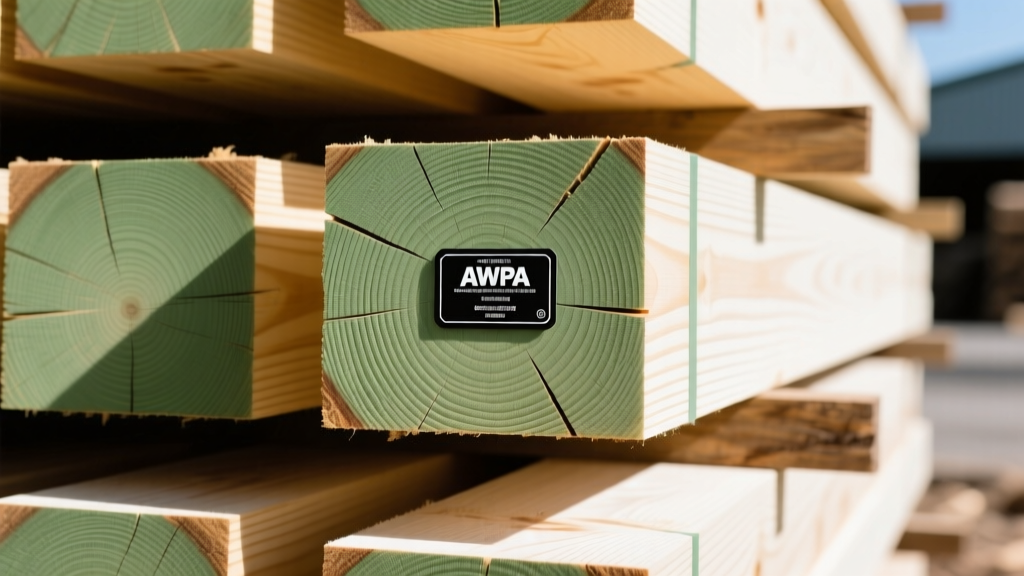
The most definitive way to identify treated lumber is by locating the black, plastic end-tag stapled to the end of the board. These tags are mandated by the American Wood Protection Association (AWPA) Standard U1 and the International Code Council (ICC). The tag contains critical data points that dictate where the wood can be legally and safely installed.
Understanding the Use Category (UC) Designation
The Use Category is the most vital piece of information on the tag. It defines the biological hazard level the wood is equipped to withstand:
- UC1 & UC2 (Interior): Treated for interior dry or damp conditions. Rarely seen in standard exterior framing.
- UC3A (Above Ground, Coated): For exterior use where the wood is coated, sloped to shed water, and at least 6 inches above the ground.
- UC3B (Above Ground, Uncoated): For exterior use with poor drainage or uncoated surfaces, but still not touching the ground.
- UC4A (Ground Contact): The standard for posts, sill plates, and structural members touching the ground or concrete. Minimum retention for MCA-C is typically 0.40 pcf (pounds per cubic foot).
- UC4B (Ground Contact, Heavy Duty): Used for critical structural components, permanent wood foundations, and high-moisture environments. Retention levels jump to 0.60 pcf.
- UC4C (Ground Contact, Extreme Duty): Reserved for utility poles and heavy marine/freshwater dock pilings.
- UC5A, UC5B, UC5C (Marine): Specifically treated to resist marine borers in saltwater environments.
Visual Signatures: How Different Wood Species React to Treatment
Not all wood species absorb preservative chemicals equally. The cellular structure of the wood dictates both the penetration depth and the final visual appearance of the treated product. When comparing pictures of types of wood post-treatment, distinct species-specific signatures emerge.
| Wood Species | Sapwood Permeability | Visual Treatment Signature | Requires Incising? |
|---|---|---|---|
| Southern Yellow Pine (SYP) | Highly Permeable | Deep, uniform olive-green to brown tint penetrating deep into the core. | No |
| Douglas Fir | Refractory (Resistant) | Surface-level color with a pale, untreated core unless heavily incised. | Yes (Mandatory for UC4A) |
| Hem-Fir (Hemlock/Fir) | Moderate to Low | Uneven coloration; often shows distinct treated sapwood rings and untreated heartwood. | Yes (For deep penetration) |
| Western Red Cedar | Highly Resistant | Rarely pressure-treated for ground contact due to poor penetration; usually left natural. | Yes (If treated) |
Southern Yellow Pine is the industry standard for pressure-treated lumber precisely because its wide sapwood band readily accepts waterborne preservatives under pressure. According to the USDA Forest Products Laboratory Wood Handbook, SYP can achieve full sapwood penetration, resulting in a board that is uniformly colored and protected throughout its structural cross-section. Conversely, Douglas Fir contains extractives and complex pit structures that block chemical flow, necessitating physical intervention.
Chemical Color Profiles: Reading the Tint
The color of the treated wood provides immediate clues about the chemical formulation used. While weathering will eventually turn all treated wood to a silver-gray, freshly milled or newly cut boards exhibit distinct chemical signatures.
Copper-Based Preservatives (MCA-C and CA-C)
Micronized Copper Azole (MCA-C) and Copper Azole (CA-C) are the most common residential treatments. MCA-C utilizes micro-ground copper particles, resulting in a lighter, more natural olive-green or golden-brown hue. CA-C uses dissolved copper, which yields a darker, more pronounced forest-green tint that eventually fades to a warm brown. Both require hot-dipped galvanized (G185) or stainless steel fasteners to prevent corrosion.
Alkaline Copper Quaternary (ACQ)
ACQ treated wood has a very dark, almost blackish-green initial color that weathers to a dark brown. ACQ is highly corrosive to standard aluminum and untreated steel. If you identify ACQ lumber (usually noted on the end-tag), you must strictly use Type 304 or 316 stainless steel fasteners, or heavily hot-dipped galvanized hardware meeting ASTM A153 Class D standards.
Borate Treatments (SBX / DOT)
Borates are colorless. To allow for visual identification, manufacturers add a tracer dye, typically pink, blue, or green. Borate-treated wood is strictly for interior, above-ground applications (UC1 and UC2) because the chemicals are water-soluble and will leach out if exposed to rain. It is highly effective against termites and drywood decay but useless in exterior environments.
Incising: The Physical Marker of Refractory Species
If you are examining a piece of treated lumber and notice a pattern of small, uniform slits or dashes cut into the surface of the board, you are looking at incised lumber. This is a critical visual identifier for wood species with resistant heartwood, primarily Douglas Fir and Hem-Fir.
Because these species naturally resist liquid penetration, manufacturers pass the lumber through a machine equipped with hundreds of small teeth that puncture the wood surface before it enters the pressure cylinder. These incisions create artificial pathways for the preservative chemicals to reach the required depth. Under AWPA standards, if a refractory species like Douglas Fir is rated for Ground Contact (UC4A), it must be incised. If you see a Douglas Fir post labeled UC4A but it lacks incising marks, it has likely been mislabeled or fails to meet code-mandated penetration depths.
Troubleshooting Weathered and Faded Lumber
UV radiation and rain will strip the green and brown chemical tints from treated wood within 6 to 12 months, leaving a uniform silver-gray patina. When the color signature is gone, field identification requires a secondary approach:
- Look for Incising: As mentioned, the physical slits do not weather away. Their presence confirms the wood is likely a refractory species that underwent a rigorous treatment cycle.
- Check the Core: Use a utility knife or a drill to expose fresh wood beneath the weathered surface. If the core reveals a green or brown tint, the wood is treated. If the core is pale, untreated white/yellow wood, the board is either untreated or the treatment failed to penetrate (a common failure mode in non-incised Douglas Fir).
- Search for Stamp Ghosts: Even if the plastic end-tag is gone, the ink stamps applied to the face of the board often leave a "ghost" impression in the wood grain that can be read with a wire brush and a flashlight held at a low angle.
If you are renovating a structure built before 2004, you may encounter Chromated Copper Arsenate (CCA) treated wood. CCA has a distinct, sharp greenish-yellow hue when freshly cut and a highly textured, deeply grooved surface grain compared to modern treatments. CCA contains arsenic and hexavalent chromium. Never burn CCA wood, and always wear a P100 respirator and use HEPA-filtered vacuums when cutting or sanding it. For disposal and handling protocols, consult the Penn State Extension Pressure-Treated Wood Guide or your local environmental protection agency.
Summary Checklist for Field Verification
Before signing off on a lumber delivery or approving a framing inspection, run through this visual checklist:
- Verify the UC code on the AWPA tag matches the architectural specs (e.g., UC4A for sill plates on concrete foundations).
- Confirm the chemical type (MCA, CA, ACQ) aligns with the specified fastener schedule.
- Inspect refractory species (Douglas Fir) for mandatory incising marks if used in ground contact.
- Check the end-grain of SYP to ensure the treatment tint penetrates past the outer sapwood rings.
Written by
Marcus ChenMarcus Chen is a licensed structural engineer (PE) and building materials analyst with over 12 years of experience across residential, commercial, and industrial construction. He holds a Master of Science in Civil Engineering from UC Berkeley and spent six years at Thornton Tomasetti before transitioning to independent consulting and technical writing. Marcus specializes in material selection for seismic-prone regions, concrete reinforcement strategies, and lifecycle cost analysis. His work has been cited by the American Concrete Institute (ACI) and the Structural Engineers Association of California (SEAOC). When he is not on a job site or at his desk, you will find him hiking the Sierra Nevada or restoring a 1920s craftsman bungalow in Oakland, CA.
More from Marcus Chen
View all
Construction Cost
How Much Did the Eiffel Tower Cost to Build?
How much did the Eiffel Tower cost to build in 1889? We adjust for inflation and compare its budget to modern skyscraper construction.
Aug 4, 2026

Fire Resistance
What Is a Fire Resistant Material? Testing & Certification Guide
Discover what is a fire resistant material through ASTM and UL testing. Learn how fire ratings, certifications, and assemblies work in construction.
Aug 4, 2026

Construction Cost
How Much Did the Burj Khalifa Cost to Build?
How much did the Burj Khalifa cost to build? We break down the $1.5B project and extract 5 money-saving strategies for your next build.
Jul 30, 2026