Different Types of Wood: Complete Species Guide for Builders
Explore the different types of wood for construction and design. Compare softwoods, hardwoods, Janka ratings, structural grades, and 2026 pricing.
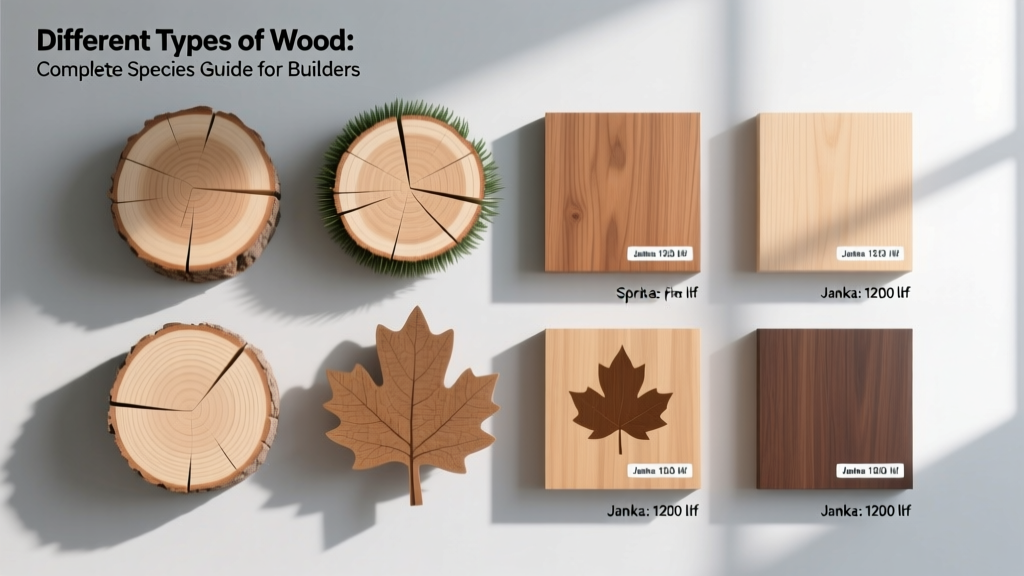
The Botanical Divide: Hardwood vs. Softwood
When evaluating the different types of wood for construction, the primary classification is botanical, not necessarily physical. Softwoods originate from gymnosperms (coniferous, needle-bearing trees like pine and fir), while hardwoods come from angiosperms (broadleaf, deciduous trees like oak and maple). This distinction dictates cellular structure: softwoods rely on tracheids for water transport and structural support, resulting in a simpler, more uniform grain. Hardwoods possess complex vessel elements (pores) and diverse fiber structures, yielding denser, more varied grain patterns. While balsa is botanically a hardwood and yew is a softwood, in commercial construction, softwoods dominate structural framing due to rapid growth and straight grain, whereas hardwoods are reserved for high-wear architectural finishes.
Structural Softwoods: Framing and Heavy Timber
Structural softwoods are graded by the American Lumber Standard Committee (ALSC) based on visual characteristics and mechanical testing. The critical engineering values are the extreme fiber in bending (Fb) and the modulus of elasticity (E). Understanding these metrics is essential when specifying lumber for load-bearing walls, floor joists, and roof rafters.
Douglas Fir-Larch (DF-L)
Douglas Fir is the benchmark for structural framing in North America. It offers the highest stiffness and bending strength among standard framing lumbers. A Select Structural grade 2x8 DF-L boasts an Fb of 1,500 psi and an E of 1,900,000 psi. It holds fasteners exceptionally well but can be prone to surface checking if kiln-dried too aggressively. In 2026, DF-L framing lumber typically commands a 15% to 20% premium over standard SPF.
Southern Yellow Pine (SYP)
Grown primarily in the US Southeast, SYP is the densest and heaviest structural softwood. Its high density provides superior fastener withdrawal resistance, making it the mandatory choice for engineered wood trusses and hurricane-tie connections. SYP is also the primary species used for pressure-treated lumber (AWPA UC4A and UC4B categories) because its porous sapwood readily accepts micronized copper azole (MCA) and alkaline copper quaternary (ACQ) preservatives.
Spruce-Pine-Fir (SPF)
SPF is a marketing grouping of several species (White Spruce, Engelmann Spruce, Lodgepole Pine, and Alpine Fir). It is the most economical framing option and dominates the light-frame residential market. While its Fb and E values are roughly 20% lower than DF-L, it is perfectly adequate for standard interior partition walls and lightly loaded floor systems.
| Species Group | Fb (psi) | E (psi) | Fastener Withdrawal | Relative Cost (2026) |
|---|---|---|---|---|
| Douglas Fir-Larch | 1,350 | 1,900,000 | High | $$$ |
| Southern Yellow Pine | 1,300 | 1,700,000 | Very High | $$ |
| Hem-Fir | 1,150 | 1,600,000 | Medium | $$ |
| SPF (South) | 1,050 | 1,400,000 | Medium-Low | $ |
Architectural Hardwoods: Flooring, Millwork, and Finishes
For interior applications where abrasion resistance, dimensional stability, and aesthetics are paramount, hardwoods are the standard. The Janka hardness test measures the force required to embed a 0.444-inch steel ball halfway into the wood, providing a reliable baseline for flooring and high-traffic millwork.
White Oak (Quercus alba)
White Oak has become the dominant species for premium architectural millwork and wide-plank flooring. With a Janka rating of 1,360 lbf, it balances hardness with workability. Crucially, White Oak contains tyloses—cellular outgrowths that plug the vascular pores, making the heartwood highly impermeable to water and rot. This allows it to be used in exterior applications and wet interiors (like shower surrounds) without chemical treatment. Current market pricing for 4/4 FAS (First and Seconds) White Oak hovers between $8.50 and $12.00 per board foot.
Hard Maple (Acer saccharum)
Boasting a Janka rating of 1,450 lbf, Hard Maple is the industry standard for bowling alleys, dance floors, and heavy-duty commercial cabinetry. Its diffuse-porous structure yields a tight, uniform grain that takes opaque pigments and painted finishes flawlessly. However, its high density and interlocked grain make it prone to burning during routing and machining; carbide tooling with high hook angles and slower feed rates are mandatory.
Black Walnut (Juglans nigra)
Prized for its rich chocolate heartwood, Black Walnut is relatively soft for a hardwood (Janka: 1,010 lbf). It is highly stable, exhibiting minimal seasonal movement compared to oak or maple. Because of its lower hardness, it is rarely used for commercial flooring but remains the premier choice for executive paneling, custom furniture, and high-end stair treads where it will not be subjected to abrasive grit. Expect to pay $14.00 to $19.00 per board foot for premium, steamed Walnut in 2026.
Exterior and Specialty Species
When specifying wood for exterior cladding, decking, or ground contact, natural decay resistance is the primary selection criteria. The USDA Forest Products Laboratory categorizes heartwood decay resistance based on accelerated soil-block tests.
- Western Red Cedar (Thuja plicata): Contains natural thujaplicins that act as fungicides. It is highly dimensionally stable (low shrinkage coefficient) but structurally weak (Fb of 750 psi). Ideal for siding, soffits, and non-structural fencing.
- Redwood (Sequoia sempervirens): Similar to cedar in stability and decay resistance, but with a higher density and richer color. Old-growth heartwood offers Class 1 durability, but most commercially available 2026 stock is second-growth, which contains more susceptible sapwood.
- Ipe (Handroanthus spp.): A tropical hardwood with a staggering Janka rating of 3,510 lbf and Class 1 decay resistance. It is so dense it sinks in water. Machining warning: Ipe dulls standard HSS and carbide blades rapidly. Pre-drilling all fastener holes with specialized brad-point bits is mandatory to prevent shearing screws.
Moisture Content and Acclimation Protocols
The most frequent cause of wood failure in construction—warping, checking, and joint separation—is improper moisture management. Wood is hygroscopic; it constantly exchanges moisture with the surrounding air until it reaches Equilibrium Moisture Content (EMC).
According to the USDA Forest Products Laboratory Wood Handbook, framing lumber is typically stamped S-DRY (surfaced dry, meaning 19% maximum moisture content at the time of surfacing) or MC-15 (15% maximum). However, interior architectural millwork and flooring must be acclimated to the building's operational HVAC environment, which typically requires a moisture content of 6% to 8%.
The Acclimation Framework
- Deliver Early: Interior hardwoods and millwork must be delivered to the job site only after the building envelope is sealed and wet trades (drywall mudding, concrete pouring, plastering) are 100% complete.
- Run HVAC: The building's permanent heating and cooling system must be operational and maintaining target living conditions (68°F-72°F, 35%-45% relative humidity) for at least 14 days prior to wood installation.
- Sticker and Stack: Bundles must be broken open, and boards must be 'stickers' (separated by 3/4-inch wooden spacers) to allow cross-ventilation. Do not stack wood directly on concrete subfloors; use a minimum 6-mil polyethylene vapor barrier underneath the stack.
- Verify with a Pin Meter: Do not rely on time. Use a calibrated pin-type moisture meter to test the core of the thickest boards. Installation should only commence when the wood's MC is within 2% of the subfloor's MC.
Decision Matrix: Matching Species to Application
Use this framework to rapidly narrow down species selection based on project requirements:
| Application Scenario | Primary Requirement | Recommended Species | Avoid |
|---|---|---|---|
| Exterior Load-Bearing Beams | High Fb, treatability | Southern Yellow Pine (Pressure Treated), Douglas Fir | SPF, Cedar (too weak) |
| Painted Interior Cabinetry | Tight grain, stability, smooth finish | Hard Maple, Poplar, MDF-core veneers | Coarse-grained Oak, Ash |
| High-Traffic Commercial Flooring | Abrasion resistance (High Janka) | Hard Maple, White Oak, Hickory | Walnut, Cherry, Pine |
| Exterior Siding / Rainscreen | Dimensional stability, natural decay resistance | Western Red Cedar, Redwood, Thermally Modified Ash | Untreated SPF, Maple |
Selecting the correct wood species requires moving beyond basic aesthetic preferences and evaluating the mechanical, hygroscopic, and biological properties of the material. By aligning the specific structural values, Janka hardness, and natural durability of a species with its intended environmental exposure, builders can ensure long-term performance and minimize costly callbacks related to moisture and structural deflection.
Written by
Elena RodriguezElena Rodriguez is a civil engineer and technical writer specializing in concrete technology, masonry systems, and ASTM/ACI compliance. She earned her B.S. in Civil Engineering from Texas A&M University and spent a decade at a materials testing laboratory, performing over 2,000 concrete compressive strength tests and masonry prism evaluations. Elena is an ACI-certified Field Testing Technician (Grade I) and a member of ASTM Committee C12 on Natural Building Stone. She currently consults on forensic engineering cases involving concrete failures and moisture intrusion. Based in San Antonio, TX, Elena is a proud member of the Society of Women Engineers (SWE) and coaches her daughter's FIRST Robotics team.
More from Elena Rodriguez
View all
Walls & Panels
Cost Analysis: Light Gauge Steel Framing Advantages and Disadvantages
Evaluate light gauge steel framing advantages and disadvantages through a strict cost analysis lens, comparing material, labor, and lifecycle expenses.
Aug 4, 2026

Walls & Panels
Gypsum Board Types: Exact Specifications, Thickness & Dimensions
Compare standard, Type X, and moisture-resistant gypsum board types. Get exact specifications, thicknesses, dimensions, and ASTM standards for your project.
Aug 4, 2026

Fire Resistance
Best Fire-Resistant Outdoor Decking Materials: 2026 Buyer Guide
Discover the best fire-resistant outdoor decking materials for 2026. Compare Class A PVC, aluminum, and hardwood options for WUI compliance and safety.
Aug 4, 2026