Identifying Types of Old Wood Siding: A Complete Species Guide
Discover common types of old wood siding in historic homes. Learn to identify species like heart pine, cypress, and redwood for accurate restoration.

The Legacy of Historic Timber: Why Species Identification Matters
When restoring a pre-1950s home, accurately identifying the specific types of old wood siding already on the structure is the most critical step in the preservation process. Modern lumber yard equivalents rarely match the density, grain profile, or rot resistance of the virgin timber used a century ago. Misidentifying the original species often leads to mismatched repairs, accelerated decay at the seams, and a compromised historic aesthetic. This complete species guide breaks down the botanical and physical characteristics of heritage siding woods, providing contractors and preservationists with the exact data needed to source, match, and restore historic exteriors.
The 'Big Four' Heritage Siding Species
Before the mid-20th century, regional availability dictated siding choices. However, four primary species dominated the high-end and vernacular markets due to their exceptional natural durability.
1. Longleaf Heart Pine (Pinus palustris)
Often referred to as 'antique heart pine,' this was the premier siding and structural timber of the American South and East Coast from the 1800s through the early 1900s. True old-growth heart pine is harvested from trees that grew for 200 to 400 years, resulting in incredibly tight growth rings (often 15 to 30 rings per inch). The wood is composed almost entirely of heartwood, which is saturated with natural resins that act as a powerful preservative. With a Janka hardness rating of 1,225 lbf, it is significantly harder and more dimensionally stable than modern Southern Yellow Pine. When identifying it, look for a deep, rich amber-to-rust color and a highly resinous scent when sanded.
2. Tidewater Cypress (Taxodium distichum)
Prevalent in coastal and southern historic districts, old-growth cypress is legendary for its rot resistance. This durability comes from 'cypressene,' a natural oil concentrated in the heartwood that repels water, fungi, and insects. Historic cypress siding was often milled from massive, swamp-grown trees. It features a straight, relatively coarse grain with a pale, yellowish-brown hue that weathers to a distinguished silvery-gray if left unfinished. 'Pecky cypress,' characterized by localized decay pockets caused by a specific fungus before the tree was harvested, was sometimes used intentionally for a rustic, textured exterior aesthetic.
3. Old-Growth Redwood (Sequoia sempervirens)
On the West Coast, old-growth redwood was the undisputed king of exterior cladding. Its massive natural tannin content provides extreme resistance to decay and termites without any chemical treatment. Historic redwood siding is typically characterized by a deep, reddish-brown color and a remarkably straight, uniform grain. Unlike modern second-growth redwood, which contains a high percentage of sapwood (prone to rapid decay), vintage redwood siding is almost exclusively heartwood. According to the USDA Forest Products Laboratory, old-growth redwood exhibits superior dimensional stability, meaning it swells and shrinks significantly less than other species when exposed to moisture cycles.
4. Western Red Cedar (Thuja plicata)
Favored for shingles, shakes, and bevel siding across North America, Western Red Cedar contains 'thujaplicins,' water-soluble fungicides that give the wood its signature aromatic scent and natural decay resistance. Historic cedar siding is lightweight, easy to mill, and features a straight grain with a reddish-brown to salmon-pink color palette. It is highly workable but relatively soft (Janka hardness of 350 lbf), making it susceptible to mechanical damage from hail or aggressive pressure washing.
Species Identification Matrix
Use this comparative matrix to cross-reference the physical properties of your existing siding against known historic species.
| Wood Species | Janka Hardness (lbf) | Natural Rot Resistance | End-Grain Characteristics | Peak Historical Usage Era |
|---|---|---|---|---|
| Longleaf Heart Pine | 1,225 | High (Resin-saturated) | Extremely tight rings, >70% latewood | 1850 – 1920 |
| Tidewater Cypress | 510 | Very High (Cypressene oil) | Distinct earlywood/latewood contrast | 1880 – 1940 |
| Old-Growth Redwood | 420 | Very High (Tannins) | Uniform, fine texture, no resin canals | 1890 – 1950 |
| Western Red Cedar | 350 | High (Thujaplicins) | Coarse texture, distinct growth rings | 1900 – Present |
| Eastern White Pine | 380 | Low to Moderate | Even texture, small resin canals | 1700 – 1900 |
Utility and Transition-Era Woods (1900–1940)
As old-growth forests were depleted and balloon framing revolutionized construction, builders shifted toward faster-growing, cheaper utility woods. If your home was built between 1900 and 1940, the siding is likely one of these species:
- Eastern White Pine (Pinus strobus): The standard for early American clapboard in the Northeast. It is soft, pale, and paints exceptionally well, but lacks the natural rot resistance of heart pine or cedar. It requires strict paint film maintenance.
- Sitka Spruce (Picea sitchensis): Used heavily during the WWI and WWII eras due to its high strength-to-weight ratio. It has a pale, almost white appearance and poor natural decay resistance.
- Douglas Fir (Pseudotsuga menziesii): While structurally excellent, early 20th-century Douglas Fir was occasionally used for rustic board-and-batten siding. It features a prominent, aggressive grain pattern and requires heavy sealing to prevent checking.
⚠️ Hazardous Materials Warning
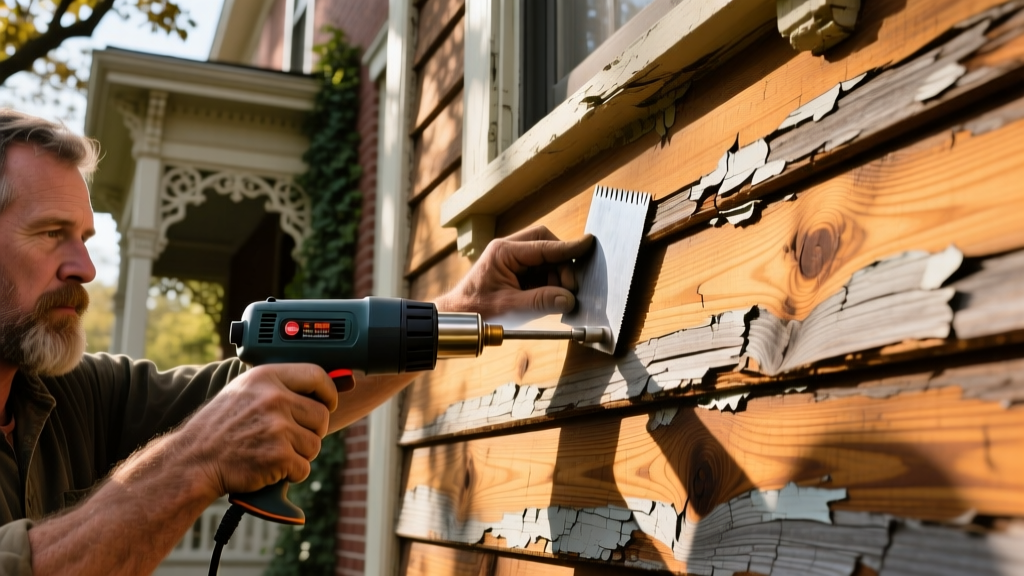
When scraping, sanding, or removing any types of old wood siding installed before 1978, assume the presence of lead-based paint. Furthermore, homes built between 1920 and 1960 occasionally utilized asbestos-cement shingles nailed directly over the original wood cladding. Always conduct XRF testing for lead and ACM (Asbestos-Containing Materials) surveys before initiating mechanical restoration work, in compliance with EPA RRP guidelines.
Field Diagnostics: 4 Steps to Identify Unknown Siding
When historical records are missing, preservationists rely on physical diagnostics to identify the wood species. Follow this step-by-step field protocol:
- The End-Grain Loupe Test: Use a 10x jeweler's loupe to examine the end-grain of a freshly cut or sanded board edge. Count the growth rings per inch. If you see more than 12-15 tight rings per inch with a high ratio of dark latewood to light earlywood, you are likely looking at old-growth heart pine or dense fir. Modern plantation pine will show 3 to 5 wide rings per inch.
- The Olfactory (Smell) Test: Sand a small, inconspicuous area to expose fresh wood. Western Red Cedar emits a distinct, sweet 'cedar closet' aroma. Heart pine smells sharply of turpentine and resin. Cypress has a slightly sour, earthy scent, while redwood has a mild, sweet, and tannic smell.
- The Moisture and Weight Check: Old-growth woods are significantly denser. A 12-foot board of old-growth heart pine will feel noticeably heavier than an identically sized piece of modern SPF (Spruce-Pine-Fir). Furthermore, use a pin-type moisture meter; dense heartwoods absorb ambient moisture much slower than porous sapwoods.
- Chemical Spot Testing: For difficult identifications, apply a drop of denatured alcohol to the sanded wood. Resinous woods like heart pine will become sticky as the alcohol dissolves the surface resins, while non-resinous woods like cedar or redwood will simply absorb the liquid.
Sourcing Matching Lumber: 2026 Market Realities
Matching historic siding in 2026 requires navigating a specialized market. You cannot simply walk into a big-box store and purchase old-growth equivalents. The National Park Service guidelines on historic exteriors emphasize repairing over replacing, but when boards are too degraded, in-kind replacement is mandatory.
Reclaimed vs. New-Growth Alternatives
True old-growth timber is only available through the reclaimed market (salvaged from demolished barns, river-logged 'sinker' timber, or deconstructed industrial buildings). Expect to pay a premium for reclaimed materials. As of early 2026, reclaimed Longleaf Heart Pine siding averages $16 to $24 per board foot, while Sinker Cypress commands $20 to $32 per board foot.
If the budget prohibits reclaimed wood, specify Clear, All-Heart (Grade A) new-growth cedar or redwood. While the growth rings will be wider, selecting 100% heartwood ensures the natural rot-resistant compounds are present. Avoid 'Select Tight Knot' or 'Construction Grade' for historic restorations, as the inclusion of sapwood will lead to localized rot within 5 to 7 years.
Historic Wood Siding FAQs
Can I use modern engineered wood to replace damaged historic clapboard?
For a true historic restoration, no. Engineered wood (OSB-based or fiber-cement) lacks the vapor-permeability and thermal expansion characteristics of solid timber. Trapping moisture against the original sheathing by mixing modern impermeable materials with antique wood often accelerates rot in the underlying framing. Always replace solid wood with solid wood.
How should old-growth wood siding be finished?
Do not use modern elastomeric or high-build acrylic paints on antique siding; they trap interior moisture, causing the wood to rot from the inside out. Use high-quality, oil-based alkyd primers followed by breathable, flat acrylic latex topcoats. For unpainted woods like cedar and redwood, apply a penetrating, oil-based semi-transparent stain that allows the wood to transpire moisture vapor.
What is the best fastener for reattaching historic siding?
Never use standard galvanized or electroplated nails, which will rust, expand, and split the dense, brittle antique wood. Use Type 304 or Type 316 stainless steel ring-shank siding nails. The ring-shank provides superior withdrawal resistance in older, potentially degraded sheathing, while the stainless steel prevents the tannins in redwood and cedar from reacting with the metal and causing black streaking.
Written by
Priya KapoorPriya Kapoor is a real estate market analyst and construction economics researcher with expertise in housing affordability, development feasibility, and infrastructure investment. She holds a Master of Regional Planning from Cornell University and previously worked as a senior analyst at CBRE's Investment Properties group, where she modeled returns for $4B in mixed-use development pipelines. Priya now runs an independent research practice advising developers, municipalities, and REITs on construction cost forecasting and market timing. She publishes the quarterly "BuildMat Market Pulse" report tracking material price indices across 12 commodity categories. Based in Austin, TX, Priya serves on the board of Habitat for Humanity Austin and is a marathon runner.
More from Priya Kapoor
View all
Construction Cost
Cost to Build a 1600 Sq Ft Home in 2026: Full Breakdown
Accurate 2026 cost to build a 1600 sq ft home—material, labor, and regional pricing breakdowns included. Plan your budget with real-time estimates.
Aug 11, 2026

Wood & Lumber
Name the Types of Wood for Pressure Treatment and Preservation
Learn how to name the types of wood best suited for pressure treatment. Compare species treatability, chemical retention levels, and 2026 preservation costs.
Aug 4, 2026

Stone & Masonry
Stone Veneer Suppliers Lindenhurst: 2026 Cost Analysis
Analyze 2026 stone veneer costs in Lindenhurst, NY. Compare local supplier pricing, delivery fees, and Suffolk County installation labor rates.
Aug 4, 2026