Installing Different Types of Oak Wood: Flooring & Trim Best Practices
Master installing different types of oak wood. Learn species-specific acclimation, fastener selection, and tannin-blocking techniques for flawless floors.

The Cellular Divide: Why Oak Species Dictates Installation
Treating all oak as a monolithic material is the most common catalyst for hardwood flooring and millwork failures. While Red Oak (Quercus rubra), White Oak (Quercus alba), and European Oak (Quercus robur/petraea) share similar density profiles, their cellular structures demand radically different installation protocols. The defining difference lies in the xylem vessels. Red Oak features open, continuous capillaries that readily absorb moisture and adhesives. White Oak, conversely, is plugged with tyloses—balloon-like cellular growths that make the wood nearly impermeable to liquids. This biological divergence dictates everything from acclimation timelines and adhesive selection to fastener metallurgy and finish chemistry.
According to the Forest Products Laboratory Wood Handbook, the dimensional stability and moisture sorption rates vary significantly even within the same genus. Installers must calibrate their site preparation, fastening mechanics, and finishing systems to the specific species and cut (plain-sawn, quarter-sawn, or rift-sawn) being deployed.
Acclimation Protocols and Moisture Equilibrium
Acclimation is not a fixed timeframe; it is the process of achieving Equilibrium Moisture Content (EMC) between the wood, the subfloor, and the ambient interior environment. The National Wood Flooring Association (NWFA) mandates that solid oak flooring must be within 2% to 4% moisture content (MC) of the subfloor before installation. Because of the tyloses in White Oak and the higher initial kiln-drying densities of imported European Oak, moisture exchange happens at a slower rate than in Red Oak.
Species-Specific Acclimation Matrix
| Oak Species | Janka Hardness | Target Interior MC | Min. Acclimation Days | Stacking Requirement |
|---|---|---|---|---|
| Red Oak (Plain Sawn) | 1,290 lbf | 6% - 9% | 7 - 10 Days | Cross-stacked, 1/2" spacers |
| White Oak (Quarter/Rift) | 1,360 lbf | 6% - 8% | 10 - 14 Days | Cross-sticked, climate-controlled |
| European Oak | 1,120 lbf | 7% - 9% | 14 - 21 Days | End-matched, elevated off subfloor |
Subfloor Preparation and Moisture Barriers
Oak is highly reactive to hydrostatic pressure and subfloor moisture vapor emission. For nail-down installations over wood subfloors, the subfloor must be a minimum of 3/4-inch CDX plywood or AdvanTech OSB, with a deflection rating of L/360. Flatness tolerances are strict: no more than 3/16-inch deviation over a 10-foot radius. Any deviation beyond this will cause the rigid oak planks to bridge, leading to immediate squeaking and eventual fastener fatigue.
Barrier Selection by Species
- Red Oak: Standard 15 lb. asphalt-saturated felt paper is sufficient for nail-down installations. It provides a slip sheet to reduce friction noise and a basic vapor retarder.
- White Oak & European Oak (Wide Plank > 5"): For wider planks, nail-and-glue is mandatory to prevent edge-cupping. Use a silane-modified polymer adhesive (like Bona K850 or Wakol MS262) paired with a liquid-applied moisture barrier if the subfloor MC exceeds 10%. Do not use asphalt felt under glue-down applications, as the adhesive will not bond to the petroleum-based surface.
Fastening Mechanics: Cleats, Staples, and Corrosion
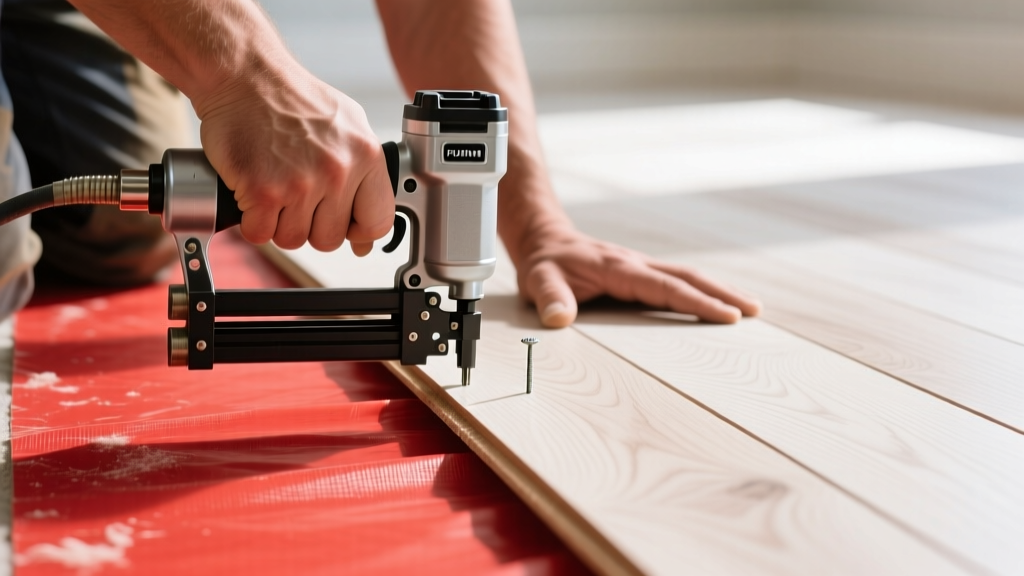
The mechanical fastening of oak requires matching the fastener gauge and length to the wood's density and the subfloor's bite depth. For 3/4-inch solid oak, 1.5-inch to 2-inch fasteners are standard, driven at 8-inch to 10-inch intervals along the tongue, and within 3 inches of every board end.
Furthermore, while staples offer higher initial withdrawal resistance, they act as a wedge. Driving a wide-crown staple into dense, quarter-sawn White Oak near the end of a board frequently splits the tongue. A 16-gauge L-cleat or T-cleat is the superior choice for rift and quarter-sawn oak, as the cleat slices through the fibers rather than wedging them apart.
Finishing Edge Cases: Preventing Tannin Bleed
The shift toward water-based polyurethanes and hardwax oils has exposed a major vulnerability in White Oak installations. Water-based finishes act as a solvent for tannic acid. If applied directly to raw White Oak, the water pulls the tannins to the surface, resulting in a mottled, greenish-yellow discoloration that is impossible to sand out without removing significant material.
The Protocol: You must seal White Oak with a dedicated tannin-blocking primer before applying water-based topcoats. Shellac-based sealers (such as Zinsser B-I-N) or specialized commercial tannin blockers (like Bona AmberSeal or Basic Coatings Seal-n-Stay) chemically bind the tannins. Apply one coat of the blocking sealer, allow it to flash off completely, and lightly abrade with 120-grit sandpaper before proceeding with your water-based polyurethane build coats.
Troubleshooting Common Oak Installation Failures
Failure 1: Post-Installation Edge Cupping
Symptom: The edges of the oak planks rise higher than the center, creating a washboard effect across the floor.
Root Cause: A negative moisture gradient. The bottom of the board is absorbing moisture from the subfloor or crawl space, causing it to expand laterally while the top remains dry and restricted.
Corrective Action: Do not sand a cupped floor flat immediately; this will result in crowning when the wood eventually dries. First, identify and eliminate the moisture source (e.g., install a 10-mil polyethylene vapor barrier in the crawl space). Run commercial dehumidifiers to bring the ambient relative humidity down to 35-45%. Allow the floor to re-equilibrate for 3 to 6 months before attempting any sanding.
Failure 2: localized Black Staining Around Fasteners
Symptom: Dark, ink-like halos appear around nail holes or along the seams of White Oak planks.
Root Cause: Iron-tannin reaction. This occurs if uncoated steel fasteners were used, or if the flooring was installed over a steel mesh or metal subfloor substrate that oxidized and transferred ions through the moisture barrier.
Corrective Action: Surface sanding will not remove this stain, as it penetrates deep into the xylem. The affected boards must be individually removed and replaced. For minor surface staining, an oxalic acid wood bleach can temporarily lighten the stain, but board replacement is the only permanent fix.
Failure 3: End-Joint Squeaking and Deflection
Symptom: Audible friction noise and vertical movement when walking over the end-joints of the oak planks.
Root Cause: Subfloor deflection or failure to blind-nail within 3 inches of the board ends. If the subfloor joists are spaced at 19.2 inches or 24 inches on-center, 3/4-inch plywood may deflect under point loads, breaking the adhesive bond and loosening the fasteners.
Corrective Action: From the basement or crawl space, identify the deflecting joist bays. Sister the joists or install mid-span blocking to stiffen the subfloor assembly. If access is impossible, inject a two-part structural epoxy or specialized squeak-relief adhesive through the subfloor from below to re-bond the oak to the plywood.
Written by
Priya KapoorPriya Kapoor is a real estate market analyst and construction economics researcher with expertise in housing affordability, development feasibility, and infrastructure investment. She holds a Master of Regional Planning from Cornell University and previously worked as a senior analyst at CBRE's Investment Properties group, where she modeled returns for $4B in mixed-use development pipelines. Priya now runs an independent research practice advising developers, municipalities, and REITs on construction cost forecasting and market timing. She publishes the quarterly "BuildMat Market Pulse" report tracking material price indices across 12 commodity categories. Based in Austin, TX, Priya serves on the board of Habitat for Humanity Austin and is a marathon runner.
More from Priya Kapoor
View all
Construction Cost
Cost to Build a 1600 Sq Ft Home in 2026: Full Breakdown
Accurate 2026 cost to build a 1600 sq ft home—material, labor, and regional pricing breakdowns included. Plan your budget with real-time estimates.
Aug 11, 2026

Wood & Lumber
Name the Types of Wood for Pressure Treatment and Preservation
Learn how to name the types of wood best suited for pressure treatment. Compare species treatability, chemical retention levels, and 2026 preservation costs.
Aug 4, 2026

Stone & Masonry
Stone Veneer Suppliers Lindenhurst: 2026 Cost Analysis
Analyze 2026 stone veneer costs in Lindenhurst, NY. Compare local supplier pricing, delivery fees, and Suffolk County installation labor rates.
Aug 4, 2026