Types of Hand Saws for Wood: A Master Carpenter Selection Guide
Master the physics of cutting timber. This selection framework matches types of hand saws for wood to specific TPI, species, and joinery needs.

The Core Selection Matrix: TPI, Kerf, and Tooth Geometry
Selecting the correct types of hand saws for wood is not a matter of brand preference; it is an applied physics problem involving wood density, moisture content, and fiber orientation. The most critical metric in this framework is Teeth Per Inch (TPI), governed by the 'Three-Tooth Rule': a minimum of three teeth must be engaged in the material at all times to prevent snagging, binding, and catastrophic tear-out. Conversely, too many teeth in thick material will clog the gullets with sawdust, generating friction heat that warps the blade.
| TPI Range | Primary Application | Ideal Material Thickness | Cut Direction |
|---|---|---|---|
| 3 - 7 TPI | Framing, rough dimensioning, wet lumber | 2' and thicker (SPF, Hem-Fir) | Aggressive Crosscut & Rip |
| 8 - 11 TPI | General carpentry, trim, sheet goods | 3/4' to 1.5' (Plywood, MDF, Pine) | Universal / Hybrid |
| 12 - 15 TPI | Fine joinery, tenons, hardwood dimensioning | 1/2' to 3/4' (Oak, Maple, Walnut) | Rip (Tenon) & Crosscut |
| 16 - 24+ TPI | Dovetails, veneer trimming, flush cuts | Under 1/2' (Hardwoods, Veneers) | Precision Rip & Crosscut |
Categorizing Saws by Mechanical Action and Function
The fundamental divide in hand saw design lies in how the blade manages compressive and tensile forces during the stroke. Understanding this divide dictates which tool belongs on your job site versus in your woodworking bench.
Western Push Saws: Crosscut and Rip
Western saws cut on the push stroke. Because a thin blade will buckle under compressive force, Western saws require a thicker steel plate (typically 0.036' to 0.042' kerf).
- Crosscut Saws: Teeth are filed with a 'fleam' angle (beveled edges) acting like a series of knives that sever wood fibers perpendicularly. A 7 to 8 TPI crosscut panel saw, such as the Stanley FatMax 15-334, is the standard for cutting dimensional SPF framing lumber.
- Rip Saws: Teeth are filed flat across the front, acting like tiny chisels that scoop out material parallel to the grain. Rip saws are rarely used in modern framing but remain essential for resawing or cutting tenon cheeks in traditional joinery.
Japanese Pull Saws: Ryoba, Dozuki, and Mawashibiki
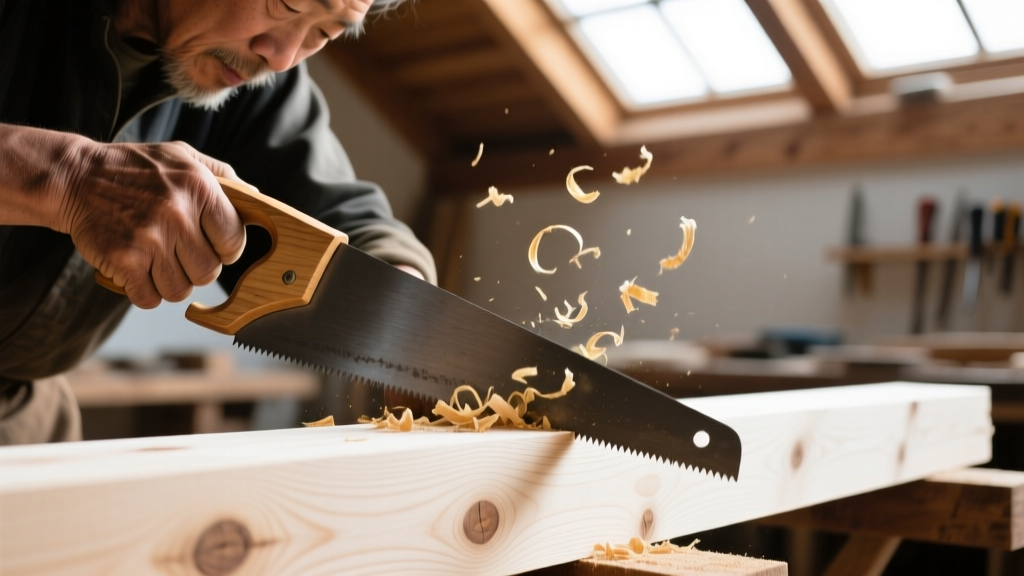
Japanese saws cut on the pull stroke. Pulling places the blade under tension, naturally straightening it and eliminating the risk of buckling. This allows for dramatically thinner plates (0.020' kerf or less), which removes less material, requires less physical exertion, and leaves a glass-smooth finish.
- Ryoba: A double-edged saw featuring crosscut teeth on one side and rip teeth on the other. The Suizan Ryoba 240mm is a benchmark tool for general hardwood dimensioning and timber framing layout.
- Dozuki: Translates to 'attached trunk.' This is a backsaw with a rigid steel spine, allowing for ultra-fine teeth (often 17 to 24 TPI). It is the definitive choice for cutting dovetails and precise tenons in dense hardwoods.
- Mawashibiki: A keyhole saw with a tapered, flexible blade designed for cutting tight internal radii and drywall cutouts.
Specialty Saws: Backsaws, Coping, and Bow Saws
When precision or aggressive curve-cutting is required, standard panel saws fail. Backsaws (like the Lie-Nielsen Dovetail Saw, filed at 15 TPI rip) utilize a thick brass or steel spine to dampen vibration and maintain a perfectly straight kerf for joinery. Coping saws and bow saws utilize narrow blades held under extreme tension within a frame, allowing the user to pivot the blade for intricate scrollwork or rapid curve-cutting in thick stock.
'Tooth set' refers to the alternating left-right bend of the teeth, which creates a kerf wider than the blade to prevent binding. Japanese pull saws have minimal set. If you use a fine-toothed Japanese saw on wet, pressure-treated lumber or green timber, the wood will compress and swell against the thin blade, instantly binding the saw. Always use a Western saw with aggressive set (like a 7 TPI panel saw) for wet or high-moisture framing lumber.
Wood Species Hardness vs. Saw Selection
According to the USDA Forest Products Laboratory's Wood Handbook, the Janka hardness scale measures the force required to embed a steel ball into wood, directly correlating to cutting resistance. Matching your saw to the Janka rating prevents premature blade dulling and user fatigue.
Pro Insight: When cutting high-density tropical hardwoods like Ipe (Janka rating: 3,684 lbf) or Cumaru (3,540 lbf), standard carbon steel teeth will dull within a dozen cuts. You must select a saw with impulse-hardened, hard-chromed teeth, or utilize a specialized carbide-tipped pull saw designed specifically for exotic decking materials.
For domestic hardwoods like White Oak (1,360 lbf) or Hard Maple (1,450 lbf), high-carbon steel Japanese pull saws excel, provided the wood is properly kiln-dried. As noted in Popular Woodworking's essential hand tool guides, maintaining a sharp saw is vastly more important than the initial cost of the tool; a dull $80 saw will perform worse than a sharp $15 saw.
Step-by-Step Job-Site Decision Flowchart
Use this conditional logic framework to select the exact saw for your current task:
- Identify Cut Direction: Are you cutting across the grain (crosscut) or with the grain (rip)? If ripping by hand, select a rip-filed saw; if crosscutting, select a fleam-filed crosscut saw.
- Measure Material Thickness: Apply the Three-Tooth Rule. For 3/4' oak, a 12-15 TPI saw is optimal. For a 3.5' timber beam, drop to a 4-5 TPI saw.
- Assess Moisture Content: Is the wood green, pressure-treated, or kiln-dried? If wet, select a Western push saw with heavy tooth set to prevent binding. If dry, a Japanese pull saw will yield a superior finish with less effort.
- Determine Finish Requirements: Will the cut be hidden (e.g., inside a wall cavity) or visible (e.g., exposed timber joinery)? Hidden cuts justify aggressive, tear-out-prone framing saws. Visible cuts demand fine-toothed backsaws or Dozuki saws with zero tear-out.
Maintenance Realities: Impulse-Hardened vs. Resharpenable
Modern hardware store saws typically feature impulse-hardened teeth. This manufacturing process uses high-frequency electrical currents to heat the tooth tips to extreme hardness (often exceeding 60 HRC). While this allows the saw to cut abrasive materials like MDF, melamine, and composite lumbers without dulling, it renders the teeth impossible to sharpen with a standard file. Once an impulse-hardened saw goes dull, it is disposable.
Conversely, traditional Western backsaws and high-end Japanese saws (where the blade is replaceable but the teeth are not impulse-hardened) are designed for a lifecycle of decades. Investing in a resharpenable saw requires learning to use a taper file and a saw set, but it is the only sustainable choice for professional finish carpenters who demand absolute control over their tool's cutting geometry. For the modern builder managing a mix of structural framing and finish trim, the optimal kit includes one disposable 7 TPI framing saw for abrasive site work, and a resharpenable 14 TPI Japanese Ryoba for precision interior tasks.
Written by
Elena RodriguezElena Rodriguez is a civil engineer and technical writer specializing in concrete technology, masonry systems, and ASTM/ACI compliance. She earned her B.S. in Civil Engineering from Texas A&M University and spent a decade at a materials testing laboratory, performing over 2,000 concrete compressive strength tests and masonry prism evaluations. Elena is an ACI-certified Field Testing Technician (Grade I) and a member of ASTM Committee C12 on Natural Building Stone. She currently consults on forensic engineering cases involving concrete failures and moisture intrusion. Based in San Antonio, TX, Elena is a proud member of the Society of Women Engineers (SWE) and coaches her daughter's FIRST Robotics team.
More from Elena Rodriguez
View all
Walls & Panels
Cost Analysis: Light Gauge Steel Framing Advantages and Disadvantages
Evaluate light gauge steel framing advantages and disadvantages through a strict cost analysis lens, comparing material, labor, and lifecycle expenses.
Aug 4, 2026

Walls & Panels
Gypsum Board Types: Exact Specifications, Thickness & Dimensions
Compare standard, Type X, and moisture-resistant gypsum board types. Get exact specifications, thicknesses, dimensions, and ASTM standards for your project.
Aug 4, 2026

Fire Resistance
Best Fire-Resistant Outdoor Decking Materials: 2026 Buyer Guide
Discover the best fire-resistant outdoor decking materials for 2026. Compare Class A PVC, aluminum, and hardwood options for WUI compliance and safety.
Aug 4, 2026