Types of Wood Paneling: A Complete Species & Application Guide
Explore the best types of wood paneling for interiors. Compare species by Janka hardness, cost, grain patterns, and ideal applications for modern projects.

Decoding Wood Paneling: Beyond the Basic Pine
Selecting the right wood species for interior wall cladding dictates the longevity, acoustic performance, and visual evolution of a space. While generic home center options often default to Eastern White Pine or MDF veneers, architectural millwork and high-end residential projects demand a precise understanding of wood anatomy, dimensional stability, and Janka hardness. The types of wood paneling available on the market range from highly stable quartersawn hardwoods to aromatic, moisture-resistant softwoods. Each species reacts differently to interior HVAC fluctuations, UV exposure, and mechanical impact.
This guide bypasses superficial design trends to provide a technical breakdown of the most reliable wood species for interior paneling, including specific milling profiles, fastening requirements, and real-world material costs.
The Hardwood Heavyweights: Oak, Walnut, and Maple
Hardwoods are milled from deciduous trees and offer superior dent resistance, making them ideal for high-traffic corridors, commercial lobbies, and wainscoting applications where furniture or carts might impact the walls.
White Oak (Quercus alba)
White oak is the benchmark for interior architectural woodwork. For paneling, specifying quartersawn white oak is critical. Quartersawing cuts the log radially, exposing the medullary rays (fleck) and reducing tangential shrinkage by up to 50% compared to plain-sawn boards. This ensures the tongue-and-groove (T&G) joints remain tight through seasonal humidity swings. White oak accepts penetrating hardwax oils (like Rubio Monocoat or Osmo Polyx) exceptionally well, which allows for easy spot-repair if the wall is scuffed.
- Janka Hardness: 1,360 lbf
- Material Cost: $9.00 - $15.00 per sq. ft. (depending on grade and width)
- Best Profile: 3/4' x 5' shiplap or square-edge T&G
Black Walnut (Juglans nigra)
Walnut provides a deep, rich heartwood that ranges from pale brown to dark chocolate. Unlike cherry, which darkens with UV exposure, walnut heartwood actually lightens slightly when exposed to direct sunlight over time. When ordering walnut paneling, specify 'steamed' if you want the sapwood (which is naturally pale yellow) to darken and blend with the heartwood, or 'unsteamed' if you prefer the high-contrast rustic look. Because walnut is relatively soft for a hardwood, it is best reserved for low-impact areas like bedroom feature walls or executive offices.
Hard Maple (Acer saccharum)
Hard maple offers a tight, subdued grain pattern ideal for contemporary and minimalist interiors. However, it is notorious for blotching when treated with traditional pigmented oil stains due to its dense, closed-pore structure. If a darker color is required for maple paneling, specify water-based dye stains or pre-catalyzed lacquers applied in a factory setting rather than attempting to stain it on-site.
While softwoods like pine and cedar are cost-effective, their low Janka ratings (under 500 lbf) make them highly susceptible to denting from luggage, vacuums, and furniture. For commercial hospitality or high-traffic residential hallways, always specify a hardwood with a minimum Janka rating of 1,000 lbf.
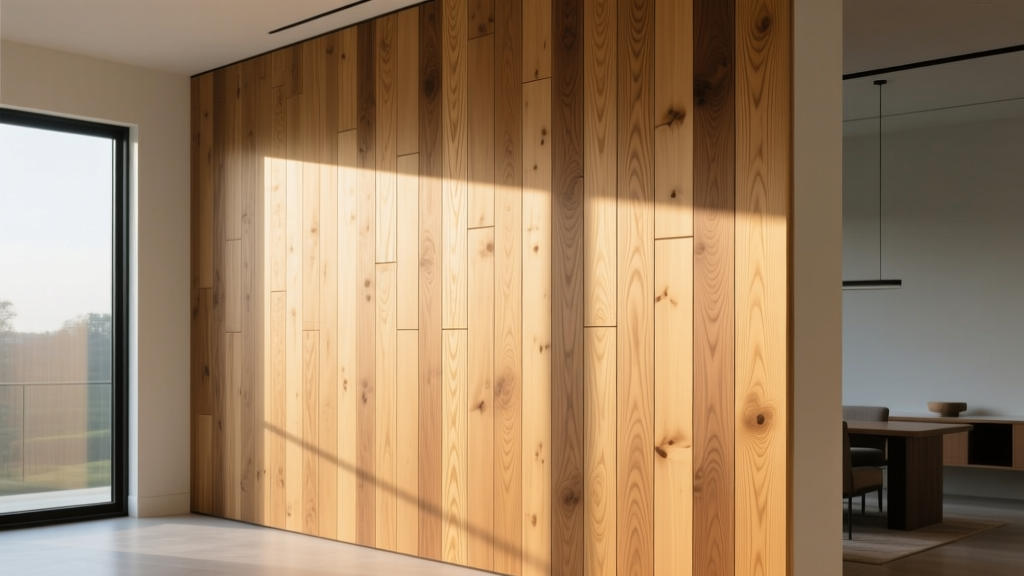
Softwood Staples: Cedar, Pine, and Fir
Softwoods are coniferous, generally lighter, easier to mill, and significantly more affordable. They are the standard for rustic, craftsman, and Scandinavian-style interiors.
Western Red Cedar (Thuja plicata)
Western Red Cedar is prized for its natural resistance to decay and its distinct aromatic oils. It is the premier choice for humid environments, such as indoor pool enclosures, spa rooms, or sauna interiors. The wood contains high levels of tannins; if you intend to paint cedar paneling rather than leaving it natural, you must apply a high-quality stain-blocking alkyd primer (such as Zinsser Cover Stain) to prevent brown tannin bleed-through.
Eastern White Pine (Pinus strobus)
The traditional choice for colonial and rustic paneling. Eastern White Pine is soft (380 lbf Janka) and features prominent knots. When specifying pine, request 'C-Grade' or 'Clear' if you want minimal knots, or '#2 Common' for a rustic, heavily knotted appearance. Be aware that pine contains pitch pockets; if installed near a heat source like a masonry fireplace, the heat can cause residual sap to weep from the knots years after installation.
Species Comparison Matrix: Hardness, Cost, and Stability
The following matrix provides a technical baseline for comparing the most common types of wood paneling. Dimensional stability refers to the wood's resistance to swelling and shrinking across the grain, a critical factor for wide-panel installations. For a deeper understanding of how these metrics are calculated, refer to the Janka Hardness Scale guide by The Wood Database.
| Species | Janka (lbf) | Dimensional Stability | Avg Cost ($/sq ft) | Ideal Application |
|---|---|---|---|---|
| Quartersawn White Oak | 1,360 | Excellent | $12.50 | High-end residential, commercial lobbies |
| Black Walnut | 1,010 | Good | $18.00 | Executive offices, master bedrooms |
| Hard Maple | 1,450 | Average | $9.50 | Modern minimalist, clean-line aesthetics |
| Western Red Cedar | 350 | Excellent | $7.00 | Saunas, humidors, humid interiors |
| Eastern White Pine | 380 | Poor | $4.50 | Rustic cabins, low-traffic accent walls |
Critical Installation Variables by Species
The failure of wood paneling rarely stems from the species itself; it almost always results from improper acclimation or fastening. Wood is hygroscopic, meaning it constantly exchanges moisture with the surrounding air. According to the wood movement principles outlined by The Wood Database, failing to account for this expansion will result in buckled panels or torn fasteners.
1. Moisture Content (MC) and Acclimation
Do not install wood paneling directly off the delivery truck. The wood must acclimate to the interior environment where the HVAC system is running at normal occupancy levels. Use a pinless moisture meter (such as the Wagner Orion 910) to test the MC of the wood and the subfloor/drywall. The target MC for most interior North American environments is between 6% and 9%. The wood must remain in the installation room for 7 to 14 days until its MC stabilizes within 2% of the subfloor's MC.
2. Fastening Protocols
For solid wood T&G paneling over 1/2' thick, rely on mechanical fasteners, not just adhesive. Use a 15-gauge or 16-gauge pneumatic finish nailer, driving nails at a 45-degree angle through the tongue (blind-nailing) at 16-inch on-center intervals, matching the wall studs. For softwoods like pine, set the nail heads slightly below the surface and fill with a wax repair stick matched to the final stain color. Never use drywall screws for solid wood paneling; the aggressive threads will split the tongues.
3. Substrate and Adhesive Considerations
If installing over masonry, concrete, or existing tile, mechanical nailing is impossible. In these scenarios, you must use a high-grab, elastomeric construction adhesive (such as Liquid Nails LN-907 or Loctite PL Premium). Apply the adhesive in a continuous serpentine bead to allow for slight micro-movements. Ensure the masonry is fully cured and passes a calcium chloride moisture emission test before applying any wood directly to the surface.
Sourcing and Sustainability Certifications
For commercial projects pursuing LEED certification or residential clients prioritizing ecological impact, specifying sustainably harvested lumber is non-negotiable. Look for the Forest Stewardship Council (FSC) label.
- FSC 100%: All wood comes from responsibly managed, FSC-certified forests. This is the gold standard but commands a 10-15% price premium.
- FSC Mix: The product is made from a combination of FSC-certified wood, recycled material, and controlled wood. This is more readily available for large-volume paneling orders.
Always request the Chain of Custody (CoC) certificate from your lumber supplier to verify that the specific batch of paneling you are purchasing is legitimately certified, ensuring your project meets modern environmental building codes.
Written by
James ThorntonJames Thornton is a construction industry veteran with 25 years of hands-on experience in wood framing, lumber grading, and residential building codes. He started as a framing carpenter in rural Oregon, earned his ICC Residential Building Inspector certification, and eventually became a senior plan reviewer for the City of Portland Bureau of Development Services. James holds a B.S. in Wood Science & Technology from Oregon State University and is a certified lumber grader through the West Coast Lumber Inspection Bureau (WCLIB). He has inspected over 3,000 residential construction sites and authored the city's internal guide on advanced framing techniques (2x6 at 24" O.C.). James lives in Bend, OR, where he builds custom timber-frame cabins and competes in lumberjack sports.
More from James Thornton
View all
Insulation
Best Home Insulation Materials: Complete 2026 Guide
Compare top home insulation materials for 2026. Find R-values, installed costs per square foot, and best uses for fiberglass, spray foam, and mineral wool.
Aug 4, 2026

Sustainable Building
Certify Your Green Building Material for LEED and WELL
Step-by-step guide to certifying a green building material for LEED v5 and WELL v2. Master EPDs, HPDs, and VOC limits for 2026 project specifications.
Aug 4, 2026

Stone & Masonry
Veneer Stacked Stone Panels: Interior Design & Style Showcase
Discover how veneer stacked stone panels transform interiors. Explore modern design profiles, material pairings, and technical installation specs.
Aug 4, 2026