Types of Wood for Building: A Structural Selection Framework
Master our structural selection framework to choose the right types of wood for building. Compare SPF, Douglas Fir, and engineered lumbers by load and cost.
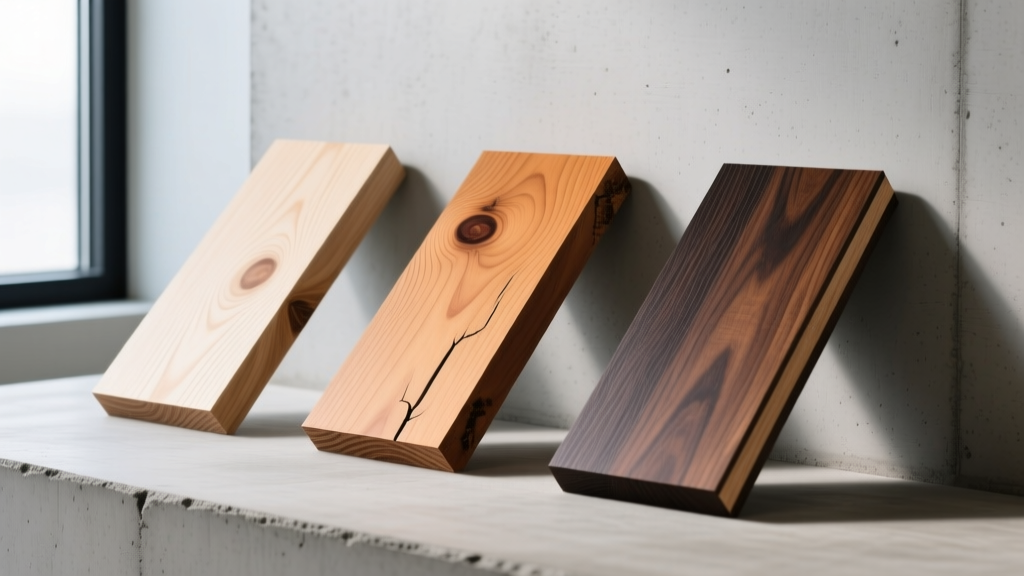
The Core Selection Framework: Load, Moisture, and Span
When evaluating the various types of wood for building, contractors and architects must move beyond basic species identification and apply a rigorous structural selection framework. Choosing the correct lumber is not merely about picking a tree species; it requires matching the material's engineering properties—specifically fiber stress in bending ($F_b$), modulus of elasticity ($E$), and shear capacity—to the exact demands of the structural assembly. According to the American Wood Council's National Design Specification (NDS), misaligning species grade with structural load is a primary cause of excessive deflection and long-term framing failure.
This framework categorizes building lumber into three primary tiers: solid-sawn softwoods, engineered wood products (EWPs), and pressure-treated exterior timbers. By filtering your project requirements through moisture exposure, clear-span distance, and live/dead load calculations, you can systematically eliminate unsuitable materials and optimize your framing budget.
Solid-Sawn Softwoods: The Structural Backbone
Solid-sawn lumber remains the default for light-frame construction, but treating all "2x4s" as identical is a critical error. The structural capacity varies wildly between the three dominant framing species groups. Below is the technical breakdown for #2 Grade lumber, the industry standard for structural framing.
1. Spruce-Pine-Fir (SPF)
SPF is the baseline economy framing lumber, predominantly harvested from Canada and the northern US. It is lightweight, easy to nail, and highly uniform.
- Design Values (#2 Grade): $F_b$ = 875 psi | $E$ = 1,400,000 psi
- Best Applications: Interior non-load-bearing walls, standard exterior wall studs (16" o.c.), and short-span ceiling joists.
- Limitations: Lower bending strength makes it unsuitable for heavily loaded headers, long-span floor joists, or rafters in high snow-load regions.
2. Douglas Fir-Larch (DF-L)
DF-L offers a significant upgrade in structural stiffness and bending strength, making it the preferred choice for structural framing in the western US and for critical load paths nationwide.
- Design Values (#2 Grade): $F_b$ = 1,350 psi | $E$ = 1,700,000 psi
- Best Applications: Roof rafters, heavily loaded headers, beams, and floor joists where deflection limits (L/360) are strict.
- Limitations: Denser wood can lead to splitting during nailing near edges; pre-drilling or specialized nails may be required for dense select structural grades.
3. Southern Yellow Pine (SYP)
SYP is the densest and strongest of the standard framing softwoods. Its high specific gravity translates to superior fastener withdrawal resistance and crushing strength.
- Design Values (#2 Dense Grade): $F_b$ = 1,500 psi | $E$ = 1,800,000 psi
- Best Applications: High-load floor systems, heavy timber decking, and structural columns.
- Limitations: Prone to warping and twisting if not properly kiln-dried (KD) to 19% moisture content or lower prior to installation.
Never accept unmarked lumber for structural framing. A valid grade stamp must include the species (e.g., D.FIR-L), the grade (e.g., NO. 2), the moisture content at surfacing (S-DRY for <19% MC, S-GRN for >19% MC), and the mill identification number. If the stamp is missing, the building inspector will reject the framing during the rough-in inspection.
Engineered Wood Products (EWP): Solving Span and Stability
When solid-sawn lumber reaches its span limits, or when dimensional stability is paramount, the framework shifts to Engineered Wood Products. The APA - The Engineered Wood Association emphasizes that EWPs eliminate the natural defects (knots, slope of grain) that weaken solid timber, allowing for longer spans and heavier loads.
| Material Type | Common Dimensions | Max Span (Approx. Residential) | Primary Use Case |
|---|---|---|---|
| LVL (Laminated Veneer Lumber) | 1.75" x 9.5" to 16" | Up to 24+ feet | Flush beams, headers, ridge beams |
| I-Joists (OSB Web) | 9.5", 11.875", 14" depths | Up to 26 feet | Floor and roof framing systems |
| LSL (Laminated Strand Lumber) | 1.25" to 3.5" thick | Up to 12 feet | Rim boards, short-span headers |
| Glulam (Glued-Laminated) | Custom widths/depths | 30 to 100+ feet | Commercial beams, exposed architectural timber |
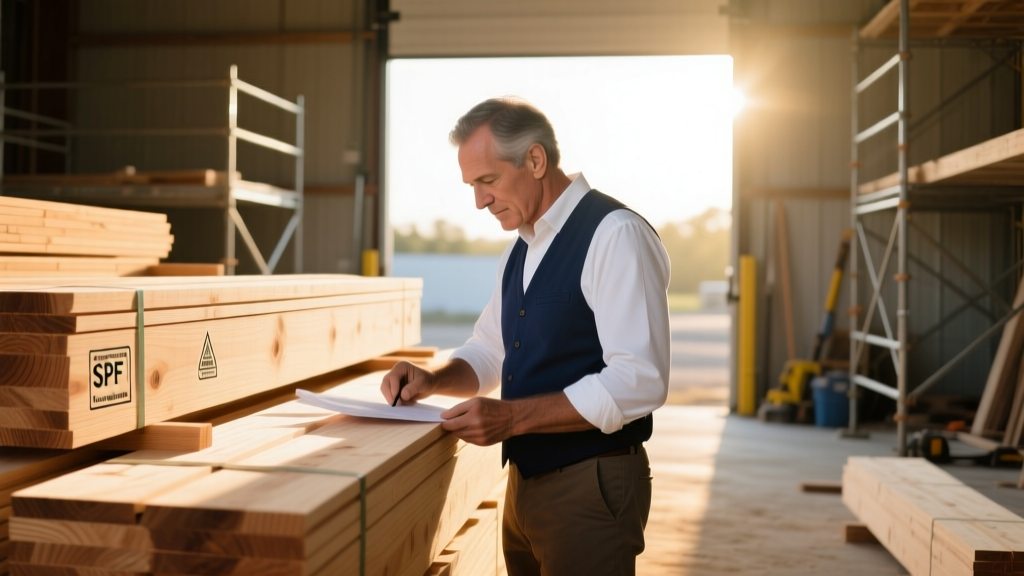
Exterior and Decay-Resistant Species
For applications exposed to weather or ground contact, the selection framework must pivot from structural capacity to biological durability. Untreated softwoods will succumb to fungal decay within 2 to 5 years in ground contact. You have two primary pathways: naturally durable species or pressure-treated lumber.
Naturally Durable Species
Western Red Cedar and Coast Redwood contain natural extractives (thujaplicins in cedar) that resist rot and insect attack. However, only the heartwood of these species possesses this resistance. Sapwood edges on cedar deck boards will rot just as quickly as pine. Furthermore, old-growth heartwood is increasingly rare and prohibitively expensive; second-growth cedar has significantly lower natural durability.
Pressure-Treated Southern Yellow Pine
For 90% of exterior structural applications, pressure-treated SYP is the most cost-effective and structurally sound choice. The American Wood Protection Association (AWPA) categorizes treated wood by Use Categories (UC), which dictate the minimum chemical retention levels (measured in pounds per cubic foot, pcf).
Do not use UC4A lumber for ground contact.
• UC3B (Above Ground, Coated): 0.25 pcf retention. Use for covered porches and protected sill plates.
• UC4A (Above Ground, Uncoated): 0.25 to 0.30 pcf retention. Use for deck joists, railing posts, and exposed beams.
• UC4B (Ground Contact): 0.40 pcf retention. Mandatory for structural posts buried in concrete, retaining walls, and permanent wood foundations.
• UC4C (Heavy Duty): 0.60 pcf retention. Required for critical structural components in severe environments or freshwater immersion.
Current Market Pricing and Availability Matrix
Material selection is ultimately constrained by budget. Below is a snapshot of national average pricing for Q1 2026. Note that regional proximity to mills can shift these prices by 15-20%.
| Material Specification | Unit | Est. Cost (Q1 2026) | Market Availability |
|---|---|---|---|
| SPF #2 2x4 (8' length) | Per Piece | $3.80 - $4.50 | High (Commodity) |
| DF-L #2 2x10 (12' length) | Per Piece | $18.50 - $22.00 | Moderate |
| LVL 1.75" x 11.875" (Beam) | Per Linear Ft | $4.80 - $6.20 | High (Special Order) |
| I-Joist 9.5" Depth (TJI) | Per Linear Ft | $3.20 - $4.10 | High |
| PT SYP 5/4x6 (UC4A Decking) | Per Linear Ft | $2.40 - $3.10 | High (Seasonal Peaks) |
Decision Tree: Which Wood Do You Actually Need?
Use this sequential logic flow to finalize your lumber schedule before submitting your material takeoff to the supplier.
- Step 1: Evaluate Moisture Exposure. Will the wood be exposed to weather, ground contact, or high interior humidity (e.g., indoor pool)?
- Yes, Ground Contact: Specify UC4B Pressure-Treated SYP.
- Yes, Above Ground Exterior: Specify UC4A Pressure-Treated, or naturally durable Cedar/Redwood heartwood for finish surfaces.
- No, Protected Interior: Proceed to Step 2.
- Step 2: Calculate the Clear Span. What is the uninterrupted distance the member must cross?
- Under 12 feet: Solid-sawn SYP or DF-L is usually cost-effective.
- 12 to 20 feet: Transition to I-Joists for floors/roofs, or LVL for beams.
- Over 20 feet: LVL, Glulam, or steel must be utilized. Solid-sawn lumber will fail deflection limits.
- Step 3: Check Deflection Limits. Is the member supporting a brittle finish (like stone tile or plaster)?
- Yes: You must design for an L/480 or L/720 deflection limit. Upsize your I-Joist depth by 2 inches or switch to a stiffer LVL flange.
- No (Standard drywall/carpet): Standard L/360 live load deflection applies. Standard sizing is acceptable.
- Step 4: Verify Fastener Compatibility. If using pressure-treated wood or high-density hardwoods, standard electro-galvanized fasteners will corrode. You must specify hot-dip galvanized (ASTM A153) or stainless steel fasteners to prevent structural connection failure.
By strictly applying this framework, you eliminate the guesswork from material procurement. You ensure that every piece of lumber on the job site is there for a specific, engineered reason, optimizing both the structural integrity and the financial efficiency of the build.
Written by
Marcus ChenMarcus Chen is a licensed structural engineer (PE) and building materials analyst with over 12 years of experience across residential, commercial, and industrial construction. He holds a Master of Science in Civil Engineering from UC Berkeley and spent six years at Thornton Tomasetti before transitioning to independent consulting and technical writing. Marcus specializes in material selection for seismic-prone regions, concrete reinforcement strategies, and lifecycle cost analysis. His work has been cited by the American Concrete Institute (ACI) and the Structural Engineers Association of California (SEAOC). When he is not on a job site or at his desk, you will find him hiking the Sierra Nevada or restoring a 1920s craftsman bungalow in Oakland, CA.
More from Marcus Chen
View all
Construction Cost
How Much Did the Eiffel Tower Cost to Build?
How much did the Eiffel Tower cost to build in 1889? We adjust for inflation and compare its budget to modern skyscraper construction.
Aug 4, 2026

Fire Resistance
What Is a Fire Resistant Material? Testing & Certification Guide
Discover what is a fire resistant material through ASTM and UL testing. Learn how fire ratings, certifications, and assemblies work in construction.
Aug 4, 2026

Construction Cost
How Much Did the Burj Khalifa Cost to Build?
How much did the Burj Khalifa cost to build? We break down the $1.5B project and extract 5 money-saving strategies for your next build.
Jul 30, 2026