Natural Wood Decking Material: Structural Span and Load Capacity Guide
Analyze the structural performance of natural wood decking material. Compare joist spans, load limits, and bending strength for Ipe, Cedar, and SYP.

The Mechanics of Deck Board Span and Deflection
When specifying natural wood decking material for structural applications, aesthetic grain patterns and decay resistance are secondary to load transfer mechanics. Decking boards act as continuous beams spanning across joists, transferring live loads (occupants, furniture, snow) and dead loads (the weight of the structure itself) into the primary framing. The critical structural limit for residential decking is not typically catastrophic failure (rupture), but rather deflection. Building codes and the American Wood Council (AWC) Prescriptive Residential Deck Construction Guide mandate a maximum live load deflection limit of L/360. This means a board spanning 16 inches cannot deflect more than 0.044 inches under a 40 psf concentrated live load.
Deflection is governed by the wood’s Modulus of Elasticity (MOE or E), while bending strength is governed by the Fiber Stress in Bending (Fb). Selecting the correct natural wood decking material requires matching the species' specific MOE and Fb values to your joist spacing and local snow load requirements.
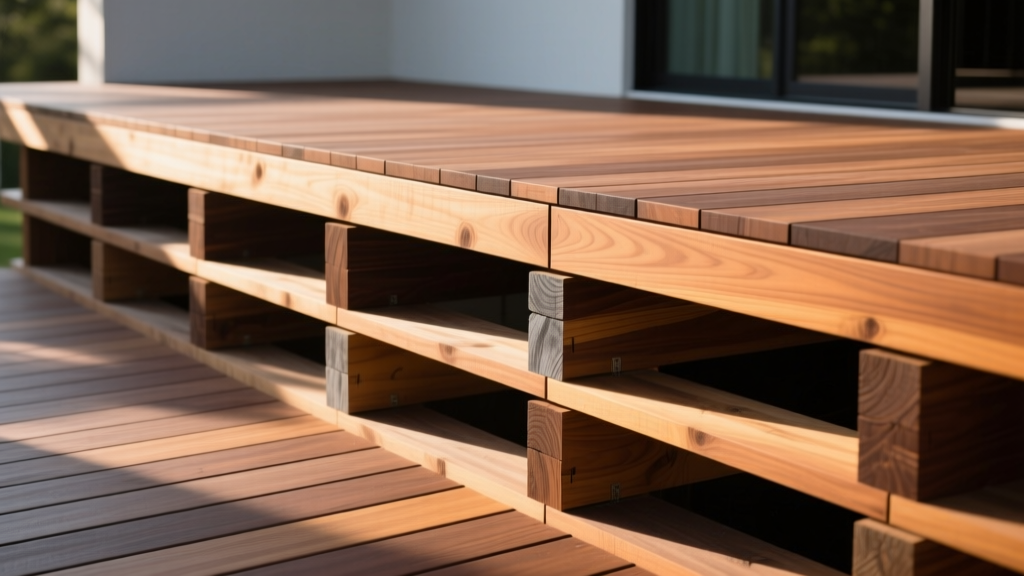
Structural Comparison Matrix: Natural Wood Decking Material
The following matrix compares the structural design values of common decking species. Data is derived from the USDA Forest Products Laboratory and adjusted for standard outdoor moisture conditions (wet service factor applied).
| Wood Species | Bending Strength (Fb - psi) | Stiffness (MOE - psi) | Max Span (5/4x6 Board) | Max Span (2x6 Board) |
|---|---|---|---|---|
| Southern Yellow Pine (SYP - PT) | 1,250 | 1,700,000 | 16" O.C. | 24" O.C. |
| Ipe (Tabebuia spp.) | 25,660 | 3,204,000 | 24" O.C.* | 32" O.C.* |
| Cumaru (Dipteryx odorata) | 24,280 | 2,791,000 | 24" O.C.* | 32" O.C.* |
| Western Red Cedar | 900 | 1,110,000 | 12" or 16" O.C. | 16" O.C. |
| Coast Redwood (Heartwood) | 1,000 | 1,200,000 | 16" O.C. | 20" O.C. |
*Note: While tropical hardwoods like Ipe and Cumaru possess the structural capacity to span 24" or 32" on center, joist spacing is often limited by the structural capacity of the underlying joists themselves, or by the need to maintain a rigid structural diaphragm. Always verify joist span tables before widening spacing.
⚠ The 5/4 vs. 2x Dimensional Lumber Trap
A common structural error in deck building is assuming 5/4x6 decking is proportionally similar to 2x6 decking. In structural engineering, the moment of inertia ($I = bh^3/12$) dictates stiffness, meaning thickness is cubed. A standard 5/4 board is actually 1.0 inch thick, while a 2x board is 1.5 inches thick. Therefore, a 2x6 board is 3.375 times stiffer than a 5/4x6 board of the exact same wood species. Never substitute 5/4 for 2x lumber on 24-inch on-center joist layouts without explicit engineering approval.
Fastener Shear and Diaphragm Action in High-Density Hardwoods
Natural wood decking material does more than support vertical loads; it provides lateral bracing to the joists, creating a structural diaphragm that resists racking and wind uplift. The effectiveness of this diaphragm relies entirely on the fastener schedule and the wood's withdrawal resistance.
The Density Challenge
Tropical hardwoods like Ipe (specific gravity of 1.05) and Cumaru (specific gravity of 1.08) are exceptionally dense. While this provides immense bending strength, it introduces severe fastener shear risks. Driving a standard #10 or #12 stainless steel deck screw directly into Ipe without pre-drilling will cause the screw shank to snap due to torsional shear stress before the head seats.
- Top-Down Fastening: Use specialized hardened stainless steel screws with type-17 auger tips and self-cutting threads, such as the Simpson Strong-Tie Cortex system. Pre-drilling with a 5/32" bit is mandatory for Ipe to prevent shear failure and surface splitting.
- Hidden Fastener Systems: Systems like the Ipe Clip Extreme rely on pre-cut grooves routed into the board edges. While aesthetically superior, hidden clips reduce the diaphragm's lateral transfer capacity compared to top-down screws. If using hidden clips in high-wind or seismic zones, you must supplement with structural blocking and diagonal bracing beneath the deck frame.
Moisture-Induced Structural Creep and Cupping
Wood is hygroscopic, and its structural integrity fluctuates with moisture content (MC). When natural wood decking material absorbs water, it swells; when it dries, it shrinks. However, shrinkage is highly anisotropic. Tangential shrinkage (parallel to the growth rings) is typically twice as high as radial shrinkage (perpendicular to the rings).
"Flatsawn decking boards, which display a 'cathedral' grain pattern on the face, are highly susceptible to cupping as the tangential edges shrink faster than the radial center. For structural longevity and reduced tripping hazards, specify quartersawn or riftsawn lumber where the growth rings intersect the face at a 45-to-90-degree angle."
— The Wood Database, Dimensional Stability Guidelines
Over a 5-to-10-year period, repeated wet-dry cycles cause "structural creep"—a permanent, gradual deflection in the boards under constant dead load. To mitigate creep in softwoods like Western Red Cedar, reduce the joist spacing from 16" to 12" on center, or upgrade to 2x6 dimensional lumber to increase the section modulus.
Code Compliance and Load Testing
When pulling permits, local building officials will reference the International Residential Code (IRC) and the AWC DCA-6. The code requires that all natural wood decking material used in structural applications be grade-stamped. For pressure-treated SYP, look for the SPIB or TP stamp indicating "No. 1" or "No. 2" grade. For hardwoods, which are not graded by the same softwood lumber associations, you must provide the architect or engineer's specification sheet detailing the Fb and E values of the specific botanical species to satisfy the building department's plan reviewer.
Frequently Asked Structural Questions
Can I mix different wood species on the same deck frame?
Structurally, yes, provided the underlying joist spacing accommodates the weakest species used. If you are using a border of Ipe (max span 24") and a field of Western Red Cedar (max span 16"), the joists must be framed at 16" on center or less. Additionally, mixing species with vastly different shrinkage rates (e.g., Ipe and Cedar) will result in uneven gaps and a non-planar surface after the first weather cycle.
Does the grade of the wood affect its load-bearing capacity?
Absolutely. A "Select Structural" grade SYP board has an Fb of roughly 2,400 psi, while a "No. 2" grade of the same species drops to 1,250 psi. The presence of knots, slope of grain, and wane directly reduce the cross-sectional area available to resist bending moments. Always verify the grade stamp on the lumber tag before finalizing your span calculations.
How do cantilevered deck boards affect structural load?
Deck boards cantilevered past the outer rim joist act as a lever, transferring upward uplift forces to the first interior joist. The AWC DCA-6 limits the cantilever of decking boards to one-quarter of the board's span. For a 5/4x6 board spanning 16" between joists, the maximum allowable overhang past the rim joist is exactly 4 inches. Exceeding this creates a structural fulcrum that can cause the board to snap at the joist line under concentrated edge loads.
Written by
Marcus ChenMarcus Chen is a licensed structural engineer (PE) and building materials analyst with over 12 years of experience across residential, commercial, and industrial construction. He holds a Master of Science in Civil Engineering from UC Berkeley and spent six years at Thornton Tomasetti before transitioning to independent consulting and technical writing. Marcus specializes in material selection for seismic-prone regions, concrete reinforcement strategies, and lifecycle cost analysis. His work has been cited by the American Concrete Institute (ACI) and the Structural Engineers Association of California (SEAOC). When he is not on a job site or at his desk, you will find him hiking the Sierra Nevada or restoring a 1920s craftsman bungalow in Oakland, CA.
More from Marcus Chen
View all
Construction Cost
How Much Did the Eiffel Tower Cost to Build?
How much did the Eiffel Tower cost to build in 1889? We adjust for inflation and compare its budget to modern skyscraper construction.
Aug 4, 2026

Fire Resistance
What Is a Fire Resistant Material? Testing & Certification Guide
Discover what is a fire resistant material through ASTM and UL testing. Learn how fire ratings, certifications, and assemblies work in construction.
Aug 4, 2026

Construction Cost
How Much Did the Burj Khalifa Cost to Build?
How much did the Burj Khalifa cost to build? We break down the $1.5B project and extract 5 money-saving strategies for your next build.
Jul 30, 2026