Marine Grade Plywood: Scenario Matching for Wet Environments
Discover when to specify marine grade plywood for exterior builds. Compare Okoume and Douglas Fir, analyze costs, and match panels to specific wet scenarios.
The BS 1088 Benchmark: What Actually Qualifies as "Marine"?
The term "marine grade plywood" is frequently misused in retail lumber yards to describe any panel with waterproof glue. True marine plywood must meet rigorous structural and veneer standards, most notably the British Standard BS 1088 or the APA Marine specification in the United States. The defining characteristic that separates marine panels from standard Exterior (CDX) plywood is the absolute prohibition of core voids.
Standard exterior plywood allows "football" patches and internal knothole voids. When exposed to cyclic wetting and freezing, water infiltrates these voids, expands, and causes internal delamination. Marine grade plywood requires that all inner veneers are solid, edge-to-edge, and free of overlapping patches. Furthermore, the panels must be bonded using phenol-formaldehyde (PF) resin, which is cured under high heat and pressure to create a glue line that is structurally stronger than the wood itself. According to the USDA Forest Products Laboratory Wood Handbook, PF resin bonds remain entirely stable even after prolonged boiling or continuous submersion, unlike the urea-formaldehyde (UF) resins used in interior panels.
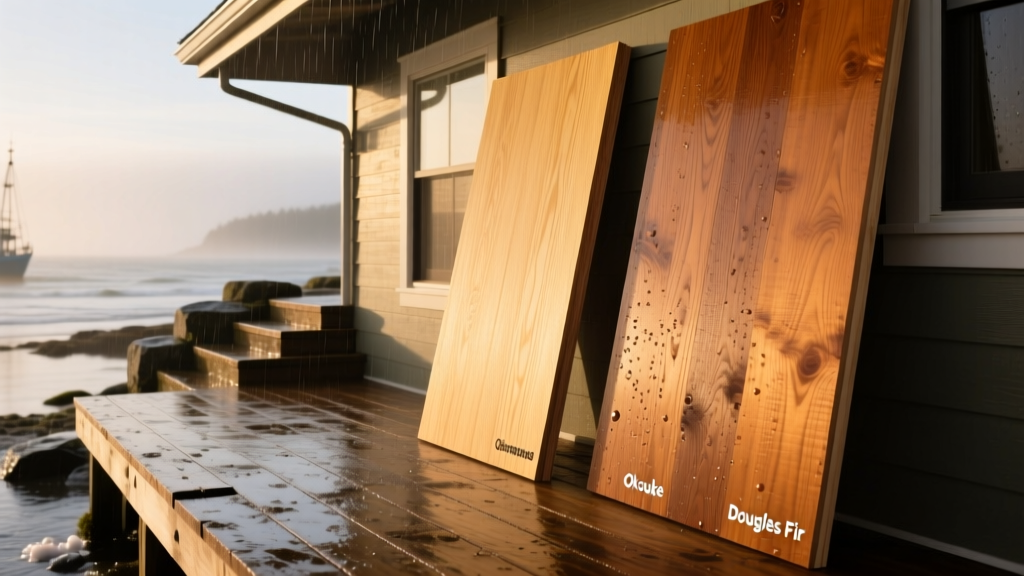
Species Showdown: Okoume vs. Douglas Fir Marine Plywood
Selecting the correct wood species is just as critical as the glue specification. The two dominant species in the marine market offer vastly different mechanical properties and price points.
| Property | Okoume (Aucoumea klaineana) | Douglas Fir (Pseudotsuga menziesii) | Meranti (Shorea spp.) |
|---|---|---|---|
| Weight (1/2" 4x8 Sheet) | ~35 lbs | ~48 lbs | ~42 lbs |
| Bending Radius | Excellent (cold-molded hulls) | Poor (stiff, prone to spring-back) | Moderate |
| Surface Checking | Low | High (requires strict sealing) | Moderate |
| Approx. Cost (2026) | $140 - $175 per sheet | $105 - $130 per sheet | $90 - $115 per sheet |
| Best Application | Boat hulls, curved architectural elements | Transoms, structural docks, flat decks | Budget marine cabinetry, interior bulkheads |
As noted by APA - The Engineered Wood Association, Douglas Fir marine plywood provides superior fastener-holding strength and compression resistance, making it mandatory for outboard motor transoms. Okoume, while significantly more expensive, is the undisputed standard for stitch-and-glue or cold-molded boat building due to its high strength-to-weight ratio and ability to bend around tight radii without fracturing the face veneer.
Scenario Matching: When to Specify Marine Grade
Over-specifying marine plywood leads to massive budget overruns, while under-specifying leads to catastrophic structural failure. Use this decision framework to match the panel to the environment.
Scenario 1: Continuous Submersion (Boat Hulls, Floating Docks, Seawalls)
Verdict: Mandatory. Any wood component that will remain below the waterline or experience constant tidal splashing requires marine grade plywood. The absence of core voids prevents water from becoming trapped inside the panel. For floating docks, specify 3/4-inch Douglas Fir marine plywood, sealed with a heavy-duty epoxy system, and capped with fiberglass cloth. The structural stiffness of Douglas Fir prevents the panel from sagging under dynamic wave loads.
Scenario 2: High-Humidity Enclosures (Spas, Indoor Pool Ceilings, Bathrooms)
Verdict: Over-specification (Use Exterior Grade instead). A common and expensive mistake is using marine grade plywood for bathroom subfloors or indoor pool soffits. These environments feature high ambient humidity but no liquid water intrusion. Standard ACX or CDX exterior plywood, combined with a liquid-applied waterproofing membrane (like RedGard or Schluter-Kerdi), performs identically to marine plywood in these scenarios at roughly 40% of the material cost.
Scenario 3: Exterior Architectural Elements (Soffits, Fascia, Outdoor Furniture)
Verdict: Conditional. For protected soffits under deep eaves, standard exterior plywood with high-quality acrylic latex paint is sufficient. However, for high-end outdoor furniture, planter boxes, or exposed fascia where the end-grain is vulnerable to wicking, marine grade plywood is highly recommended. The solid inner veneers ensure that when you route or sand the edges for a finished look, you will not expose unsightly voids or glue pockets that plague standard plywood.
Critical Installation Protocols: The Edge-Sealing Imperative
Marine grade plywood is not inherently rot-proof; it is merely delamination-proof. If the exposed end-grain of a marine panel is left unsealed, it will wick moisture directly into the veneer layers, leading to fungal decay. According to WEST SYSTEM epoxy guidelines, proper encapsulation is non-negotiable for longevity.
Follow this exact protocol for sealing marine plywood edges and faces in exterior applications:
- Sand and Clean: Sand all edges to 120-grit. Wipe away dust with denatured alcohol. Do not use water, as it raises the grain and closes the wood pores.
- Unthickened Epoxy Coat: Apply a coat of unthickened, slow-curing epoxy resin (e.g., WEST SYSTEM 105 Resin with 206 Slow Hardener). The slow cure time allows the epoxy to penetrate deep into the end-grain capillaries rather than flash-curing on the surface.
- Fairing Compound: Once the first coat is tacky, apply a thickened epoxy mixture (using microballoons or wood flour) to fill the edge-grain texture and create a perfectly smooth, radiused corner.
- UV Protection Topcoat: Epoxy resin degrades under ultraviolet light. You must apply a marine-grade spar varnish or a two-part linear polyurethane (LPU) paint within 48 hours of the epoxy curing to lock out UV radiation.
Summary: The Application-Fit Matrix
To finalize your material selection, cross-reference your project requirements against this matrix to ensure optimal performance and budget efficiency:
- Structural Boat Transoms & Docks: Douglas Fir Marine Plywood (BS 1088 / APA Marine).
- Curved Hulls & Lightweight Marine Cabins: Okoume Marine Plywood.
- Budget Marine Bulkheads (Above Waterline): Meranti Marine Plywood.
- Bathroom Subfloors & Tile Backing: Exterior Grade Plywood + Liquid Membrane.
- Roof Sheathing & Wall Bracing: Standard CDX or OSB (Exterior rated).
By strictly matching the panel species and grade to the specific moisture and structural demands of your project, you eliminate both premature failure modes and unnecessary material expenditures.