Structural Types of Deck Wood: Framing, Joists & Beams
Explore the best structural types of deck wood for framing, joists, and beams. Compare AWPA treatment grades, species strength, and 2026 costs.

The Structural Hierarchy: Beyond the Decking Boards
When homeowners and contractors research the best types of deck wood, the focus overwhelmingly lands on surface decking materials like composite, cedar, or tropical hardwoods. However, according to structural forensic data, over 80% of catastrophic deck failures stem from the degradation or miscalculation of the hidden structural skeleton. The framing, joists, beams, and ledger boards bear the entire live and dead load of the structure, making the selection of structural lumber the most critical decision in deck engineering.
Structural deck wood must simultaneously resist high bending stresses, shear forces, and the relentless biological threat of moisture and fungal decay. This guide dissects the specific species, preservative treatment grades, and dimensional requirements necessary to engineer a safe, code-compliant deck frame that will outlast the decking attached to it.
Decoding AWPA Use Categories for Structural Lumber
The American Wood Protection Association (AWPA) classifies pressure-treated wood into specific Use Categories based on exposure to moisture and biological hazards. Selecting the wrong category for a structural member is a primary cause of premature joist rot. You can review the full specifications via the American Wood Protection Association (AWPA).
- UC4A (Above Ground): Treated to a minimum retention of 0.15 pcf (pounds per cubic foot) for CA-C or ACQ. Suitable for elevated deck joists, beams, and blocking that are fully exposed to air circulation and remain at least 6 inches above grade.
- UC4B (Ground Contact): Treated to 0.31 pcf. Mandatory for structural posts embedded in concrete, joists over unvented crawl spaces, and ledger boards attached to masonry or concrete foundations where moisture trapping is inevitable.
- UC4C (Heavy Duty Ground Contact): Treated to 0.40 pcf or higher. Required for critical structural components in high-termite areas, permanent wood foundations, or posts supporting massive multi-tier deck structures in direct soil contact.
Primary Wood Species for Deck Framing
Not all pressure-treated lumber shares the same structural capacity. The base wood species dictates the bending strength (Fb) and modulus of elasticity (E), which directly determine how far a joist can span before deflecting. The American Wood Council (AWC) Prescriptive Residential Deck Construction Guide provides the definitive span tables based on these species.
| Species | Bending Strength (Fb) | Modulus of Elasticity (E) | Typical Application |
|---|---|---|---|
| Southern Yellow Pine (SYP) #2 | 1,250 psi | 1,700,000 psi | Joists, Beams, Posts (East/South US) |
| Douglas Fir-Larch #2 | 1,500 psi | 1,900,000 psi | Long-span Joists, Heavy Beams (West US) |
| Hem-Fir #2 | 1,300 psi | 1,600,000 psi | Standard Joists, Blocking (West/Pacific) |
| Spruce-Pine-Fir (SPF) #2 | 1,150 psi | 1,500,000 psi | Short-span Joists, Railing Posts (North) |
Southern Yellow Pine dominates the pressure-treated market due to its excellent cellular structure, which allows for deep, uniform penetration of preservative chemicals. Douglas Fir, while structurally superior in bending strength, is notoriously difficult to treat and often requires incising (small slits cut into the wood), which reduces its structural capacity by up to 15%.
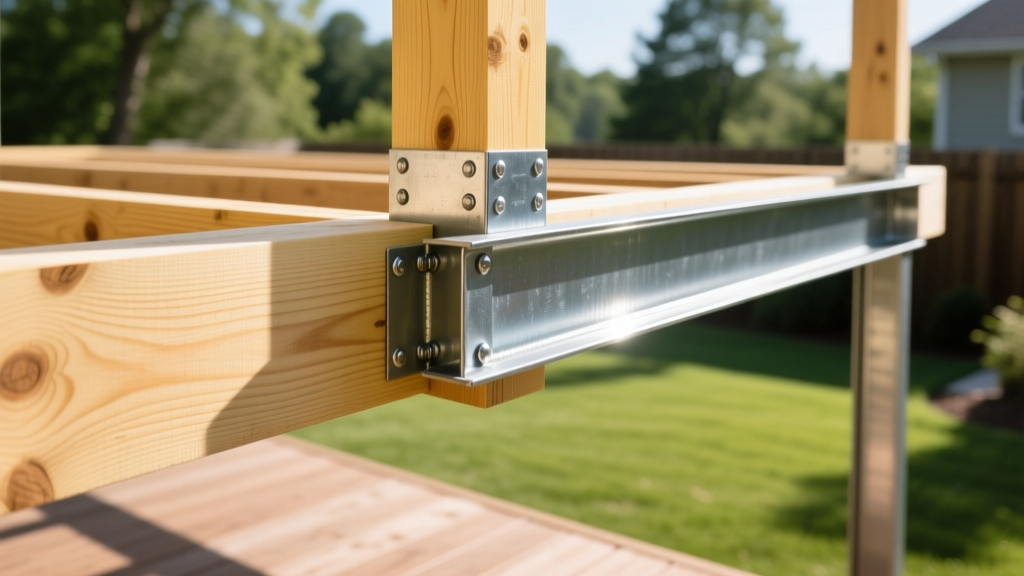
Sizing and Span Limits: Practical Engineering
Deflection, not just sheer breaking strength, governs deck joist sizing. A deck that feels 'bouncy' underfoot fails the serviceability limit state, even if it is structurally safe from collapse. The standard live load for residential decks is 40 psf (pounds per square foot), with a deflection limit of L/360.
Maximum Spans for SYP #2 Joists (40 psf Live Load, 10 psf Dead Load)
- 2x8 at 12" O.C.: 11 feet, 10 inches
- 2x8 at 16" O.C.: 10 feet, 9 inches
- 2x10 at 12" O.C.: 15 feet, 1 inch
- 2x10 at 16" O.C.: 13 feet, 8 inches
- 2x12 at 16" O.C.: 16 feet, 6 inches (Maximum practical span for solid lumber)
Fastener Corrosion and Chemical Compatibility
The shift away from Chromated Copper Arsenate (CCA) in 2004 led to the use of highly alkaline copper-based preservatives like ACQ (Alkaline Copper Quaternary) and CA-C (Copper Azole). These chemicals are highly corrosive to standard metals. Using the wrong fastener with your chosen types of deck wood will result in the structural connectors dissolving within 3 to 5 years.
| Preservative Treatment | Minimum Fastener Coating | Connector Hardware Requirement |
|---|---|---|
| ACQ / CA-C (UC4A & UC4B) | ASTM A153 Class D (G185) | ZMAX or Triple-Zinc Galvanized |
| Micronized Copper (MCA/ MCQ) | ASTM A153 Class D (G90) | Standard Hot-Dipped Galvanized |
| Borate (UC2 - Indoor/Above Ground) | Standard Zinc Plated | Standard Galvanized or Stainless |
| All Treatments (Coastal/Saltwater) | Type 304 or 316 Stainless Steel | Type 316 Stainless Steel Mandatory |
2026 Cost Breakdown: Structural Framing Materials
Budgeting for the structural skeleton requires looking beyond the per-board price to the cost per linear foot (LF) and the total volume of the frame. As of early 2026, regional supply chain stabilizations have normalized pressure-treated lumber prices, though premium treatments still carry a markup.
- 2x8 SYP #2 Pressure-Treated (UC4A): $1.45 - $1.65 per LF
- 2x10 SYP #2 Pressure-Treated (UC4A): $2.10 - $2.40 per LF
- 4x4 SYP Ground Contact Post (UC4B): $4.50 - $5.20 per LF
- 6x6 SYP Ground Contact Post (UC4B): $9.80 - $11.50 per LF
- Premium Joist Flashing Tape (Butyl-based): $0.35 - $0.55 per LF (Mandatory for extending joist lifespan)
Common Structural Failure Modes and Prevention
Understanding how structural wood fails in the real world allows builders to implement preventative details that exceed minimum building codes.
1. Ledger Board Moisture Trapping
The Failure: The ledger board, which attaches the deck to the house, is the most common point of catastrophic collapse. Water gets trapped between the ledger and the house sheathing, rotting the structural rim joist of the home.
The Fix: Never bolt a ledger board directly flush against wood siding or stucco. Use structural spacers or a manufactured ledger bracket system that maintains a 1/2-inch air gap. Alternatively, build a freestanding deck with a dropped beam adjacent to the house, eliminating the ledger connection entirely.
2. End-Grain Wicking in Posts
The Failure: Even UC4B treated posts will rot if the bottom end-grain sits in a concrete footing that holds water. Concrete acts as a sponge, wicking moisture directly into the highly permeable end-grain of the wood.
The Fix: Elevate all structural posts above the concrete using heavy-duty, powder-coated or galvanized post bases (e.g., Simpson Strong-Tie EPB44 or ZMAX equivalents). Pour the concrete footing with a slight slope away from the center, and apply a copper naphthenate brush-on treatment to the cut bottom end of the post before setting it in the bracket.
3. Joist Top-Edge Decay
The Failure: Decking boards trap water and debris on the top edge of the joists. Because the top edge is end-grain or quarter-grain exposed to standing water, it rots from the top down, compromising the fastener holding power of the decking.
The Fix: Apply a self-adhering butyl or bitumen flashing tape to the top edge of every joist and beam before laying the decking. This costs roughly $0.40 per LF but prevents water infiltration and extends the structural frame's lifespan by decades.
Written by
David NakamuraDavid Nakamura is a licensed architect (AIA) and construction technology writer focused on sustainable building methods, mass timber engineering, and high-performance building envelopes. He holds a Master of Architecture from the University of Washington and is a certified Passive House Consultant (CPHC). David spent eight years at the Seattle firm Mithun, where he led the design of three LEED Platinum projects, before founding his own practice specializing in net-zero residential design. He serves on the editorial advisory board of GreenBuilder Magazine and has authored peer-reviewed papers on cross-laminated timber (CLT) connections for the Journal of Structural Engineering. In his spare time, David teaches woodworking at Pratt Fine Arts Center and kayaks the Puget Sound.
More from David Nakamura
View all
Construction Cost
Labor Cost to Build a Deck Per Sq Ft: 2026 Installation Guide
Discover the exact labor cost to build a deck per sq ft in 2026. This installation guide breaks down contractor rates, complexity factors, and hidden fees.
Aug 4, 2026

Construction Cost
How Much Does It Cost to Build a 3 Bedroom House? Financing Guide
Learn exactly how much it costs to build a 3 bedroom house and explore 2026 financing options, construction loan types, and budget frameworks for your build.
Aug 4, 2026

Construction Cost
Cost to Build a Tennis Court: 2026 Guide
How much does it cost to build a tennis court in 2026? Breakdowns for asphalt, concrete, and synthetic surfaces plus fencing and lighting.
Jul 30, 2026