OSB Sheathing Brand Guide: Huber ZIP vs LP WeatherLogic 2026
Compare top OSB sheathing brands in 2026. We analyze Huber ZIP, LP WeatherLogic, and AdvanTech specs, costs, and failure modes for structural framing.
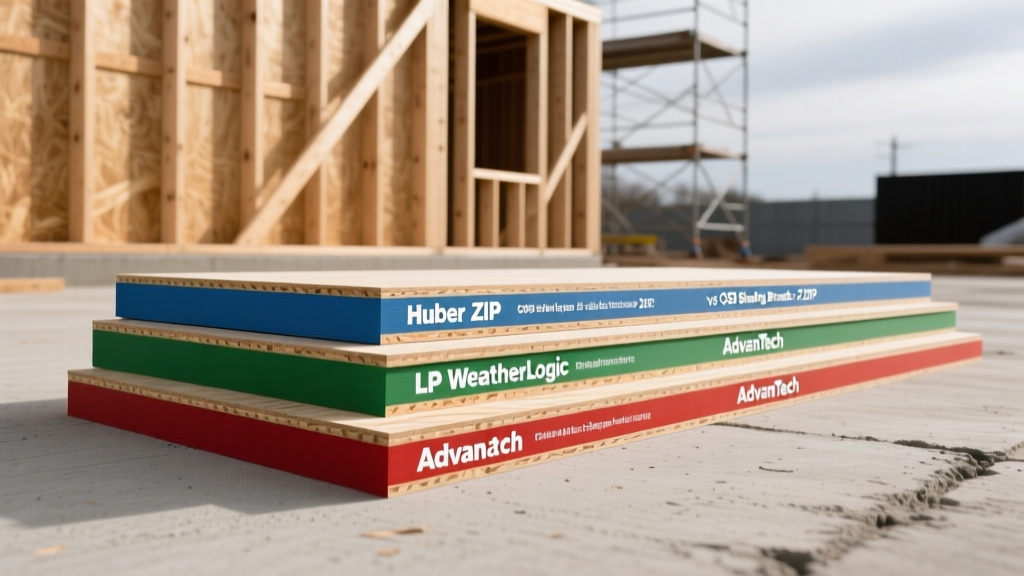
The Evolution of OSB Sheathing: From Commodity to High-Performance System
The oriented strand board (OSB) market has fundamentally shifted over the last decade. While commodity 7/16-inch OSB remains the baseline for structural sheathing, premium integrated panels now dominate high-performance residential and light-commercial framing. According to APA - The Engineered Wood Association, modern performance-rated panels are engineered not just for shear strength, but for integrated moisture management and air sealing. This deep-dive analyzes the two dominant premium OSB sheathing ecosystems in 2026: Huber Engineered Woods (ZIP System, AdvanTech) and LP Building Solutions (WeatherLogic, Legacy), breaking down their material science, real-world pricing, and specific failure modes.
Huber Engineered Woods: ZIP System and AdvanTech Deep-Dive
ZIP System Sheathing: Specifications and Edge Cases
Huber's ZIP System sheathing integrates a water-resistive barrier (WRB) directly into the OSB panel using a proprietary phenolic resin-impregnated kraft paper overlay. The critical metric for building scientists is its vapor permeability. ZIP System sheathing typically tests between 12 and 16 perms, classifying it as a Class III vapor retarder. This high permeability is intentional; as noted in research by Building Science Corporation, allowing outward drying is critical in cold and mixed climates to prevent interstitial condensation within the wall cavity.
AdvanTech: The Moisture-Resistant Subfloor Standard
While ZIP handles the vertical envelope, AdvanTech dominates the horizontal plane. AdvanTech subflooring uses a polymeric resin blend that coats individual wood strands before pressing. This results in a 24-hour thickness swelling rate of less than 3% when exposed to water, compared to the 15% maximum allowed by standard PS-2 commodity OSB specifications. The edge coating is a microporous polyurethane that prevents liquid water ingress while allowing trapped vapor to escape, effectively eliminating the edge-swelling that causes floor squeaks and requires expensive sanding before hardwood installation.
LP Building Solutions: WeatherLogic and Legacy Panels
LP WeatherLogic Air & Water Barrier
LP's direct competitor to ZIP is WeatherLogic. The material science here differs significantly. WeatherLogic utilizes a catalyzed polyolefin overlay rather than a resin-impregnated paper. This results in a much lower vapor permeability rating of less than 5 perms, classifying it as a Class II vapor retarder. This makes WeatherLogic highly effective in hot-humid climates (IECC Zones 1-3) where limiting exterior vapor drive into air-conditioned wall cavities is paramount, but it requires careful dew-point analysis if used in Zone 6 or higher without exterior rigid insulation.
LP Legacy Premium Subflooring
LP Legacy addresses the subfloor market with a high-density wood strand formulation pressed at higher temperatures and pressures than standard OSB. The panels feature a proprietary edge sealant and a tongue-and-groove profile that is precision-milled to a tighter tolerance than commodity panels. Legacy panels boast a bending stiffness (EI) that is approximately 15% higher than standard PS-2 rated panels, allowing for wider joist spacing (up to 24 inches on center for certain thicknesses) while maintaining L/360 deflection limits under live loads.
Head-to-Head Comparison Matrix
| Product Line | Nominal Thickness | Vapor Permeability | Avg. Cost per 4x8 (2026) | Primary Application |
|---|---|---|---|---|
| Commodity OSB + Housewrap | 7/16" | 50+ perms (Wrap dependent) | $22 - $28 | Standard production framing |
| Huber ZIP System | 7/16" | 12 - 16 perms (Class III) | $42 - $48 | Mixed/Cold climate airtight walls |
| LP WeatherLogic | 7/16" | < 5 perms (Class II) | $38 - $45 | Hot-humid climate vapor control |
| Huber AdvanTech | 3/4" | N/A (Subfloor) | $70 - $82 | Premium hardwood/tile subfloors |
| LP Legacy | 3/4" | N/A (Subfloor) | $60 - $72 | Wide-joist spacing structural floors |
Real-World Failure Modes and Installation Gotchas
Premium OSB sheathing fails not because of material defects, but due to improper field execution. When evaluating ICC Evaluation Service reports for these products, specific installation tolerances must be met to maintain the warranty and code compliance.
- Fastener Over-driving: Pneumatic nail guns set to high PSI will blow the fastener head through the WRB overlay on both ZIP and WeatherLogic. This compromises the water seal. Crews must use depth-adjustable collated nailers and dial back the compressor to 90-100 PSI, ensuring the head sits flush without cutting the overlay.
- Unsealed Field Cuts: When panels are ripped to fit around windows or at gable ends, the exposed OSB core is highly susceptible to capillary water uptake. Both manufacturers mandate that all field cuts be sealed with their proprietary liquid flashing or mesh tape. Ignoring this leads to localized edge swelling within 6 months.
- Cross-Contamination of Tapes: ZIP tape and WeatherLogic tape use different chemical adhesives optimized for their specific overlays. Applying ZIP tape to WeatherLogic panels (or vice versa) to save money will result in adhesion failure during the first wind-driven rain event, voiding the system warranty.
Cost Analysis: Commodity OSB vs. Integrated Systems
The material premium for integrated OSB sheathing is substantial, but the true cost must be evaluated on a total installed basis. In 2026, commodity 7/16-inch OSB costs roughly $25 per sheet, while a roll of high-quality housewrap and cap nails adds about $12 per 100 square feet. Labor to hang wrap, tape seams, and flash windows averages $0.65 per square foot.
ZIP System sheathing costs roughly $45 per sheet, and the required tape adds $8 per 100 square feet. However, you entirely eliminate the housewrap labor. On a 2,500-square-foot home with 3,200 square feet of wall sheathing, the material premium for ZIP is approximately $640. The labor savings from skipping the wrap phase averages $2,080. The net result is a savings of $1,440, plus the benefit of a continuous structural air barrier that is far more robust than a mechanically fastened housewrap.
Decision Framework: Which OSB Sheathing Line Fits Your Build?
- Choose Huber ZIP System if: You are building in IECC Climate Zones 4 through 7, where outward drying potential is required, and you want to achieve passive-house level airtightness (sub-1.0 ACH50) using the sheathing as the primary air control layer.
- Choose LP WeatherLogic if: You are building in IECC Climate Zones 1 through 3 (hot-humid), where limiting the vapor diffusion from the exterior into the cooled wall assembly is critical to preventing mold on interior drywall.
- Choose Huber AdvanTech if: The finish schedule includes wide-plank engineered hardwood or large-format natural stone tile. The superior stiffness and near-zero edge swelling prevent grout cracking and floor squeaks over the life of the structure.
- Choose LP Legacy if: The structural engineer has specified 24-inch on-center floor joist spacing to reduce material costs, and you need the enhanced bending stiffness to prevent bouncy floors without adding mid-span blocking.