Preservation Methods for Various Types of Petrified Wood
Learn specialized treatment and preservation methods for different types of petrified wood used in luxury architectural surfaces and feature walls.

The Architectural Reality of Fossilized Timber
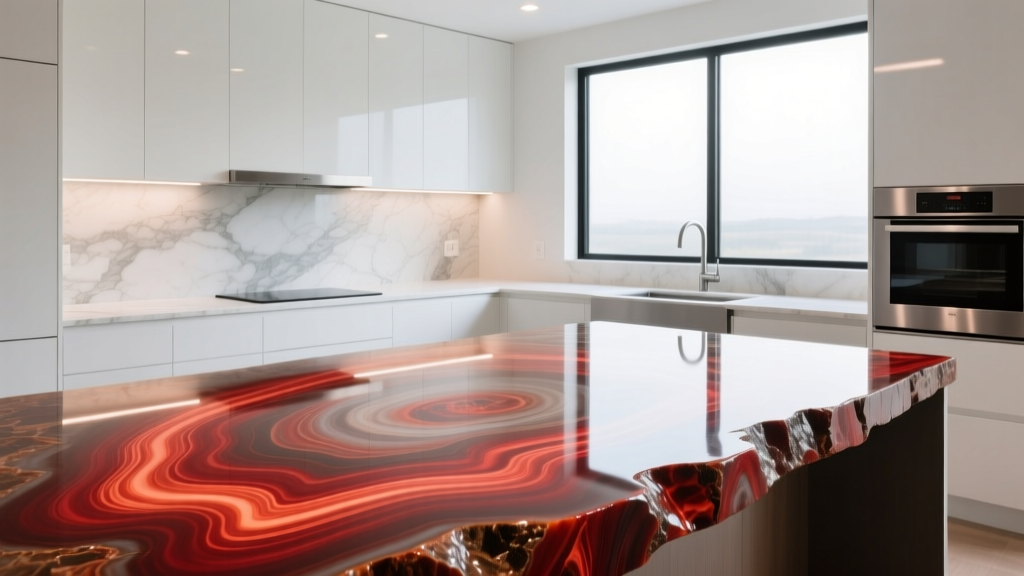
In high-end architectural design, petrified wood is prized for luxury countertops, feature wall cladding, and bespoke flooring inlays. However, treating and preserving these materials requires a fundamental shift in perspective: petrified wood is not wood. It is a fossilized stone matrix where organic cellulose has been entirely replaced by minerals, primarily quartz, chalcedony, or opal. According to the National Park Service, the permineralization process creates a material with the structural properties of stone but the visual characteristics of timber. Because different types of petrified wood possess distinct mineralogical compositions, their porosity, hardness, and chemical reactivity vary drastically. A preservation protocol that works for a dense, agatized specimen will fail catastrophically on a porous, opalized slab. Effective treatment and preservation demand a precise understanding of these mineral variations.
Mineral Composition and Vulnerability Matrix
The primary challenge in preserving petrified wood for interior and exterior architectural applications lies in the secondary minerals trapped within the quartz matrix. These inclusions dictate the material's vulnerability to moisture, oxidation, and acidic etching. The Natural Stone Institute emphasizes that treating any natural stone requires matching the sealer to the specific porosity and mineral reactivity of the slab.
| Petrified Wood Type | Primary Mineral Matrix | Mohs Hardness | Porosity & Risk Factors | Required Preservation Strategy |
|---|---|---|---|---|
| Silicified (Quartz) | Microcrystalline Quartz | 7.0 | Extremely low porosity. Highly resistant to etching and staining. | Standard fluoropolymer impregnators; minimal stabilization required. |
| Agatized | Banded Chalcedony/Quartz | 6.5 - 7.0 | Low porosity, but prone to micro-fractures along banding lines. | Low-viscosity epoxy stabilization followed by topical enhancing sealers. |
| Opalized | Amorphous Silica (Opal) | 5.5 - 6.5 | High porosity; susceptible to water absorption, crazing, and chemical etching. | Deep-penetrating siloxane sealers; strict moisture barriers required. |
| Pyritized | Quartz with Iron Sulfide | 6.0 - 7.0 | Iron sulfide inclusions oxidize when exposed to moisture and oxygen, causing rust staining. | Strict anaerobic sealing; solvent-based acrylics to block oxygen ingress. |
Structural Stabilization: Addressing Micro-Fractures
Unlike uniform granite or marble, petrified wood often contains internal voids, cellular casts, and stress fractures formed during the millions of years of fossilization. Before any surface sealing can occur, structural stabilization is mandatory for architectural slabs, particularly those used horizontally as countertops or flooring.
Epoxy Resin Selection and Application
Stabilization requires injecting resin into the stone's micro-voids to create a monolithic structure. The choice of epoxy depends on the fracture width:
- Micro-cracks (Under 1mm): Use a low-viscosity, penetrating epoxy (e.g., TotalBoat Penetrating Epoxy or System Three Rot Fix). These resins have the consistency of water, allowing capillary action to pull the resin deep into the fossilized cellular structure. Apply at a rate of approximately 200 square feet per gallon.
- Macro-voids and Cellular Casts (1mm - 10mm): Use a high-viscosity, gap-filling epoxy (e.g., System Three Clear Coat). These require precise mixing—typically a 2:1 resin-to-hardener ratio by volume—and must be poured slowly to prevent trapped air bubbles. For deep voids, pour in layers no thicker than 1/4 inch to manage exothermic heat generation and prevent thermal cracking.
Standard epoxies will amber and degrade when exposed to ultraviolet light. For petrified wood feature walls near south-facing windows or exterior cladding, you must specify an epoxy formulated with HALS (Hindered Amine Light Stabilizers) and UV absorbers, or apply a UV-blocking polyurethane topcoat after the epoxy cures.
Surface Sealing: Penetrating Impregnators vs. Topical Enhancers
Once the slab is structurally sound, surface preservation focuses on stain resistance and aesthetic enhancement. The treatment must be matched to the specific type of petrified wood and its intended finish (honed, polished, or natural cleft).
Fluoropolymer Impregnators for Silicified and Agatized Wood
For dense, quartz-heavy petrified wood, fluoropolymer-based impregnators (such as Tenax Ager or Lithofin Stain-Stop) are the industry standard. Unlike silicones, fluoropolymers create a microscopic, oleophobic (oil-repelling) and hydrophobic (water-repelling) barrier within the stone's pores without altering the surface traction.
Application Protocol: Apply the impregnator using a low-pressure pump sprayer, maintaining a wet edge. Allow a 10-minute dwell time for the carrier solvent to evaporate and the active polymers to bond with the silica matrix. Buff off any residual surface haze immediately with a clean microfiber cloth; allowing it to dry on the surface will result in a permanent, sticky film that requires mechanical stripping.
Siloxane and Acrylic Treatments for Opalized and Pyritized Wood
Opalized petrified wood requires a different approach due to its amorphous silica structure and higher porosity. Siloxane-based sealers penetrate deeper and provide superior moisture vapor transmission control, which is critical for preventing the 'crazing' (surface cracking) that opal is prone to when moisture cycles rapidly.
For pyritized specimens, the primary threat is oxidation. Iron sulfide (pyrite) inclusions will react with atmospheric oxygen and moisture to form iron oxide (rust), which bleeds into the surrounding quartz matrix as ugly brown halos. Preservation requires a solvent-based, film-forming acrylic sealer that creates a true anaerobic barrier, completely cutting off oxygen to the pyrite nodules.
Step-by-Step Preservation Protocol for Countertops
Executing a flawless preservation treatment on a petrified wood kitchen island or vanity requires strict adherence to environmental conditions and timing.
- Surface Preparation: Clean the slab with a pH-neutral stone cleaner (pH 7.0). Never use acidic cleaners (like vinegar or citrus-based degreasers) or alkaline strippers, as they can etch opalized inclusions or trigger pyrite oxidation. Allow the stone to dry completely for 24 hours at 70°F (21°C) and 50% relative humidity.
- Void Stabilization: Inject low-viscosity epoxy into all visible fissures. Scrape the surface flush with a carbide scraper once the epoxy reaches a tack-free state (usually 4-6 hours).
- Impregnation: Apply the first coat of fluoropolymer impregnator. Maintain a surface temperature between 50°F and 90°F. If the stone absorbs the sealer instantly, apply a second coat wet-on-wet within 15 minutes.
- Curing and Protection: Allow a minimum 48-hour cure time before exposing the surface to moisture, and a full 7-day cure before subjecting it to oils or heavy use. During this period, the sealer is cross-linking within the stone's capillary network.
Long-Term Maintenance and Troubleshooting
Even perfectly sealed petrified wood requires specific maintenance regimens to preserve its architectural integrity over decades of use.
To determine if a petrified wood surface requires resealing, place a 2-inch diameter drop of water on the surface. If the water beads up and remains intact for 10 minutes, the seal is intact. If the water darkens the stone or absorbs within 3 minutes, the impregnator has degraded and immediate reapplication is necessary.
Addressing Seal Failure and Etching
If an opalized section of the slab becomes etched by an acidic spill (such as lemon juice or wine), the damage is physical, not merely a stain. The sealer cannot prevent etching on softer minerals; it only delays liquid penetration. Repairing an etched opal inclusion requires localized mechanical polishing. Use a variable-speed polisher with diamond-impregnated resin pads, progressing sequentially from 400-grit to 3000-grit, finishing with a tin oxide polishing powder to restore the optical clarity of the fossilized cellular structure.
By respecting the mineralogical reality of petrified wood and applying targeted, chemistry-specific preservation treatments, architects and fabricators can ensure these ancient materials perform flawlessly in modern, high-traffic built environments.
Written by
Marcus ChenMarcus Chen is a licensed structural engineer (PE) and building materials analyst with over 12 years of experience across residential, commercial, and industrial construction. He holds a Master of Science in Civil Engineering from UC Berkeley and spent six years at Thornton Tomasetti before transitioning to independent consulting and technical writing. Marcus specializes in material selection for seismic-prone regions, concrete reinforcement strategies, and lifecycle cost analysis. His work has been cited by the American Concrete Institute (ACI) and the Structural Engineers Association of California (SEAOC). When he is not on a job site or at his desk, you will find him hiking the Sierra Nevada or restoring a 1920s craftsman bungalow in Oakland, CA.
More from Marcus Chen
View all
Construction Cost
How Much Did the Eiffel Tower Cost to Build?
How much did the Eiffel Tower cost to build in 1889? We adjust for inflation and compare its budget to modern skyscraper construction.
Aug 4, 2026

Fire Resistance
What Is a Fire Resistant Material? Testing & Certification Guide
Discover what is a fire resistant material through ASTM and UL testing. Learn how fire ratings, certifications, and assemblies work in construction.
Aug 4, 2026

Construction Cost
How Much Did the Burj Khalifa Cost to Build?
How much did the Burj Khalifa cost to build? We break down the $1.5B project and extract 5 money-saving strategies for your next build.
Jul 30, 2026