How to Tell What Type of Wood You Have in Structural Framing
Learn how to tell what type of wood you have in structural framing. Identify SPF, Douglas Fir, and Southern Pine lumber grades for safe building.

The Structural Stakes: Why Species Identification Matters
When renovating older structures, assessing storm damage, or salvaging reclaimed timber, knowing how to tell what type of wood you have is not an aesthetic exercise—it is a structural imperative. Unlike furniture making, where wood species dictate stain absorption and joint workability, structural framing relies on species-specific engineering values. The bending strength (Fb), shear strength (Fv), and Modulus of Elasticity (E) vary wildly between species, even when the dimensional size (e.g., a 2x8) remains identical.
Decoding the Ink Stamp: Your First Line of Identification
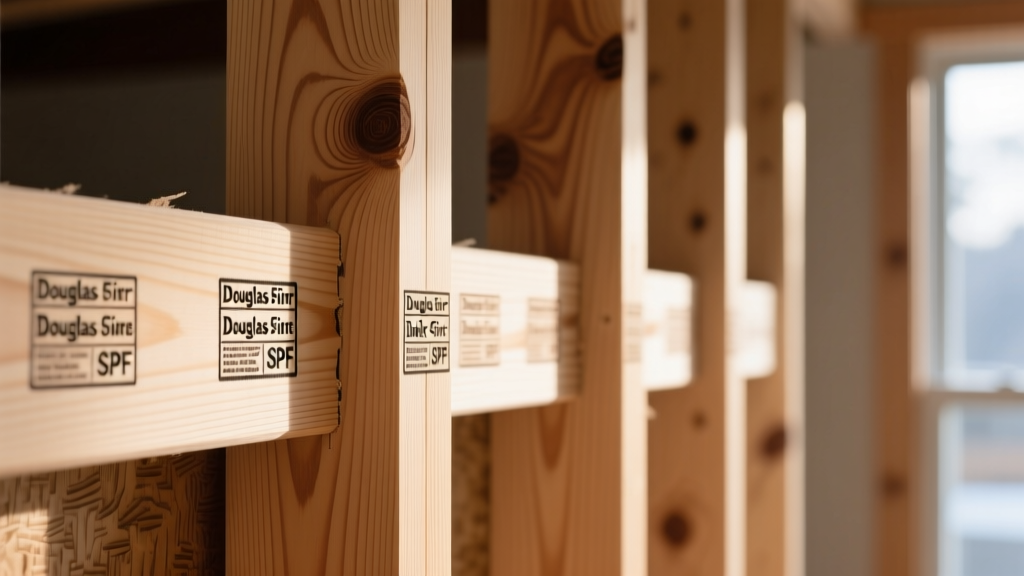
Before resorting to physical testing, examine the wide face of the lumber for an ink grade stamp. Applied at the sawmill, this stamp is the most reliable indicator of both species and structural capacity. Over time, these stamps fade, but using a UV flashlight or lightly sanding the surface with 120-grit sandpaper can often reveal the ghosted ink.
| Stamp Abbreviation | Species Group | Grading Agency | Primary Structural Trait |
|---|---|---|---|
| DF-L | Douglas Fir-Larch | WWPA / NLGA | Highest stiffness (E); excellent for long-span joists. |
| SYP | Southern Yellow Pine | SPIB | Highest density and fastener withdrawal strength. |
| SPF | Spruce-Pine-Fir | NLGA | Lightweight, uniform; standard for vertical wall studs. |
| HF | Hem-Fir | WWPA | Moderate strength; highly resistant to splitting. |
Visual and Physical Identification of the "Big Four"
When stamps are missing, you must rely on macroscopic wood anatomy and physical properties. According to the USDA Forest Products Laboratory Wood Handbook, structural softwoods can be differentiated by latewood transitions, resin canal presence, and color gradients.
Southern Yellow Pine (SYP)
SYP is the heavyweight of North American framing. It features a stark, abrupt transition between the light-colored earlywood and the dark, dense latewood. This creates a highly pronounced, striped grain pattern on the flat-sawn face. SYP is heavily resinous; running a hand plane or power saw across it will quickly gum up blades with pitch. It is noticeably heavier than SPF, weighing roughly 2.5 to 3.0 pounds per linear foot for a dry 2x4.
Douglas Fir-Larch (DF-L)
DF-L exhibits a reddish-brown heartwood with a yellowish-white sapwood. The grain is exceptionally straight, and the growth rings are tightly packed, especially in old-growth or high-grade timber. Unlike SYP, the transition between earlywood and latewood is more gradual. DF-L has a distinct, slightly sweet scent when freshly cut and lacks the aggressive resin canals found in pine, making it cleaner to machine but prone to surface checking if exposed to rapid moisture changes.
Spruce-Pine-Fir (SPF)
SPF is a catch-all commercial grouping, making exact species identification difficult without microscopic analysis. However, as a structural class, SPF is uniformly pale white to light yellow. The grain is subdued, with very little contrast between earlywood and latewood. It is remarkably lightweight and lacks any distinct odor or resinous stickiness. If a piece of framing lumber feels surprisingly light and looks almost entirely white, it is almost certainly SPF.
Hem-Fir
Hem-Fir is often confused with SPF due to its pale color, but it tends to have a slightly more uniform, almost bland texture with very small, inconspicuous resin canals. Western Hemlock (the primary component) is unique among structural softwoods because it lacks resin canals entirely. If you examine the end-grain with a 10x jeweler's loupe and see no tiny white dots (resin canals) in the latewood bands, you are likely looking at Hemlock.
Field Testing: Moisture, Density, and End-Grain Analysis
When visual cues are obscured by paint, fire damage, or decades of dirt, structural engineers and seasoned framers use a sequence of non-destructive field tests to narrow down the species and grade.
- The Moisture Content (MC) Check: Use a pin-type moisture meter. Structural lumber is stamped S-DRY (Surface Dry, max 19% MC) or S-GRN (Surface Green, >19% MC). If an older piece of SYP reads 12% MC, it has fully acclimated and achieved its maximum published design values. Green lumber shrinks as it dries, which can loosen structural connections.
- The End-Grain Pore Test: Slice a clean 1/8-inch section off the end of the board using a fine-tooth saw. Apply a drop of water to the end-grain. In true pines (like SYP), water will wick rapidly through the large longitudinal resin canals. In Hem-Fir, water absorption is slower and more uniform across the tracheids.
- The Fingernail Density Test: Press your thumbnail firmly into the latewood band on the edge of the board. If your nail barely leaves an indentation, you are likely dealing with dense-grade SYP or DF-L. If the wood crushes easily, it is a lower-density SPF or a low-grade Hem-Fir.
- Acoustic Tapping: Strike the center of a spanning joist with a hammer. DF-L and high-grade SYP produce a sharp, high-pitched "ping" due to their high Modulus of Elasticity. SPF and degraded timber produce a dull, low-pitched "thud," indicating lower stiffness or internal checking.
Decision Matrix: When to Replace vs. Reinforce Unidentified Lumber
Identifying the wood is only half the battle; deciding what to do with it is the structural challenge. Use the following matrix when evaluating unmarked or partially identified framing members during a remodel.
| Scenario | Identified Traits | Engineering Action |
|---|---|---|
| Unmarked 2x10 floor joist spanning 15 feet. | Pale color, lightweight, no resin (Suspected SPF). | Reinforce: Sister with new LVL or flitch with steel plate. SPF #2 cannot safely span 15' under modern residential live loads (40 psf). |
| Unmarked 2x6 exterior wall stud with heavy checking. | Reddish hue, straight grain, tight rings (Suspected DF-L). | Retain: Surface checking does not compromise axial compressive strength parallel to grain. Verify plumbness and retain for vertical loads. |
| Salvaged 4x12 beam with deep edge splits. | Extremely heavy, abrupt latewood transition (Suspected SYP). | Replace or Downgrade: Deep splits severely reduce horizontal shear capacity (Fv). Do not reuse as a primary header without professional grading. |
Sourcing Authoritative Guidelines for Site Verification
When field identification leaves room for doubt, structural codes require conservative assumptions. If you cannot definitively prove a piece of lumber is DF-L or SYP, the building inspector will mandate that you calculate your span and load tables using the lowest common denominator—typically SPF #2 or visually graded Hem-Fir. To ensure compliance and safety, always cross-reference your field observations with the Western Wood Products Association (WWPA) grading manuals or the specific span tables published by the American Wood Council. Proper identification prevents catastrophic deflection, ensures fastener schedules are accurate, and keeps your structural framing compliant with the latest International Residential Code (IRC) standards.
Written by
David NakamuraDavid Nakamura is a licensed architect (AIA) and construction technology writer focused on sustainable building methods, mass timber engineering, and high-performance building envelopes. He holds a Master of Architecture from the University of Washington and is a certified Passive House Consultant (CPHC). David spent eight years at the Seattle firm Mithun, where he led the design of three LEED Platinum projects, before founding his own practice specializing in net-zero residential design. He serves on the editorial advisory board of GreenBuilder Magazine and has authored peer-reviewed papers on cross-laminated timber (CLT) connections for the Journal of Structural Engineering. In his spare time, David teaches woodworking at Pratt Fine Arts Center and kayaks the Puget Sound.
More from David Nakamura
View all
Construction Cost
Labor Cost to Build a Deck Per Sq Ft: 2026 Installation Guide
Discover the exact labor cost to build a deck per sq ft in 2026. This installation guide breaks down contractor rates, complexity factors, and hidden fees.
Aug 4, 2026

Construction Cost
How Much Does It Cost to Build a 3 Bedroom House? Financing Guide
Learn exactly how much it costs to build a 3 bedroom house and explore 2026 financing options, construction loan types, and budget frameworks for your build.
Aug 4, 2026

Construction Cost
Cost to Build a Tennis Court: 2026 Guide
How much does it cost to build a tennis court in 2026? Breakdowns for asphalt, concrete, and synthetic surfaces plus fencing and lighting.
Jul 30, 2026