How to Identify Types of Wood Borers and Treat Structural Timber
Learn to identify common types of wood borers damaging structural lumber. Discover specific chemical and physical treatments to preserve timber.

Diagnostic Matrix: Identifying the Intruder
Structural timber degradation by wood-boring insects compromises load-bearing capacity and costs the construction industry millions in remediation annually. Accurate identification is the critical first step; misidentifying the borer species leads to ineffective chemical selection and wasted capital. The diagnostic matrix below correlates physical evidence left in the wood with specific insect families.
| Borer Family | Common Name | Exit Hole Diameter | Frass Texture | Target Wood Species |
|---|---|---|---|---|
| Lyctidae | True Powderpost Beetles | 1/32 to 1/16 inch (round) | Fine, talc-like powder | Hardwoods (oak, ash, hickory, walnut) |
| Anobiidae | Deathwatch / Furniture Beetles | 1/16 to 1/8 inch (round) | Gritty, sand-like with pellets | Both hardwoods and softwoods |
| Cerambycidae | Old House Borers | 1/4 to 3/8 inch (oval) | Cylindrical, distinct pellets | Softwoods (pine, spruce, fir) |
| Buprestidae | Flatheaded Borers | 1/8 to 1/2 inch (flattened oval) | Tightly packed, fine sawdust | Both (rarely reinfests dry wood) |
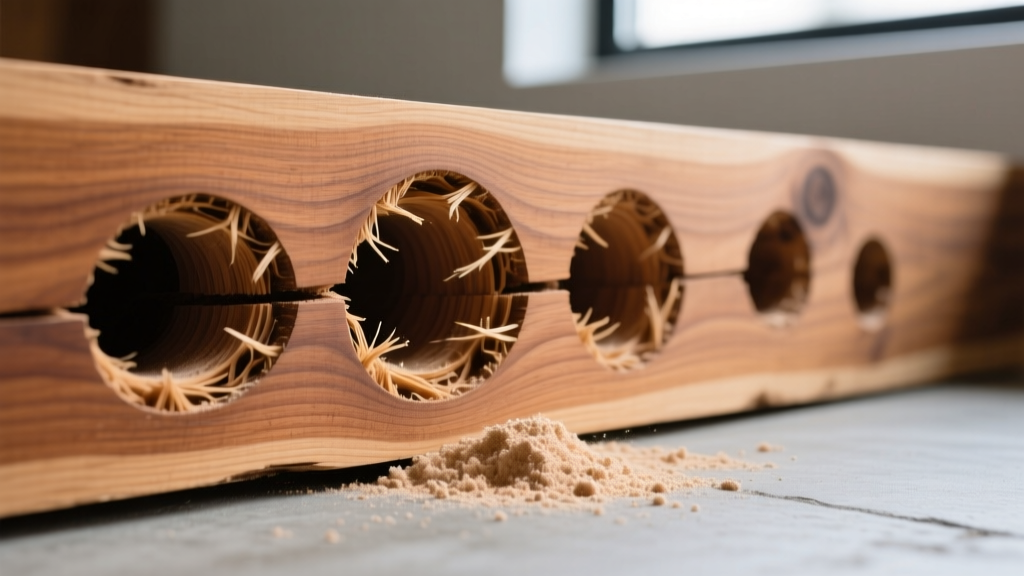
| Siricidae | Horntail Wasps | 1/8 to 1/2 inch (round) | Coarse, fibrous strands | Softwoods (emerges but does not reinfest) |
The Big Three: Structural Timber Borers in Detail
While horntails and flatheaded borers occasionally emerge from newly installed lumber, they do not reinfest seasoned wood. The true threats to structural longevity are the reinfesting species that thrive in indoor environments. According to University of Kentucky Entomology, understanding the moisture and species preferences of these three families dictates your preservation strategy.
1. Lyctidae (True Powderpost Beetles)
Lyctid beetles, primarily Lyctus brunneus, exclusively attack the sapwood of ring-porous hardwoods. They are frequently introduced into residential and commercial structures via imported hardwood flooring, custom cabinetry, and exposed timber frame elements made of white oak or hickory. The larvae require a wood moisture content between 8% and 30% to survive. Because modern climate-controlled buildings maintain wood moisture around 8% to 12%, Lyctid infestations can persist for decades. The defining characteristic is the frass: when sifted between the fingers, Lyctid frass feels exactly like baby powder or cornstarch, lacking any gritty texture.
2. Anobiidae (Deathwatch and Furniture Beetles)
Anobiid beetles, such as the deathwatch beetle (Hemicoelus carinatus), are highly destructive because they attack both hardwoods and softwoods. Unlike Lyctids, Anobiids require higher moisture levels, typically thriving in wood with a moisture content exceeding 14%. Consequently, infestations are heavily concentrated in unventilated crawl spaces, basement joists, and areas with chronic plumbing leaks. Their frass is distinctly gritty and contains tiny, lemon-shaped pellets. Eradicating Anobiids requires a dual approach: chemical intervention combined with mechanical moisture reduction (installing vapor barriers and improving cross-ventilation).
3. Cerambycidae (Old House Borers)
Despite the common name, the Old House Borer (Hylotrupes bajulus) predominantly targets newer construction. This longhorn beetle exclusively infests softwoods, particularly the sapwood of pine, spruce, and fir used in standard dimensional framing (2x4s, joists, trusses). The larvae can remain inside the wood for 3 to 15 years before emerging, meaning an infestation often reveals itself years after construction is completed. The exit holes are noticeably larger and oval-shaped. According to NC State Extension, the frass consists of tightly packed, cylindrical pellets that feel like coarse sand, and the larvae often produce a distinct clicking or rasping sound audible in quiet rooms.
Treatment Decision Framework
Selecting the correct remediation protocol depends on the extent of the infestation, the accessibility of the timber, and the finish state of the wood. Use the following decision parameters to guide your specification.
Scenario A: Localized Infestation in Bare, Unfinished Wood
Protocol: Liquid Borate Application.
Why: Disodium octaborate tetrahydrate (DOT) is highly lethal to wood-boring larvae but possesses low mammalian toxicity. However, borates cannot penetrate paint, varnish, or water-repellent sealers. If the structural timber or flooring is unfinished, borates offer the most cost-effective, permanent solution.
Scenario B: Widespread Infestation in Finished/Enclosed Spaces
Protocol: Structural Fumigation.
Why: If the borers are inside finished hardwood floors, behind drywall, or deep within enclosed timber trusses, surface treatments will not reach the larvae. Fumigation with sulfuryl fluoride gas penetrates all wood elements simultaneously. This requires tenting the structure and vacating the premises for 48 to 72 hours.
Scenario C: High-Value Timber Frames or Antique Elements
Protocol: Thermal Remediation (Heat Treatment).
Why: For localized, high-value architectural timber where chemical residues are undesirable, heating the wood core to 130°F (54°C) for a minimum of 30 minutes will achieve 100% mortality across all life stages. This requires specialized industrial heaters and thermal imaging to verify core temperatures.
Chemical Specifications and Application Rates
When specifying borate treatments for structural lumber, generic hardware store products are insufficient. Professional-grade formulations utilize glycol carriers to drive the active ingredient deep into the wood cellular structure.
- Bora-Care (40% DOT, 60% Glycol): The industry standard for active infestations. The glycol carrier pulls the borate up to 4 inches deep into dry wood. Mix ratio for active Cerambycid or Lyctid infestations is 1:1 with water. Apply at a rate of 1 gallon of mixed solution per 200 square feet of wood surface area.
- Tim-bor (98% DOT, no glycol): A water-soluble powder best used for preventative treatments during the framing stage or in high-moisture crawl spaces where wood is already damp (moisture content >19%). Mix at 1 pound per gallon of water. Apply 1 gallon per 500 square feet.
Critical Application Note: Borates only kill insects when they ingest the treated wood. They do not act as contact poisons or repellents. Therefore, complete saturation of the outer 1/4 inch of the timber surface is mandatory. The Environmental Protection Agency (EPA) mandates that all wood preservative applications follow the specific label rates, which supersede any general contractor guidelines.
2026 Cost Breakdown for Remediation
Budgeting for borer remediation requires understanding the pricing metrics. Surface treatments are calculated by board foot or square foot of exposed wood surface, while fumigation is calculated by the total cubic volume of the enclosed structure.
| Treatment Method | Active Ingredient / Process | Pricing Metric | Estimated 2026 Cost Range |
|---|---|---|---|
| Preventative Borate Spray | Tim-bor (DOT) | Per square foot of wood surface | $0.10 - $0.18 |
| Active Infestation Borate | Bora-Care (DOT + Glycol) | Per square foot of wood surface | $0.25 - $0.45 |
| Whole-Structure Fumigation | Sulfuryl Fluoride (Vikane) | Per cubic foot of building volume | $1.50 - $3.25 |
| Thermal Remediation | Industrial Convection Heat | Per square foot of floor plan | $4.00 - $7.50 |
| Timber Replacement | Engineering & Carpentry | Per linear foot of structural joist | $85.00 - $150.00 |
Preventative Procurement and AWPA Standards
The most cost-effective treatment occurs before the timber is installed. When procuring structural lumber for high-risk environments (e.g., coastal regions, high-humidity climates, or ground-contact applications), specify pressure-treated wood that meets the American Wood Protection Association (AWPA) U1 standards.
For borate-treated lumber (AWPA Category SBX - Sodium Borate), the required retention levels vary by exposure category:
- UC1 (Interior, dry): Minimum 0.25 pounds per cubic foot (pcf) of DOT. Sufficient to prevent Lyctid and Cerambycid infestations in interior framing.
- UC2 (Interior, damp): Minimum 0.42 pcf of DOT. Required for crawl spaces, basement joists, and areas prone to condensation.
- UC4A (Ground Contact): Borates are generally not recommended for direct ground contact due to leaching; specify micronized copper azole (MCA) or alkaline copper quaternary (ACQ) instead.
Always demand the AWPA treatment tag or the supplier's certification of compliance when receiving borate-treated timber on the job site. Untreated sapwood left exposed in humid environments is an open invitation for Anobiid beetles, turning a minor material oversight into a six-figure structural remediation project within a decade.
Written by
Elena RodriguezElena Rodriguez is a civil engineer and technical writer specializing in concrete technology, masonry systems, and ASTM/ACI compliance. She earned her B.S. in Civil Engineering from Texas A&M University and spent a decade at a materials testing laboratory, performing over 2,000 concrete compressive strength tests and masonry prism evaluations. Elena is an ACI-certified Field Testing Technician (Grade I) and a member of ASTM Committee C12 on Natural Building Stone. She currently consults on forensic engineering cases involving concrete failures and moisture intrusion. Based in San Antonio, TX, Elena is a proud member of the Society of Women Engineers (SWE) and coaches her daughter's FIRST Robotics team.
More from Elena Rodriguez
View all
Walls & Panels
Cost Analysis: Light Gauge Steel Framing Advantages and Disadvantages
Evaluate light gauge steel framing advantages and disadvantages through a strict cost analysis lens, comparing material, labor, and lifecycle expenses.
Aug 4, 2026

Walls & Panels
Gypsum Board Types: Exact Specifications, Thickness & Dimensions
Compare standard, Type X, and moisture-resistant gypsum board types. Get exact specifications, thicknesses, dimensions, and ASTM standards for your project.
Aug 4, 2026

Fire Resistance
Best Fire-Resistant Outdoor Decking Materials: 2026 Buyer Guide
Discover the best fire-resistant outdoor decking materials for 2026. Compare Class A PVC, aluminum, and hardwood options for WUI compliance and safety.
Aug 4, 2026