Types of Wood Saws for Structural Framing and Timber Construction
Explore the best types of wood saws for structural framing. Compare worm drives, beam saws, and chainsaws for heavy timber and engineered lumber.

The Structural Cutting Paradigm: Beyond Finish Carpentry
When evaluating the types of wood saws available on the market, it is critical to distinguish between finish carpentry tools and structural framing equipment. Structural applications—ranging from stick-framing residential roofs to erecting heavy timber commercial structures—demand saws engineered for high torque, deep cutting capacities, and extreme durability. Finish saws prioritize tear-out prevention and precision; structural saws prioritize raw power, bevel capacities for complex roof pitches, and the ability to chew through dense engineered lumber and pressure-treated sill plates without binding or burning.
Selecting the wrong saw for structural work leads to burned LVL (Laminated Veneer Lumber) beams, premature motor burnout, and severe safety hazards on the framing deck. This guide breaks down the specific saw categories required for structural timber work, detailing exact models, blade metallurgy, and maintenance protocols for modern building materials.
Core Types of Wood Saws for Framing and Heavy Timber
1. Worm Drive Circular Saws: The Framer's Workhorse
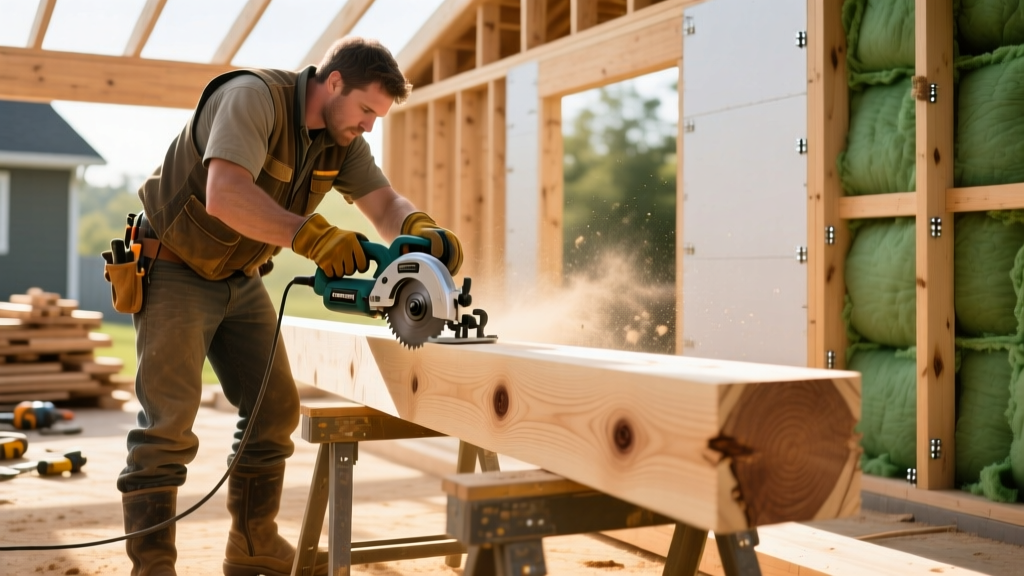
For standard dimensional lumber (2x4 through 2x12) and engineered I-joists, the worm drive circular saw remains the undisputed king of the framing deck. Unlike direct-drive (sidewinder) saws where the motor sits parallel to the blade, worm drive saws position the motor inline with the handles, driving the blade via a 90-degree gear reduction. This geometry yields lower RPMs (typically around 4,500 RPM) but exponentially higher torque, allowing the saw to power through wet, dense Southern Yellow Pine or thick LVL headers without stalling.
The left-side blade orientation of traditional worm drives also provides superior sightlines for right-handed framers when snapping chalk lines and cutting top plates in place.
2. Portable Beam Saws: Deep Timber and Flush Cuts
When structural designs call for solid sawn timbers (6x6, 8x8, or larger) or massive Glulam (Glued Laminated Timber) beams, standard 7-1/4 inch circular saws lack the depth of cut. Portable beam saws, sometimes referred to as carpenter's chainsaws or specialized plunge saws, are engineered to cut up to 5 inches deep in a single pass.
The Mafell ZS 125 (approx. $1,500+) is a premier example. It utilizes a specialized chain-and-bar mechanism enclosed in a safe housing, allowing framers to make precise, square cuts on heavy timbers and perform flush cuts against existing structural members during retrofit work. For crews that cannot justify the Mafell's price point, the Bosch GKE 40 offers a more accessible entry into deep timber cutting, though with slightly less refinement in dust extraction.
3. Chainsaws: Timber Framing and Log Scribing
In traditional timber framing and post-and-beam construction, the chainsaw is an indispensable layout and cutting tool. Timber framers use chainsaws not for felling trees, but for roughing out complex joinery—such as mortises, tenons, and birdsmouths—before refining the joints with hand chisels and slicks.
Structural chainsaws require specific configurations. A mid-range professional saw like the Stihl MS 261 C-M (approx. $650) paired with a 20-inch or 24-inch bar is ideal. Crucially, timber framers must swap standard crosscut chains for ripping chains (filed to a 10-degree angle rather than the standard 30-degree angle) when cutting along the grain to excavate deep mortises cleanly without tearing the wood fibers.
4. Heavy-Duty Reciprocating Saws: Structural Retrofits
Structural renovation and seismic retrofitting require cutting through existing framing that is often riddled with hardened nails, lag bolts, and structural connectors. Heavy-duty reciprocating saws are mandatory for this work. The Milwaukee M18 Fuel Super Sawzall delivers 15 amps of corded-equivalent power, featuring an orbital action that aggressively clears debris when cutting through nail-embedded structural headers or treated sill plates.
Blade Metallurgy for Engineered and Treated Lumber
The most common failure point when using the correct saw with the wrong blade is cutting engineered lumber or pressure-treated wood. Modern structural materials are highly abrasive and chemically reactive.
Cutting LVL, PSL, and Glulam
Engineered beams like LVL and PSL (Parallel Strand Lumber) are bound by heavy phenol-formaldehyde or polyurethane resins. These resins generate immense friction and heat, which will melt the carbide on standard Alternate Top Bevel (ATB) framing blades, causing severe burning and dangerous binding.
- The Solution: Use a Triple-Chip Grind (TCG) carbide blade. The Diablo D0757X (7-1/4 inch, 57-tooth) is engineered specifically for laminated materials. The TCG tooth geometry shears the dense resin rather than scraping it, dissipating heat and extending blade life by up to 400% compared to standard framing blades.
- Authority Guideline: According to APA - The Engineered Wood Association, cutting Glulam and LVL requires sharp, carbide-tipped blades to prevent micro-fracturing at the cut line, which can compromise the beam's load-bearing shear capacity.
The Corrosion Threat of Pressure-Treated Sill Plates
Sill plates and mud sills are treated with preservatives like ACQ (Alkaline Copper Quaternary) or MCA-C (Micropro Micronized Copper Azole). According to the American Wood Protection Association (AWPA), these copper-based preservatives are highly corrosive to metals, particularly when mixed with the moisture present in green treated lumber.
Saw Selection Matrix by Structural Task
| Saw Type | Max Cut Depth | Primary Structural Application | Est. Price Range |
|---|---|---|---|
| Worm Drive (7-1/4') | 2-3/8' | Dimensional lumber, I-joists, LVL headers | $180 - $250 |
| Hypoid / Sidewinder (7-1/4') | 2-1/2' | Light framing, sheathing, decking | $120 - $180 |
| Portable Beam Saw | 4.9' | Solid timbers, Glulam, flush retrofit cuts | $800 - $1,600 |
| Pro Chainsaw (Gas/Battery) | 20' - 36' (Bar) | Timber framing joinery, log scribing | $500 - $800 |
| Reciprocating Saw | 9' - 12' (Stroke) | Demolition, nail-embedded retrofits | $180 - $300 |
Safety and Deck Protocols for Structural Saws
Operating high-torque structural saws on elevated decking or scaffolding introduces severe kickback and drop hazards. The Occupational Safety and Health Administration (OSHA) strictly mandates that portable circular saws weighing more than 8 pounds must be equipped with functioning lower blade guards that automatically retract and cover the blade when withdrawn from the workpiece.
Preventing Bind and Kickback in Deep Beams
When cutting heavy structural beams, the weight of the timber can cause the kerf to close before the cut is complete, pinching the blade and triggering violent kickback. Protocol: Always support the beam on both sides of the cut line, but allow the waste side to drop freely. Never support a beam at both ends while cutting the middle, as the structural deflection will inevitably pinch the blade. For massive Glulam beams, use wooden wedges driven into the kerf behind the saw shoe to keep the cut open during deep passes.
Frequently Asked Questions
Can I use a standard miter saw for structural framing?
While a 12-inch sliding compound miter saw (like the DeWalt DWS780) is excellent for cutting repetitive structural truss components or decking in a controlled staging area, it is entirely impractical for on-deck framing. Miter saws lack the portability, bevel capacity for complex roof hips, and ruggedness required for cutting plates and studs in place. Stick to worm drives and hypoid saws for active deck work.
How often should I replace the blade when cutting pressure-treated lumber?
If you are using a standard 24-tooth carbide framing blade on wet, ACQ-treated sill plates, expect to replace or resharpen the blade after every 40 to 50 linear feet of cutting. The copper preservatives act like sandpaper on carbide edges. Upgrading to a specialized treated-wood blade with a corrosion-resistant PTFE coating will extend this lifespan significantly.
Are battery-powered worm drives viable for heavy structural work?
Yes, modern brushless 60V and 72V battery platforms (such as DeWalt's FlexVolt or Milwaukee's M18 Fuel) now produce torque figures that rival or exceed corded 15-amp worm drives. However, for high-volume production framing where crews are cutting hundreds of LVL headers and I-joists daily, corded saws remain the standard to eliminate the downtime and logistical burden of swapping and charging heavy-capacity battery packs.
Written by
Sarah WhitfieldSarah Whitfield is a chartered quantity surveyor (MRICS) and construction cost analyst with 15 years of experience in material pricing, procurement strategy, and project budgeting. She earned her degree in Construction Management from the University of Reading (UK) and has worked on projects ranging from $2M custom homes to $180M mixed-use developments across North America and Europe. Sarah currently leads cost estimating for BuildMat Insight, maintaining a proprietary database of 4,000+ material price points updated quarterly. She is a frequent contributor to RSMeans cost data panels and has presented at the International Cost Engineering Council (ICEC) congress. Based in Denver, CO, Sarah is an avid trail runner and volunteer mentor for Women in Construction.
More from Sarah Whitfield
View all
Wood & Lumber
What Are the Different Types of Wood? A Builder's Guide
Compare structural softwoods, finish hardwoods, and engineered lumber. Analyze Janka ratings, MOE values, and 2026 pricing for construction.
Aug 4, 2026

Walls & Panels
Steel Framing vs Wood Framing: Corrosion and Moisture Defense
Compare steel framing vs wood framing for moisture resistance. Learn about galvanized coatings, condensation risks, and corrosion protection strategies.
Jul 21, 2026

Stone & Masonry
How to Cut Stone Veneer: Wet Saw vs Grinder Comparison
Compare the best tools for cutting stone veneer. We review wet saws, angle grinders, and chop saws to help you achieve clean, chip-free cuts.
Jul 21, 2026