Preserving the Rarest Type of Wood: Treatment Protocols for Ultra-Dense Timbers
Discover specialized treatment and preservation protocols for the rarest type of wood, including African Blackwood and Lignum Vitae stabilization techniques.

The Paradox of the Rarest Type of Wood: Density vs. Stability
When discussing the rarest type of wood in specialty construction, marine engineering, and precision woodworking, two species immediately dominate the conversation: African Blackwood (Dalbergia melanoxylon) and Lignum Vitae (Guaiacum officinale). These timbers are prized for their extreme density, natural rot resistance, and acoustic properties. However, their rarity is not just a product of slow growth rates and overharvesting; it is compounded by the immense difficulty of treating, drying, and preserving them. Standard lumber preservation methods, such as pressure-treated chemical baths or conventional kiln drying, are entirely ineffective on these ultra-dense exotics. In 2026, as global timber stocks face unprecedented ecological pressure, understanding the advanced stabilization and preservation protocols for these materials is critical for any professional working with high-value, endangered species.
Why Standard Preservation Fails on Ultra-Dense Exotics
The fundamental challenge in preserving the rarest type of wood lies in its cellular structure. Standard structural timbers like Southern Yellow Pine have a specific gravity (SG) of around 0.50, allowing preservative chemicals to penetrate deeply via standard pressure vessels. Lignum Vitae, by contrast, boasts an SG of 1.28 to 1.37—meaning it is so dense it sinks in water. Its cells are tightly packed and heavily congested with natural resins and guaiac gum, creating an impermeable barrier to water-based preservatives.
Furthermore, the drying process for these woods is notoriously volatile. Because the outer layers dry and shrink much faster than the dense, moisture-trapped core, ultra-dense woods are highly susceptible to catastrophic checking (splitting) and honeycombing. According to data from The Wood Database, Lignum Vitae exhibits a volumetric shrinkage of up to 8.5%, which, when combined with its extreme rigidity, generates enough internal tension to literally tear the wood apart during conventional kiln drying.
| Property | Standard Pine (SG ~0.50) | African Blackwood (SG ~1.20) | Lignum Vitae (SG ~1.30) |
|---|---|---|---|
| Preservative Penetration | Deep (Pressure Treated) | Surface Only (0-2mm) | None (Impervious) |
| Conventional Kiln Drying Time | 2-4 Weeks | 12-24 Months | 2-5 Years |
| Checking / Splitting Risk | Low to Moderate | Extreme | Extreme |
| Natural Rot Resistance | Low (Requires Treatment) | Exceptional | Exceptional |
Advanced Treatment Protocols for African Blackwood and Lignum Vitae
Because chemical rot treatment is unnecessary (and physically impossible) due to their natural toxicity and density, "preservation" for the rarest type of wood focuses entirely on dimensional stabilization and moisture management. The goal is to prevent the wood from destroying itself through internal stress.
1. Immediate End-Grain Sealing and Micro-Batch Drying
The preservation process begins the moment the tree is felled. Moisture escapes from wood 10 to 15 times faster through the end grain than the face grain. For ultra-dense exotics, the ends must be sealed within hours of cutting using a thick, wax-based emulsion like Anchorseal. This forces the moisture to migrate slowly through the radial and tangential faces. Drying must be done in micro-batches in a highly controlled environment, often taking up to a year per inch of thickness to reach the target moisture content (MC) of 6-8%.
2. Cross-Linking Polymer Stabilization (The Pentacryl Method)
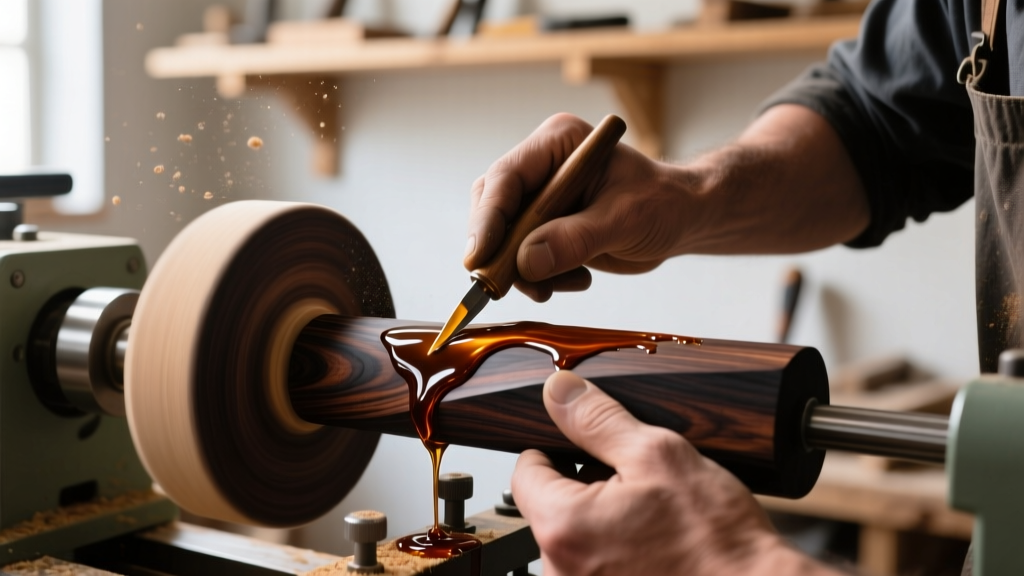
For thick turning blanks and structural components that cannot wait years to air-dry, chemical stabilization is required. Pentacryl is a cross-linking polymer specifically designed for high-density woods. Unlike PEG (polyethylene glycol), which can leave the wood feeling waxy and interfere with finishing, Pentacryl replaces the water molecules in the wood cells and cross-links as it dries. The wood is submerged in a Pentacryl bath, allowing the polymer to penetrate the dense cellular structure, effectively locking the cell walls in their expanded state and reducing shrinkage by up to 97%.
3. Vacuum-Assisted Acrylic Impregnation
For smaller, high-precision components (such as marine bearings, fine tool handles, and musical instrument parts), heat-cured acrylic resins like Cactus Juice provide the ultimate preservation. This process forces stabilizing resin completely through the dense timber, rendering it virtually impervious to moisture fluctuations.
To properly stabilize African Blackwood blanks using heat-cured acrylic, you must use a vacuum chamber capable of pulling at least 29 inHg (inches of mercury). The blanks must be fully submerged in the resin and left under vacuum until the air bubbles completely cease—often taking 12 to 24 hours for ultra-dense species. After curing in an oven at 200°F (93°C) for 2 to 4 hours, the wood becomes a dense, stable wood-plastic composite.
Long-Term Preservation and Hygrometric Storage
Even after successful stabilization and drying, the rarest type of wood requires strict environmental controls during long-term storage. Because these woods are often kept as investment-grade inventory in 2026, improper warehouse conditions can ruin thousands of dollars of material in a matter of weeks.
Hygrometric Storage Framework
Lumber yards and specialty workshops storing Dalbergia and Guaiacum species must implement strict climate control protocols:
- Relative Humidity (RH): Maintain a strict RH between 45% and 50%. Fluctuations greater than 5% in a 24-hour period can trigger micro-checking in partially stabilized blanks.
- Temperature: Keep storage areas at a consistent 65°F to 70°F (18°C - 21°C). Avoid placing rare timber near HVAC vents, exterior doors, or direct sunlight.
- Sticker Spacing: Use rigid, dry hardwood stickers placed every 12 inches to ensure uniform air circulation. Never stack ultra-dense exotics directly on concrete floors, which transmit ambient moisture.
- Weighting: Place heavy weights (e.g., cinder blocks or steel plates) on the top layer of the stack to physically restrict the top boards from warping or cupping as they acclimate.
Frequently Asked Questions
Can I use standard wood hardeners on the rarest type of wood?
Standard liquid wood hardeners (like Minwax High Performance) rely on capillary action to penetrate soft, rotted wood. They will simply pool on the surface of African Blackwood or Lignum Vitae. You must use vacuum-assisted stabilization or specialized cross-linking polymers designed for dense, non-porous materials.
Is Lignum Vitae still used for marine shaft bearings?
Historically, Lignum Vitae was the gold standard for ship propeller shaft bearings due to its natural guaiac gum, which acts as a self-lubricant in water. While genuine Lignum Vitae is still used in some heritage restorations and specialized naval applications, modern marine engineering in 2026 largely relies on synthetic composites like Vesconite or Thordon to protect endangered Dalbergia and Guaiacum populations.
How do I identify if my rare wood blank has internal honeycombing?
Internal honeycombing (hidden internal splits) is common in improperly dried dense exotics. Tap the blank with a brass hammer or the handle of a chisel; a clear, bright ring indicates solid internal structure, while a dull thud or buzzing vibration suggests internal cellular failure. For high-value inventory, non-destructive ultrasonic testing is recommended.
Written by
David NakamuraDavid Nakamura is a licensed architect (AIA) and construction technology writer focused on sustainable building methods, mass timber engineering, and high-performance building envelopes. He holds a Master of Architecture from the University of Washington and is a certified Passive House Consultant (CPHC). David spent eight years at the Seattle firm Mithun, where he led the design of three LEED Platinum projects, before founding his own practice specializing in net-zero residential design. He serves on the editorial advisory board of GreenBuilder Magazine and has authored peer-reviewed papers on cross-laminated timber (CLT) connections for the Journal of Structural Engineering. In his spare time, David teaches woodworking at Pratt Fine Arts Center and kayaks the Puget Sound.
More from David Nakamura
View all
Construction Cost
Labor Cost to Build a Deck Per Sq Ft: 2026 Installation Guide
Discover the exact labor cost to build a deck per sq ft in 2026. This installation guide breaks down contractor rates, complexity factors, and hidden fees.
Aug 4, 2026

Construction Cost
How Much Does It Cost to Build a 3 Bedroom House? Financing Guide
Learn exactly how much it costs to build a 3 bedroom house and explore 2026 financing options, construction loan types, and budget frameworks for your build.
Aug 4, 2026

Construction Cost
Cost to Build a Tennis Court: 2026 Guide
How much does it cost to build a tennis court in 2026? Breakdowns for asphalt, concrete, and synthetic surfaces plus fencing and lighting.
Jul 30, 2026