Evaluating Types of Cedar Wood for Structural Building Applications
Discover how different types of cedar wood perform in structural applications, from timber framing beams to load-bearing posts and decay-resistant sill plates.

The Structural Reality of Cedar: Beyond Siding and Decking
While cedar is globally recognized for its decay resistance and aesthetic appeal in exterior cladding, its role in structural engineering is often misunderstood or underestimated. When architects and structural engineers specify types of cedar wood for load-bearing applications, they are not merely choosing a finish material; they are leveraging specific mechanical properties, dimensional stability, and natural durability that outperform many standard framing lumbers in high-moisture or heavy-timber environments.
However, not all cedar species possess the structural integrity required for beams, columns, and trusses. Misidentifying species or ignoring grading standards can lead to catastrophic deflection or joint failure. This guide dissects the engineering data, grading matrices, and real-world application parameters for structural cedar in 2026 construction.
Species Matrix: Western Red vs. Port Orford vs. Eastern White
Understanding the mechanical divergence between cedar species is the first step in structural specification. Below is a comparative matrix of the three primary North American cedar species and their viability for structural frameworks.
| Species | Primary Structural Use | Modulus of Elasticity (E) | Decay Resistance | Availability for Framing |
|---|---|---|---|---|
| Western Red Cedar (WRC) | Timber framing, beams, posts, light framing | 1,000,000 - 1,100,000 psi | High (Heartwood) | High (West Coast, National distributors) |
| Port Orford Cedar (POC) | Heavy structural beams, marine pilings, specialty trusses | 1,400,000 - 1,600,000 psi | Very High | Low (Restricted, high cost) |
| Eastern White Cedar | Light studs, non-load-bearing partitions, sill plates | 700,000 - 800,000 psi | Moderate to High | Moderate (Northeast, Great Lakes) |
Port Orford Cedar (Chamaecyparis lawsoniana) is the undisputed powerhouse of the cedar family, boasting structural values that rival Douglas Fir. However, due to susceptibility to Phytophthora lateralis (root rot) and limited old-growth harvesting, it is rarely specified outside of specialized marine or high-budget architectural projects. Western Red Cedar (Thuja plicata) remains the industry standard for structural cedar applications, offering an optimal balance of workability, span capabilities, and natural durability.
Load-Bearing Applications: Where Cedar Excels Structurally
1. Timber Framing and Heavy Beams
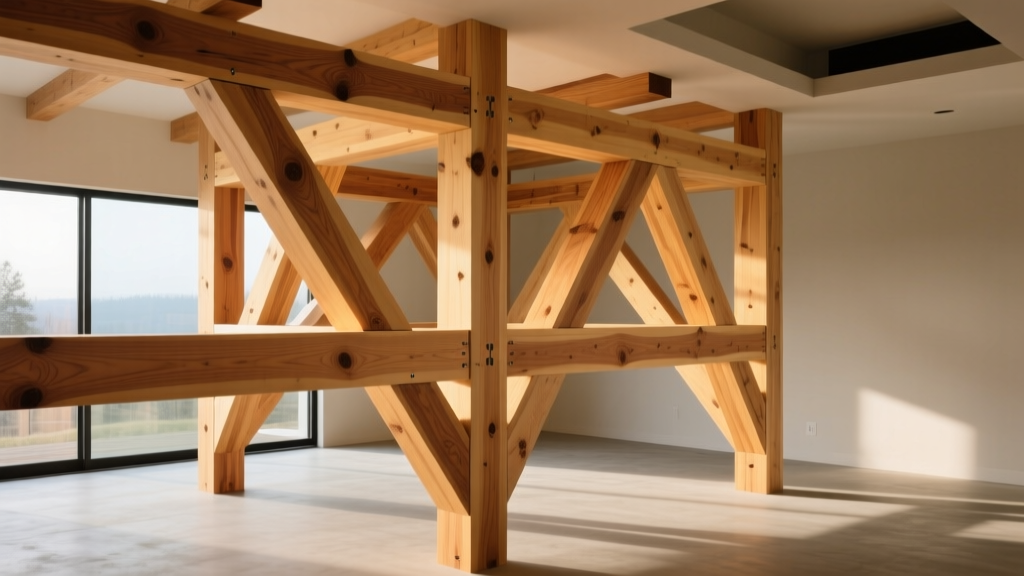
Western Red Cedar is a premier species for post-and-beam construction. Its low density (approximately 21 lbs/ft³ at 12% moisture content) makes massive timbers (e.g., 8x8, 10x12) significantly lighter to hoist and maneuver than Southern Yellow Pine or Oak, reducing crane time and labor costs. Furthermore, cedar's exceptional dimensional stability minimizes the twisting and checking that can compromise traditional mortise and tenon joinery.
2. Foundation Posts and High-Moisture Sill Plates
In areas prone to high groundwater or where concrete stem walls are subject to capillary moisture, pressure-treated Southern Yellow Pine is the default. However, for projects requiring non-chemical, natural decay resistance (such as LEED-certified or Living Building Challenge projects), heart-grade Western Red Cedar is specified for sill plates and structural posts embedded in or resting on masonry. The natural thujaplicins in WRC heartwood provide a Class 1 decay resistance rating without the need for copper-based preservatives.
Understanding Cedar Lumber Grades for Structural Use
Structural cedar is graded primarily by the Western Wood Products Association (WWPA) or the National Lumber Grades Authority (NLGA). Unlike appearance grades (Clear A-D), structural grades focus on the size, location, and frequency of knots, slope of grain, and checks that affect load-bearing capacity.
- Select Structural: The highest grade, designed for maximum strength. Knots are small and widely spaced. Used for critical tension members, long-span beams, and primary roof rafters.
- No. 1 Structural: Allows slightly larger knots and minor slope-of-grain deviations. Ideal for standard load-bearing posts, columns, and intermediate-span joists.
- No. 2 Structural: The most common and economical grade for general framing. Permits larger knots and some wane. Suitable for studs, plates, and short-span beams where extreme fiber stress is not a factor.
- No. 3 Structural: Restricted to light-load applications, blocking, bracing, and temporary structures. Never use for primary load-bearing spans.
Engineering Data: Allowable Stress Design (ASD) Values
Structural engineers rely on the National Design Specification (NDS) for Wood Construction, published by the American Wood Council, to calculate span limits and load capacities. Below are the baseline ASD reference design values for visually graded Western Red Cedar (Dry Service, Normal Temperature).
| Grade | Bending (Fb) psi | Tension Parallel (Ft) psi | Shear Parallel (Fv) psi | Compression Perpendicular (Fc⊥) psi | Modulus of Elasticity (E) psi |
|---|---|---|---|---|---|
| Select Structural | 1,000 | 675 | 145 | 425 | 1,100,000 |
| No. 1 | 750 | 500 | 145 | 425 | 1,000,000 |
| No. 2 | 575 | 350 | 145 | 425 | 1,000,000 |
Note: These are base reference values. Engineers must apply modification factors (CM, Ct, CF, CL) based on moisture content, temperature, beam depth, and lateral support conditions as outlined in the NDS. For comprehensive timber engineering case studies, resources from WoodWorks provide excellent structural modeling templates.
Cost Analysis: Structural Cedar vs. Douglas Fir (2026 Market Rates)
Specifying cedar for structural framing carries a premium over standard framing lumbers like Douglas Fir-Larch (DF-L) or Hem-Fir. In 2026, supply chain stabilization has normalized prices, but the inherent scarcity of large-dimension cedar keeps costs elevated.
Average Material Costs (Uninstalled, 2026)
- 2x6 Studs (No. 2 Grade, 8ft): DF-L: $1.35 / WRC: $3.10
- 6x6 Posts (No. 1 Grade, 12ft): DF-L: $65.00 / WRC: $115.00
- 8x12 Timber Beams (Select Structural, per board foot): DF-L: $7.50 / WRC: $14.50 - $18.00
- Glulam Cedar Beams (Custom fabricated): $22.00 - $30.00 per board foot
While the upfront material cost of Western Red Cedar is 2.2x to 2.5x higher than Douglas Fir, the total installed cost in timber framing can be offset by reduced crane time (due to lighter weight) and the elimination of secondary finishing costs, as structural cedar is often left exposed architecturally.
Fastening and Joinery Considerations in Structural Cedar
Cedar's chemical composition and moisture dynamics dictate strict fastening protocols. The natural tannins and extractives in cedar, combined with its moisture content, will rapidly corrode standard electro-galvanized or plain steel fasteners, leading to structural joint degradation and unsightly black staining.
- Hot-Dipped Galvanized (HDG): Must meet ASTM A153 standards. Acceptable for general structural connections, but the rough surface of HDG can tear cedar fibers during driving.
- Stainless Steel (Type 304 or 316): The mandatory choice for exposed structural connections, coastal environments, or where aesthetic preservation of the timber is required. Type 316 is required within 10 miles of saltwater coastlines.
- Shrinkage and Joint Tolerances: WRC has a radial shrinkage of 2.6% and tangential shrinkage of 5.0% (green to oven-dry). While low compared to Oak (tangential 8.6%), timber framers must still calculate shrinkage allowances for pegged mortise and tenon joints to prevent racking as the building dries over the first 24 months.
For further detailing on exterior exposure and fastener compatibility, the Western Red Cedar Lumber Association design manuals provide exhaustive connection diagrams and hardware matrices.
Frequently Asked Questions
Can Western Red Cedar be used for roof trusses?
Yes, but it requires careful engineering. Because its Modulus of Elasticity (E) is lower than Douglas Fir, cedar truss members will deflect more under identical loads. Engineers must increase the depth of the truss chords or reduce the span intervals to meet building code deflection limits (typically L/360 for live loads).
Is structural cedar fire-resistant?
Cedar is a combustible wood species and does not possess an inherent Class A fire rating. However, in heavy timber framing (members exceeding 8 inches in cross-section), cedar performs predictably in fires by forming an insulating char layer that protects the inner core, allowing it to meet Type IV (Heavy Timber) construction fire-resistance requirements without chemical retardants.
Does structural cedar require pressure treatment for ground contact?
If you are using 100% heartwood Western Red Cedar or Port Orford Cedar for structural posts embedded in concrete or direct earth contact, it can perform adequately without pressure treatment due to natural thujaplicins. However, modern building codes (IBC/IRC) often strictly mandate AWPA-approved pressure-treated wood for any structural member in direct ground contact. Always verify with your local building official before omitting preservative treatments.
Written by
Priya KapoorPriya Kapoor is a real estate market analyst and construction economics researcher with expertise in housing affordability, development feasibility, and infrastructure investment. She holds a Master of Regional Planning from Cornell University and previously worked as a senior analyst at CBRE's Investment Properties group, where she modeled returns for $4B in mixed-use development pipelines. Priya now runs an independent research practice advising developers, municipalities, and REITs on construction cost forecasting and market timing. She publishes the quarterly "BuildMat Market Pulse" report tracking material price indices across 12 commodity categories. Based in Austin, TX, Priya serves on the board of Habitat for Humanity Austin and is a marathon runner.
More from Priya Kapoor
View all
Construction Cost
Cost to Build a 1600 Sq Ft Home in 2026: Full Breakdown
Accurate 2026 cost to build a 1600 sq ft home—material, labor, and regional pricing breakdowns included. Plan your budget with real-time estimates.
Aug 11, 2026

Wood & Lumber
Name the Types of Wood for Pressure Treatment and Preservation
Learn how to name the types of wood best suited for pressure treatment. Compare species treatability, chemical retention levels, and 2026 preservation costs.
Aug 4, 2026

Stone & Masonry
Stone Veneer Suppliers Lindenhurst: 2026 Cost Analysis
Analyze 2026 stone veneer costs in Lindenhurst, NY. Compare local supplier pricing, delivery fees, and Suffolk County installation labor rates.
Aug 4, 2026