PT Plywood Performance Ratings & AWPA Retention Specifications
Master PT plywood specifications with our guide to AWPA retention levels, span ratings, preservative types, and fastener compatibility.
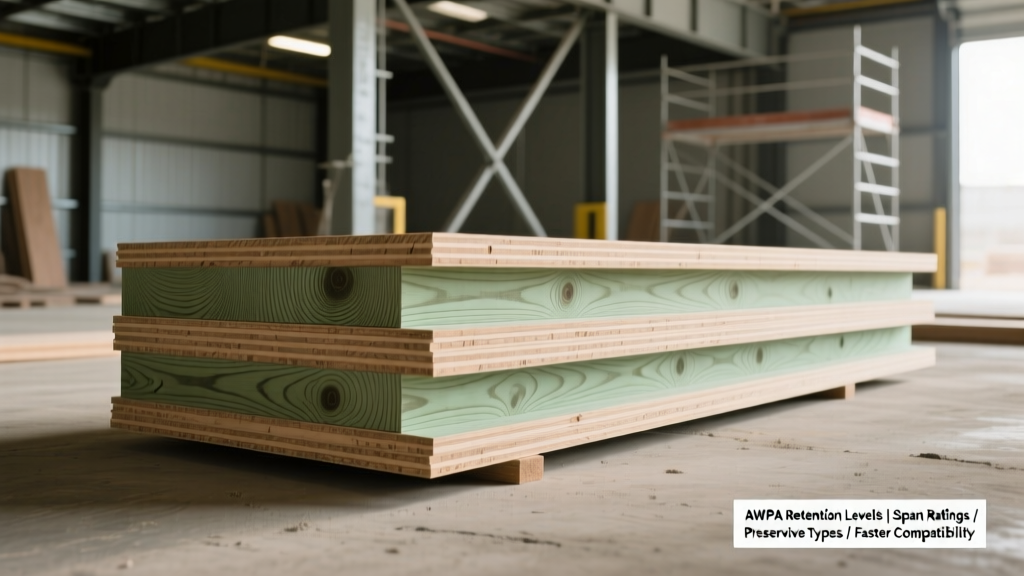
Decoding the AWPA Use Category System for PT Plywood
Pressure-treated (PT) plywood bridges structural engineering and chemical preservation, requiring specifiers to navigate two distinct rating systems simultaneously: the structural span ratings governed by the APA (The Engineered Wood Association) and the biological durability ratings governed by the American Wood Protection Association (AWPA). Specifying PT plywood based solely on a generic "treated" label leads to premature delamination, structural sagging, or catastrophic biological failure. The cornerstone of biological performance is the AWPA Use Category (UC) system, which dictates the minimum preservative retention levels required for specific environmental exposures.
Retention level is measured in pounds of preservative chemical per cubic foot of wood (pcf). The required pcf fluctuates based on the specific chemical formulation used (e.g., MCA, ACQ, CA-C) and the severity of the biological hazard. Below is the critical specification matrix for the most common PT plywood applications in commercial and residential construction.
| Use Category | Exposure Condition | MCA-C (pcf) | ACQ (pcf) | CA-C (pcf) |
|---|---|---|---|---|
| UC3B | Above Ground (Uncoated, critical moisture) | 0.15 | 0.25 | 0.15 |
| UC4A | Ground Contact (General use) | 0.31 | 0.40 | 0.31 |
| UC4B | Ground Contact (Heavy duty / structural) | 0.46 | 0.60 | 0.46 |
| UC4C | Ground Contact (Foundation / permanent wood) | 0.60 | 0.80 | 0.60 |
For standard exterior wall sheathing or roof decking where moisture intrusion is possible but ground contact is not, UC3B is the baseline. However, for retaining walls, sill plates on concrete slabs, or marine bulkheads, UC4A or UC4B is strictly required by the International Building Code (IBC). Always verify the end-tag on the plywood bundle; the AWPA standard mandates that the specific Use Category and minimum retention level be printed on the physical tag.
APA Span Ratings and Exposure Durability Classifications
While the AWPA governs decay resistance, the APA stamp dictates structural load capacity. A common specification error is assuming that pressure treatment inherently upgrades a panel's moisture resistance. It does not. The structural performance of PT plywood relies entirely on the resin chemistry used in the veneer glue lines.
Exposure 1 vs. Exterior Durability
When specifying PT plywood, you must cross-reference the APA Exposure Durability Classification with the intended application timeline:
- Exposure 1: Utilizes moisture-resistant adhesives (often MDI or specific phenolic blends) designed to withstand construction delays and temporary weather exposure. However, the high heat and moisture of the pressure-treatment retort process can stress these glue lines. Exposure 1 PT plywood is suitable for protected applications (like subflooring over a crawlspace) but should not be used in permanent, high-moisture exterior environments.
- Exterior: Manufactured exclusively with 100% phenol-formaldehyde (PF) resins. PF glue lines are virtually impervious to water, boiling, and the extreme conditions inside a pressure-treatment cylinder. Specification Rule: Any PT plywood designated for permanent exterior exposure, ground contact, or marine applications must carry the "Exterior" APA stamp. Using Exposure 1 rated panels in a UC4A ground-contact scenario will result in delamination long before the wood itself decays.
Understanding Span Ratings
The span rating (e.g., 32/16, 40/20, 48/24) appears as a fraction on the APA stamp. The left number indicates the maximum recommended center-to-center spacing (in inches) for roof sheathing, while the right number indicates the maximum spacing for floor sheathing. According to APA The Engineered Wood Association, the pressure-treatment process does not inherently reduce the allowable span rating of the panel, provided the panel is dried back to a moisture content of 19% or less post-treatment and the correct Exposure Durability classification was utilized during manufacturing.
Preservative Chemistries and Fastener Corrosion Dynamics
The shift away from Chromated Copper Arsenate (CCA) in the early 2000s fundamentally altered fastener specifications for PT plywood. Modern copper-based preservatives are highly alkaline and significantly more corrosive to standard steel and aluminum hardware.
Standard G90 galvanized nails and screws will corrode rapidly when in contact with ACQ or MCA treated plywood. The alkaline copper environment strips the zinc coating, leading to fastener failure and subsequent structural pull-through.
- Minimum Requirement: Hot-dipped galvanized fasters meeting ASTM A153 Class D (G185 rating, meaning 1.85 oz of zinc per square foot).
- Coastal/Saltwater: Type 316 Stainless Steel is mandatory for PT plywood used in saltwater splash zones or within 1,000 feet of a coastline.
- Aluminum: Never use untreated aluminum flashing or joist hangers in direct contact with PT plywood. Use heavy-gauge PVC separators or specialized anodized/coated aluminum rated for copper-azole contact.
Comparing Modern Preservatives
When reviewing submittals from suppliers, you will encounter three primary chemistries. Understanding their nuances allows for more precise material optimization:
- MCA-C (Micronized Copper Azole - Type C): Currently the dominant market leader. Uses finely ground, particulate copper rather than dissolved copper. This results in a lower pH (less alkaline) compared to ACQ, slightly reducing the corrosive impact on hardware while maintaining excellent fungal and termite resistance. It leaves the plywood with a natural brown/green tint.
- ACQ (Alkaline Copper Quaternary): Uses dissolved copper and a quaternary ammonium co-biocide. Highly effective but highly alkaline, demanding the strictest fastener corrosion protections (G185 or Stainless).
- CA-C (Copper Azole - Type C): Similar to MCA but utilizes dissolved copper. Often specified for heavy-duty ground contact (UC4B/UC4C) applications where deep cellular penetration of dissolved chemicals is preferred over particulate suspensions.
Manufacturing Dynamics: Incising and Moisture Content
To achieve the required AWPA retention levels, particularly in thicker panels (3/4" or 1" structural ply), manufacturers utilize a mechanical process called incising. Incising involves running the veneers through rollers equipped with small teeth that puncture the wood surface before the retort process. This creates micro-channels that allow the preservative chemicals to penetrate deep into the dense latewood of the Southern Yellow Pine typically used for PT plywood.
While incising is necessary for biological performance, it slightly reduces the localized shear strength of the veneer. For highly engineered structural applications, such as stressed-skin panels or heavy-load diaphragms, structural engineers must account for this minor strength reduction. Furthermore, the USDA Forest Products Laboratory notes that PT plywood shipped directly from the treatment facility can have a moisture content exceeding 40%. Installing high-moisture PT plywood as a subfloor without allowing it to acclimate and dry to below 19% will trap moisture, potentially leading to edge swelling, floor squeaks, and mold growth on adjacent untreated framing.
Application-Specific Selection Matrix
Use the following decision matrix to align your project requirements with the correct PT plywood specifications, eliminating over-specification costs and under-specification risks.
| Application Scenario | Required AWPA Category | APA Exposure Rating | Recommended Span / Thickness | Fastener Spec |
|---|---|---|---|---|
| Exterior Wall Sheathing (Protected by WRB) | UC3B (Above Ground) | Exposure 1 | 32/16 (7/16" or 15/32") | G185 Hot-Dipped Galvanized |
| Crawlspace Subfloor (High Humidity) | UC3B or UC4A | Exposure 1 or Exterior | 40/20 (3/4" T&G) | G185 Hot-Dipped Galvanized |
| Retaining Wall / Planter Box | UC4A (Ground Contact) | Exterior (PF Resin) | 48/24 (3/4" or 1") | 304 or 316 Stainless Steel |
| Permanent Wood Foundation (PWF) | UC4B or UC4C | Exterior (PF Resin) | Engineered specific (1"+) | 316 Stainless Steel |
| Marine Dock Decking / Bulkhead | UC4C or UC5 (Marine) | Exterior (Marine Grade) | Span dictated by live load | 316 Stainless Steel |
Edge Cases and Common Specification Failures
A frequent failure mode in commercial landscaping occurs when contractors use standard UC3B PT plywood for the backing of concrete paver retaining walls. The constant moisture wicking from the soil and concrete pushes the biological hazard into the UC4A or UC4B territory. The 0.15 pcf retention of UC3B MCA-C is rapidly depleted in this environment, leading to rot behind the hardscape within 3 to 5 years.
Another critical edge case involves the use of PT plywood as a substrate for adhered stone veneer or stucco. The residual salts and copper compounds on the surface of newly treated plywood can interfere with the chemical cure of Portland cement-based mortars and acrylic adhesives. When using PT plywood as a tile backer or veneer substrate in wet areas, it must be kiln-dried after treatment (KDAT) to 15-19% moisture content and sealed with a compatible waterproofing membrane to isolate the cementitious materials from the preservative chemicals.