How Much Did Dollywood Cost to Build? Timber Cost Analysis
Discover how much Dollywood cost to build and explore 2026 commercial timber construction costs, wood coaster engineering, and rustic lumber pricing.

The Origins: How Much Did Dollywood Cost to Build Initially?
When analyzing the economics of Appalachian-themed hospitality and entertainment, a frequent question among developers and historians is how much did Dollywood cost to build. The answer requires separating the historical land acquisition from the physical timber and lumber infrastructure. In 1986, Dolly Parton entered a joint venture with Herschend Enterprises, investing an estimated $15 million to $20 million to rebrand the existing Silver Dollar City Tennessee into Dollywood. However, that figure primarily covered marketing, new ride installations, and operational capital.
The original wooden infrastructure—rooted in the 1961 Rebel Railroad and subsequent 1970s Goldrush Village expansions—relied heavily on locally sourced, light-frame Southern Yellow Pine (SYP) and rough-sawn oak. Adjusting the 1986 physical structure valuation for inflation and modern building codes, the baseline wood package for the original 160-acre footprint would cost approximately $42 million in today's market. But to replicate Dollywood's current architectural footprint in 2026, utilizing heavy timber, fire-retardant treatments, and engineered wood products, the lumber and structural wood costs scale dramatically.
2026 Commercial Timber & Lumber Cost Matrix
Building a modern theme park village or rustic resort requires navigating complex commercial building codes (IBC Type III and Type IV construction). The aesthetic demands exposed wood, while the code demands rigorous fire and structural performance. Below is a 2026 cost breakdown for the primary wood materials used in Appalachian-style commercial construction.
| Material Type | Specific Grade / Product | Application | 2026 Est. Cost (per Sq. Ft. / Unit) |
|---|---|---|---|
| Glulam Beams | 24F-V8 Douglas Fir, Architectural Grade | Lodge Atriums, Pavilion Roofs | $85 - $120 per linear foot |
| Half-Log Siding | Eastern White Pine, 8-inch profile, kiln-dried | Exterior Facades, Ticket Booths | $14.50 - $18.00 per sq. ft. |
| FRT Plywood | 3/4" Fire-Retardant Treated (Interior) | Sheathing, Egress Corridors | $78 - $95 per 4x8 sheet |
| Heavy Timber Decking | 3x6 T&G Southern Yellow Pine, Select Structural | Boardwalks, Queue Lines, Porches | $22.00 - $28.50 per sq. ft. |
| Cedar Shakes | 18" Perfection, Pressure-Treated Class A Fire Rated | Resort Roofing (e.g., DreamMore Resort) | $450 - $600 per square (100 sq. ft.) |
The Thunderhead Effect: Wooden Coaster Lumber Economics
No analysis of Dollywood's wood infrastructure is complete without examining its wooden roller coasters. The Thunderhead, which debuted in 2004, remains a masterclass in structural timber engineering. Wooden coasters are not built with standard framing lumber; they require highly specific, dense, and resilient wood species to withstand dynamic cyclical loading and outdoor weathering.
Southern Yellow Pine vs. Douglas Fir in Ride Engineering
Modern wooden coasters typically utilize a hybrid approach. The structural bents (the vertical support towers) are predominantly constructed from Southern Yellow Pine (SYP) due to its high density, exceptional fastener-holding strength, and cost-effectiveness in the Southeastern United States. The track itself, however, is often laminated using Douglas Fir or specialized hardwoods for its superior dimensional stability and resistance to crushing under the steel running rails.
Cost Insight: The Dynamic Loading Premium
Lumber graded for roller coaster construction must meet strict 'Select Structural' or specialized dynamic-loading criteria. In 2026, sourcing the estimated 1.5 to 2 million board feet of SYP required for a mid-sized wooden coaster commands a 35% to 45% premium over standard #2 framing lumber. Furthermore, the hardware—specifically hot-dipped galvanized or Type 304 stainless steel through-bolts and custom fabricated malleable iron connectors—adds roughly $3.5 million to $5 million to the structural wood package alone.
Commercial Wood Treatments: Fire Retardants and Preservatives
Theme parks and high-occupancy resorts face stringent life-safety codes. Exposed timber in assembly occupancies (like show theaters and large dining lodges) must either meet heavy-timber dimensional requirements (which char predictably in a fire) or be treated with fire-retardant chemicals.
According to guidelines published by the American Wood Council (AWC), Fire-Retardant-Treated (FRT) wood is essential for interior roof decks, exterior walls near property lines, and decorative elements that do not meet the minimum thickness for inherent fire resistance. The treatment process involves impregnating the lumber with chemical salts under high pressure, followed by kiln-drying.
- Interior FRT Wood: Must maintain structural integrity under high humidity and temperature cycles without leaching. Expect to pay a 25-30% premium over untreated SPF (Spruce-Pine-Fir).
- Exterior FRT Wood: Must withstand weathering without losing its fire-rating. The American Wood Protection Association (AWPA) sets strict standards (U1) for these treatments. Exterior FRT plywood and lumber carry a 40% premium and require specialized corrosion-resistant fasteners.
- Preservative Treated (ACQ / Copper Azole): Used for all wood in direct contact with the ground (e.g., fence posts, retaining walls, queue line stanchions). While the chemical cost is lower than FRT, the mandatory upgrade to stainless steel fasteners to prevent galvanic corrosion increases the total installed cost by 12-15%.
Value Analysis: ROI of Authentic Timber Architecture
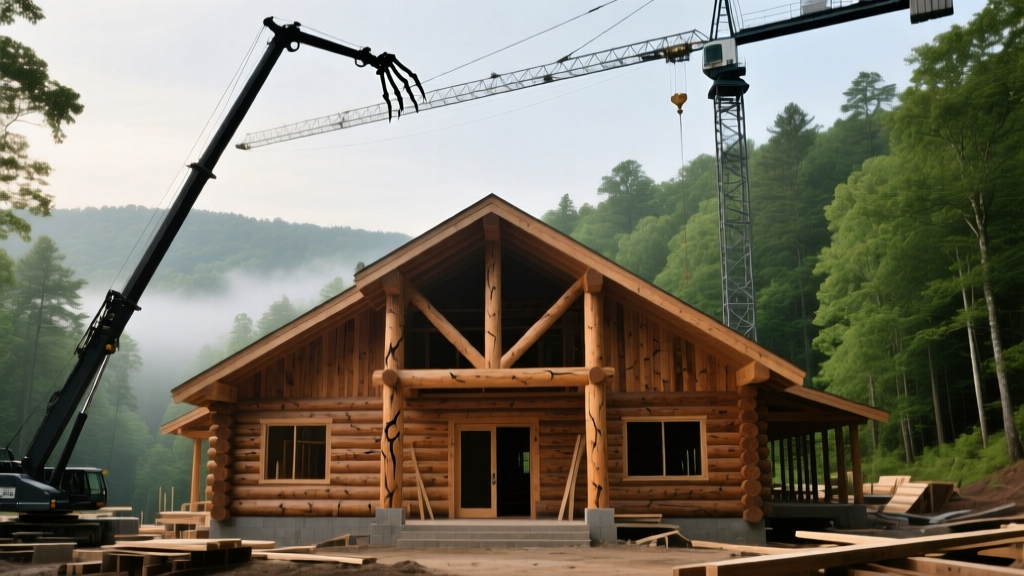
Why invest tens of millions in heavy timber and authentic log construction when light-gauge steel framing with synthetic stone and polyurethane wood facades could mimic the look for 30% less? The answer lies in the hospitality ROI and brand authenticity.
'In the experiential economy, guests can instantly distinguish between authentic architectural timber and synthetic facades. The acoustic dampening properties of heavy wood, combined with the thermal mass and natural scent of cedar and pine, elevate the perceived value of the resort, allowing for a 20-25% premium on nightly cabin and lodge rates.' — Commercial Hospitality Design Index, 2025
Dollywood's expansion into the hospitality sector, notably with the DreamMore Resort and Spa, utilized extensive cedar shake roofing, exposed rafter tails, and heavy timber porch structures. While the initial lumber and millwork package for a 300-room rustic luxury resort of this caliber easily exceeds $18 million in 2026, the material choice directly supports premium pricing strategies. Authentic wood structures in the Smoky Mountain region also benefit from lower long-term maintenance costs compared to synthetic stucco or EIFS, which are prone to impact damage and moisture trapping in high-humidity, high-rainfall environments.
2026 Lumber Market Realities for Theme Park Developers
If a developer were to break ground on a Dollywood-equivalent park today, the procurement strategy for wood products would require a multi-year lead time. Custom Glulam beams spanning 60 feet or more for grand lodges are currently facing 14-to-18-week lead times from Pacific Northwest and Canadian manufacturers. Furthermore, the shift toward mass timber and Cross-Laminated Timber (CLT) in commercial construction has tightened the supply of high-grade Douglas Fir, pushing prices for architectural exposed timber up by 8% year-over-year.
Ultimately, while the historical answer to how much it cost to build Dollywood rests in the $15M-$20M partnership investment of 1986, the true cost of its wood and timber infrastructure in the modern era represents a $75M+ material commitment. For builders and architects, the lesson is clear: authentic timber construction in high-traffic commercial spaces is a premium investment that demands rigorous attention to lumber grading, moisture management, and fastener compatibility.
Written by
Marcus ChenMarcus Chen is a licensed structural engineer (PE) and building materials analyst with over 12 years of experience across residential, commercial, and industrial construction. He holds a Master of Science in Civil Engineering from UC Berkeley and spent six years at Thornton Tomasetti before transitioning to independent consulting and technical writing. Marcus specializes in material selection for seismic-prone regions, concrete reinforcement strategies, and lifecycle cost analysis. His work has been cited by the American Concrete Institute (ACI) and the Structural Engineers Association of California (SEAOC). When he is not on a job site or at his desk, you will find him hiking the Sierra Nevada or restoring a 1920s craftsman bungalow in Oakland, CA.
More from Marcus Chen
View all
Construction Cost
How Much Did the Eiffel Tower Cost to Build?
How much did the Eiffel Tower cost to build in 1889? We adjust for inflation and compare its budget to modern skyscraper construction.
Aug 4, 2026

Fire Resistance
What Is a Fire Resistant Material? Testing & Certification Guide
Discover what is a fire resistant material through ASTM and UL testing. Learn how fire ratings, certifications, and assemblies work in construction.
Aug 4, 2026

Construction Cost
How Much Did the Burj Khalifa Cost to Build?
How much did the Burj Khalifa cost to build? We break down the $1.5B project and extract 5 money-saving strategies for your next build.
Jul 30, 2026