Types of Metal Brackets for Wood: Cost and Value Analysis
Compare costs and structural value of joist hangers, post bases, and framing anchors. Find the best types of metal brackets for wood projects.

The Hidden Economics of Wood-to-Metal Connections
When budgeting a wood framing project, contractors and DIY builders often fixate on the cost per board-foot of lumber while treating metal connectors as an afterthought. This is a critical financial miscalculation. The hardware connecting your timber dictates the structural load path, the lifespan of the wood against moisture intrusion, and the ultimate labor cost of assembly. Choosing the correct types of metal brackets for wood framing is not merely a code-compliance exercise; it is a fundamental value-engineering decision.
A $2.00 joist hanger that fails prematurely due to galvanic corrosion can trigger thousands of dollars in structural remediation. Conversely, overspending on stainless steel hardware for an interior, climate-controlled partition wastes capital that could be allocated to higher-grade finishes. This analysis breaks down the true cost, labor economics, and long-term value of primary metal framing brackets to help you optimize your construction budget.
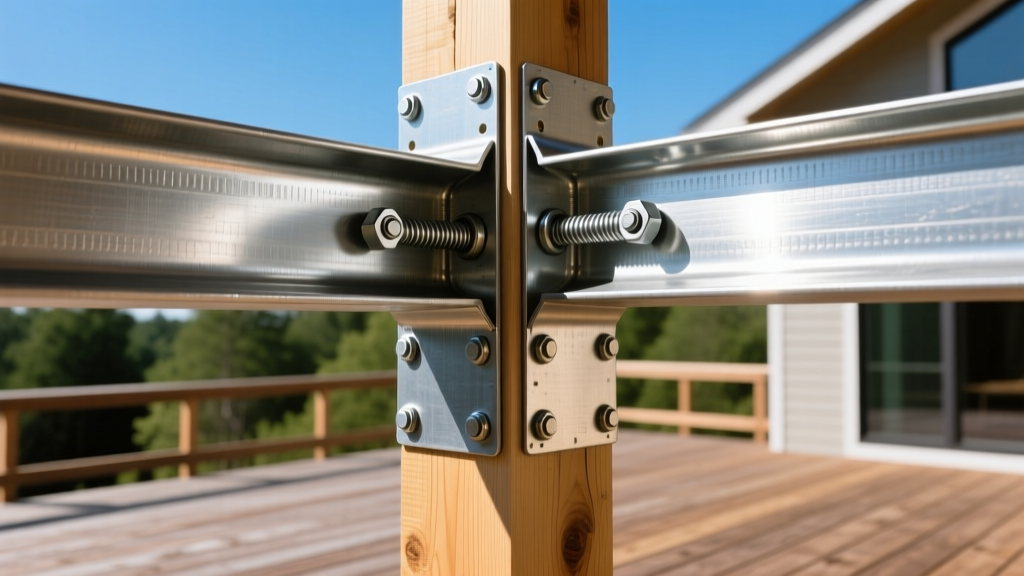
Cost vs. Capacity Matrix: Primary Bracket Categories
The market offers hundreds of bracket variations, but 90% of residential and light-commercial wood framing relies on four core categories. The table below outlines the baseline economics for standard dimensional lumber (Douglas Fir-Larch) applications.
| Bracket Category | Industry Standard Model | Avg. Unit Cost (ZMAX) | Primary Value Driver | Labor Impact |
|---|---|---|---|---|
| Face-Mount Joist Hanger | Simpson LUS210-2 | $1.85 - $2.40 | High shear capacity, rapid pneumatic nailing | Low (Fastest install) |
| Concealed Flange Hanger | Simpson CCFH210-2 | $4.50 - $6.20 | Aesthetic invisibility, flush architectural finishes | High (Requires precision cutting) |
| Adjustable Post Base | Simpson ABU44Z / ABU66Z | $14.00 - $22.50 | Prevents end-grain rot, allows post leveling | Medium (Requires concrete anchor drilling) |
| Hurricane Tie / Clip | Simpson H2.5A | $0.95 - $1.30 | Uplift resistance, continuous load path | Low (High volume, repetitive nailing) |
Deep Dive: Joist Hangers and the Concealed Flange Premium
Standard face-mount joist hangers, like the ubiquitous LUS series, represent the highest volume-to-cost ratio in wood framing. For a standard 2x10 floor joist, a G185 galvanized hanger costs roughly $2.00. However, when framing exposed ceiling beams in architectural builds, the visible flanges and nail heads of standard hangers are unacceptable.
The Economics of Concealed Hardware
Concealed flange hangers (such as the CCFH series) tuck entirely behind the joist. While the unit cost jumps by 150% to 200% (averaging $5.50 per joint), the value proposition extends beyond aesthetics. Concealed hangers often feature integrated seat geometry that temporarily holds the joist in place before fastening, reducing the need for a second worker to support the lumber during installation. In high-wage labor markets, saving 45 seconds per joint across 200 joists can offset the hardware premium entirely.
Modern pressure-treated lumber (ACQ and Copper Azole) contains high levels of copper, which acts as a cathode and aggressively strips standard G90 zinc coatings via galvanic corrosion. According to the Simpson Strong-Tie Corrosion Guidelines, using standard G90 brackets on ACQ-treated wood will result in catastrophic connection failure within 5 to 7 years in exterior environments. You must specify ZMAX (G185) or Type 304/316 Stainless Steel. The 30% upcharge for ZMAX is non-negotiable for exterior or ground-adjacent framing.
Post Bases: Elevating Structural ROI
The most vulnerable point in any timber structure is the end-grain of a vertical post resting on concrete. Concrete wicks moisture, and end-grain acts like a bundle of straws, drawing that moisture directly into the wood column. The result is dry rot and structural collapse.
Fixed vs. Adjustable Post Bases
A fixed post base (like the ABA series) costs around $8.00 and provides a 1-inch standoff from the concrete. However, it requires the concrete footing to be poured with absolute, millimeter-perfect precision. If the footing is uneven, the carpenter must physically shave the bottom of the timber post to achieve plumb—a time-consuming and error-prone process.
Adjustable post bases (like the ABU66Z for 6x6 posts) cost approximately $21.00. While the upfront material cost is 160% higher, the integrated 1-inch vertical adjustment nut allows the carpenter to level the post after it is stood up. When you factor in the $65/hour burdened labor rate of a skilled framer, the $13.00 hardware premium pays for itself the first time a carpenter avoids spending 20 minutes planing the bottom of a heavy timber column.
Replacing a rotted 6x6 structural deck post involves temporary shoring, demolition of the rotten timber, purchasing a new pressure-treated post ($45 - $80), and 2 hours of skilled labor ($130). Total remediation cost: $175 - $210. Investing in a $21 adjustable post base with a 1-inch standoff yields a 10x ROI over the 30-year lifespan of the structure by entirely eliminating end-grain moisture wicking.
Material Finishes and Their True Cost Over Time
Understanding the metallurgy of your brackets is essential for accurate lifecycle costing. The USDA Forest Products Laboratory Wood Handbook details how moisture and chemical preservatives interact with metal fasteners and connectors. Here is the financial breakdown of coating tiers:
- G90 Galvanized (Standard): Baseline cost. Suitable only for interior, dry, untreated lumber applications. Using this outdoors or with treated wood voids most structural warranties.
- ZMAX / G185 (Heavy Galvanized): 30% to 45% price premium over G90. Features 1.85 oz of zinc per square foot. This is the mandatory minimum for all modern ACQ and CA-C pressure-treated lumber, as well as exterior applications in non-coastal zones.
- Type 304 Stainless Steel: 250% to 300% price premium. Required for indoor pools, agricultural buildings with high ammonia environments, and fire-retardant treated wood (FRTW) which is highly acidic.
- Type 316 Stainless Steel: 350% to 450% price premium. Contains molybdenum for superior pitting resistance. Mandatory for structures within 10 miles of a saltwater coastline or for direct ground-contact applications.
Fastener Economics: The Often-Ignored Cost Multiplier
A metal bracket is only as strong as the fasteners securing it. Builders frequently analyze the bracket cost but ignore the fastener math, leading to severe budget overruns or compromised structural integrity.
Consider a standard LUS210-2 joist hanger, which requires 10 face nails and 4 joist nails (14 total). Using standard 10d x 1.5" galvanized joist hanger nails, the fastener cost is roughly $0.28 per joint ($0.02 per nail). However, driving 14 nails requires a pneumatic nail gun, a compressor, and carries a high risk of 'shiners' (missed strikes that damage the wood or bend the nail).
Alternatively, using structural screws like the Simpson Strong-Drive SD9212 costs roughly $2.52 per joint ($0.18 per screw). While the fastener cost is 900% higher, structural screws feature self-drilling tips and aggressive threads that pull the joist tight against the hanger seat without pre-drilling. In retrofit scenarios, tight attic spaces, or high-end custom builds where visible nail blowouts on the opposite side of the joist are unacceptable, the $2.24 premium per joint is easily absorbed by a 30% reduction in installation time and zero misfires.
Decision Framework: Selecting the Right Bracket for Your Budget
To optimize your material spend without sacrificing structural value, apply this decision matrix to your lumber takeoffs:
- If framing interior, non-load-bearing partitions with untreated wood: Use standard G90 face-mount hangers and 10d galvanized nails. Minimize hardware spend.
- If building exterior decks or retaining walls with ACQ-treated lumber: Mandate ZMAX (G185) coatings for all brackets. Pair with adjustable post bases (ABU series) to prevent end-grain rot. The 40% hardware premium prevents thousands in future rot remediation.
- If constructing exposed architectural timber ceilings: Invest in concealed flange hangers (CCFH series) and black-oxide or stainless structural screws. The high material cost is offset by eliminated drywall-soffit costs and premium aesthetic value.
- If building within 10 miles of the ocean: Bypass galvanized entirely. Specify Type 316 Stainless Steel brackets and fasteners. The 4x upfront cost is the only way to prevent catastrophic salt-spray galvanic corrosion.
By aligning your metal bracket selection with the specific environmental and structural demands of your project, you transform hardware from a hidden liability into a measurable asset that protects your lumber investment for decades.
Written by
Elena RodriguezElena Rodriguez is a civil engineer and technical writer specializing in concrete technology, masonry systems, and ASTM/ACI compliance. She earned her B.S. in Civil Engineering from Texas A&M University and spent a decade at a materials testing laboratory, performing over 2,000 concrete compressive strength tests and masonry prism evaluations. Elena is an ACI-certified Field Testing Technician (Grade I) and a member of ASTM Committee C12 on Natural Building Stone. She currently consults on forensic engineering cases involving concrete failures and moisture intrusion. Based in San Antonio, TX, Elena is a proud member of the Society of Women Engineers (SWE) and coaches her daughter's FIRST Robotics team.
More from Elena Rodriguez
View all
Walls & Panels
Cost Analysis: Light Gauge Steel Framing Advantages and Disadvantages
Evaluate light gauge steel framing advantages and disadvantages through a strict cost analysis lens, comparing material, labor, and lifecycle expenses.
Aug 4, 2026

Walls & Panels
Gypsum Board Types: Exact Specifications, Thickness & Dimensions
Compare standard, Type X, and moisture-resistant gypsum board types. Get exact specifications, thicknesses, dimensions, and ASTM standards for your project.
Aug 4, 2026

Fire Resistance
Best Fire-Resistant Outdoor Decking Materials: 2026 Buyer Guide
Discover the best fire-resistant outdoor decking materials for 2026. Compare Class A PVC, aluminum, and hardwood options for WUI compliance and safety.
Aug 4, 2026